

The short answer
Most people with everyday back, neck, knee or shoulder pain need 6 to 15 physiotherapy sessions, usually 2 to 3 a week at the start and fewer as they get better. A few problems settle in 1 to 3 sessions, such as the common kind of vertigo called BPPV. Rehab after a knee replacement, a fracture or a stroke takes much longer, often months.
Those are ranges, not a quote. Your exact number is set only after an in-person assessment, where a physiotherapist examines you and works out what is actually causing the problem. At Dynamics Mend in Sector 52, Noida, you get that number after your first session, at the clinic or at your home, along with what we expect to change and when we will check.
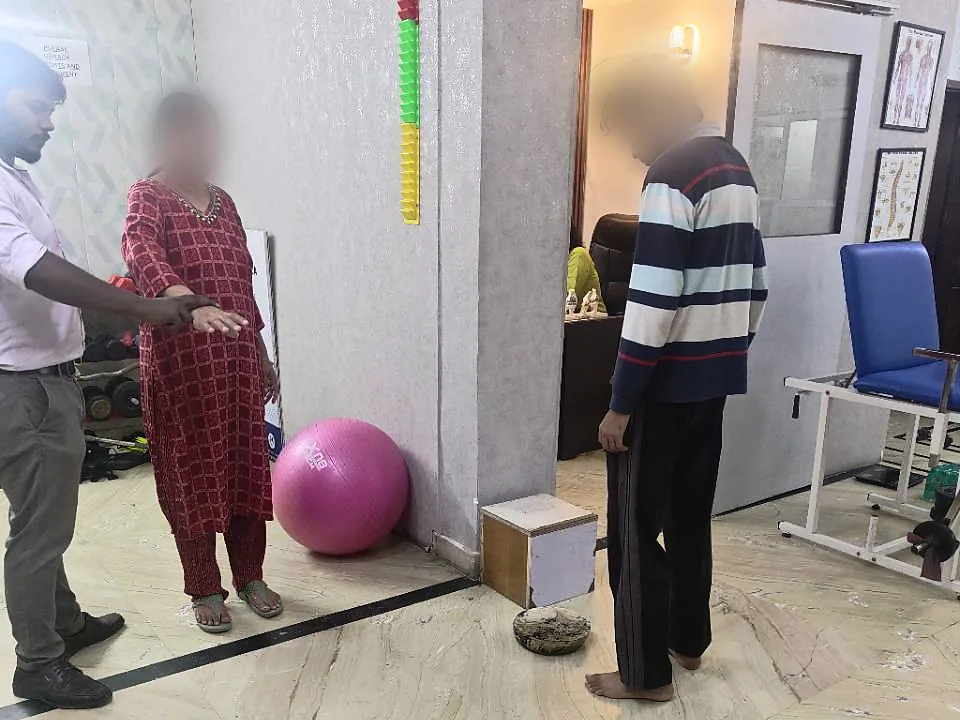
A balance and posture check at our Sector 52 clinic. What we find here, not what was said on the phone, sets the number of sessions.
Why no one can tell you your number on a phone call
We get this call every day. "My mother has knee pain, how many sessions will it take?" "I have a slip disc, how many days?" It's a fair question. You want to plan your time and your money. But any honest physiotherapist will give you the same answer: we can't know until we have examined you.
That's because the same words can mean very different problems. "Knee pain" can be a stiff, arthritic knee, a strained tendon from running, a torn meniscus, or pain that is actually coming from the hip or the lower back. "Back pain" can be a strained muscle that settles in a week, or an irritated nerve that needs two months. Each has its own plan, and its own number of sessions.
What the assessment tells us that a call can't
- What is actually causing the pain, and which part is involved
- How irritable it is: whether a little movement settles it or flares it up
- Your movement, strength, posture, balance and walking, measured, not guessed
- Nerve signs such as tingling, numbness or weakness, which change the plan
- Warning signs that mean you should see a doctor first, not start physiotherapy
- Your scans, prescriptions or discharge papers, read alongside the examination
- What you need to get back to: climbing stairs, a 10-hour desk day, or a half marathon
What we can do on the phone
Quite a lot, just not the count. On a call, or in the free 30-minute teleconsultation, we can listen to what happened, check for warning signs that need a doctor first, tell you whether the clinic or a home visit makes more sense, share the typical range for problems like yours (the same ranges you'll find below), and book your slot. Your real number comes only after we examine you in person, at the clinic or at your home.
The same goes for a WhatsApp message or a scan report on its own. An MRI or X-ray shows what a disc or joint looks like, not how you move, how strong you are or how easily it flares up, so it cannot set your number either. We read your reports alongside the examination, not instead of it.
What decides how many sessions you need
After the assessment, these are the things that push your number up or down:
- The cause. A muscle strain usually heals faster than a tendon problem, and a tendon problem faster than a frozen shoulder
- How long you have had it. Pain that started two weeks ago usually settles faster than pain you have lived with for two years
- How severe and irritable it is. Very painful, easily flared problems need gentler, slower early sessions
- Your age and general health. Healing slows with age, and diabetes, for example, often makes a frozen shoulder slower to recover
- Surgery or a fracture. After an operation, your surgeon's instructions set the pace, such as how much weight a healing bone can take
- Your goal. Walking to the market without pain and getting back to cricket are different finish lines
- Your home exercises. This one is in your hands. Patients who do their 10 to 15 minutes a day usually need fewer sessions
This is also why two people with "the same problem" rarely end up with the same number.
Typical session ranges by condition
Use this table to plan, not as your plan. These are the ranges we commonly see at our Sector 52 clinic, and they match our condition pages. Your assessment can put you below or above them.
| Condition | Typical plan |
|---|---|
| Acute neck pain or a stiff neck | 3 to 5 sessions |
| Simple lower back painFrom a strain, lifting or long sitting | 6 to 10 sessions over 2 to 4 weeks |
| Sciatica | 8 to 12 sessions over 6 to 8 weeks |
| Slip disc (PIVD) without surgery | 2 to 4 a week at first; some change in the first few weeks, solid improvement usually within 6 to 12 weeks |
| Chronic neck pain, cervical spondylosis | 10 to 15 sessions |
| Knee pain or knee arthritisWithout surgery | 2 to 3 a week for 4 to 6 weeks, then fewer |
| Frozen shoulder | 15 to 25 sessions over a few months |
| Tennis elbow | 8 to 14 sessions over 6 to 12 weeks |
| Muscle strain from the gym or sport | Mild: back to sport in 2 to 4 weeks · moderate: 4 to 8 weeks |
| Ligament sprain or tearWithout surgery | Grade 1: 8 to 10 · Grade 2: 12 to 18 · Grade 3: 20 to 30 sessions, if your orthopaedic doctor advises treatment without surgery |
| Vertigo from BPPV | 1 to 3 sessions |
| Posture correction | 2 a week for 3 to 4 weeks, then weekly; measurable change in 6 to 8 weeks, full programme over a few months |
| After a knee replacement | 10 to 12 weeks of rehab; the first 2 to 3 weeks usually at home |
| After a stroke | 4 to 6 a week early on; a full cycle is often 30 to 60 sessions, reviewed every 4 weeks |
These ranges assume no warning signs and regular home exercise. Your physiotherapist sets your number after examining you. More detail: back pain, sciatica, frozen shoulder, knee replacement and stroke rehab at home.
How often you'll come, and why it gets less
A plan isn't the same number of sessions every week. It usually moves through three phases:
- Settle the pain (first 1 to 2 weeks): 2 to 3 sessions a week. Hands-on treatment, gentle movement and, where they help, machines such as TENS or IFT
- Build movement and strength (the middle weeks): often 2 a week. More exercise, less machine, and your home routine grows
- Get back to normal life (the last weeks): once a week or less. We check your progress, move you to harder exercises and hand you a programme to carry on alone
After surgery or a stroke, sessions are more frequent at the start, because that is when the most change is possible. The aim is always the same: you need us a little less each week.
Home visit physiotherapy: how the count works at home
Home visits follow exactly the same rule. On the first visit, our physiotherapist brings a portable kit, does the full assessment at your home and reads any scans or discharge papers you have. The findings go to Dr. Purti Shukla, who reviews them and confirms the treatment plan: how many visits a week, what we expect by when, and when we will review. There is no separate charge for the assessment or for travel.
When a home visit makes sense
- The first few weeks after a knee or hip replacement, or after a fracture
- Stroke, paralysis or other neuro conditions, where frequent sessions matter most
- Elderly parents who find the stairs, the car or the waiting room hard
- Severe back pain or sciatica, when sitting in a car or an auto is painful
- Anyone who can't leave home for a while, for any reason
Do home visits mean more sessions?
Not usually. The number depends on your condition, not on where you are treated. What often changes is the mix. Many of our patients start at home and move to the clinic once they are walking comfortably, which costs less per session and gives them our full equipment. After a knee replacement, for example, the first 2 to 3 weeks of rehab usually happen at home and the rest at Sector 52.
Home visits cover the sectors around our clinic, including Sectors 50, 51, 53, 55, 56, 58 to 62, 71 and 72, often on the same day. See home physiotherapy in Noida for how visits work, and home physiotherapy charges for the fees.
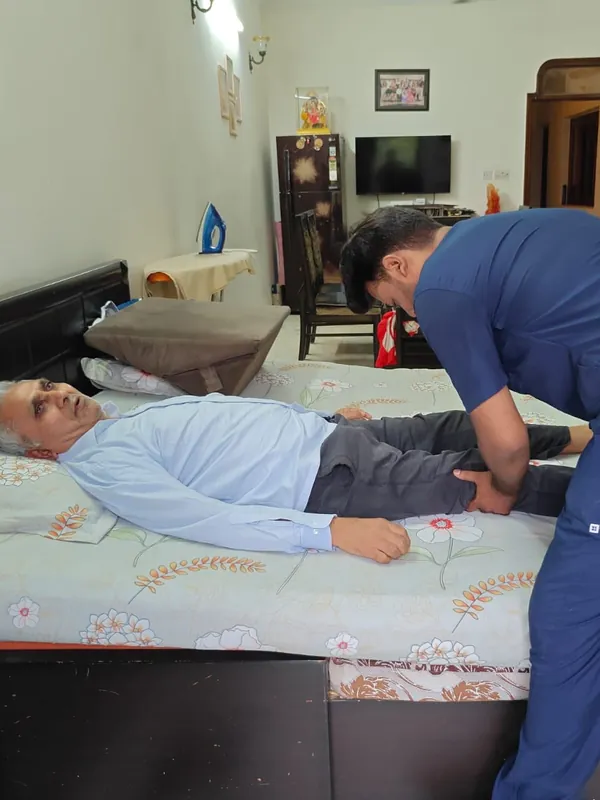
A home visit in Noida. The first visit at home includes the full assessment, so your plan is set there, not over the phone.
How you'll know it's working
A good plan has checkpoints, not just a number. At Dynamics Mend we re-measure about every 4 sessions: how far the joint moves, how strong the muscles are, and what you can do now that you couldn't before, like climbing the stairs, sitting through a meeting or sleeping through the night. Pain can go up and down from day to day, so we look at the whole picture.
Most people notice some change within the first 2 to 4 weeks, even when full recovery takes longer. If you're not improving by the checkpoint we set at your first visit, we reassess, change the plan, and refer you to a doctor if something doesn't add up. The number can go down as well as up. If you're doing well, you finish early.
What it costs, and when a package makes sense
At Dynamics Mend, standard clinic sessions are ₹500 to ₹800 (₹600 to ₹1,000 for sports or neuro rehab), and home visits are usually ₹800 to ₹1,200, with no travel charge. Specialised home rehab, such as after a stroke or surgery, is ₹1,200 to ₹1,800 because the visits are longer. Every fee includes the assessment, the machines (IFT, TENS, ultrasound), hands-on treatment and exercise guidance. There is no separate consultation fee, and the first 30-minute teleconsultation is free.
You can pay session by session. If your assessment shows you need a longer plan, a 10 or 20-session package brings the price per session down a little. We suggest a package only after the assessment, and only for the number of sessions we expect you to need. The full rate card is on our pricing page, and our physiotherapy cost guide explains what a fair fee should include.
Two cases from Noida
Illustrative examples based on cases we commonly see. Names and details changed.
Sunita, 54, from Sector 50. Her son called us about her knee pain and asked how many sessions she would need. We told him honestly that we couldn't say yet. At the assessment, her knee moved well. Much of the pain was coming from a stiff hip, and the muscles around her hip and thigh had become weak. Her plan, about 10 sessions over 5 weeks, worked on the hip as much as the knee, with a short daily routine at home. A number guessed on the phone for "knee pain" would have been the wrong plan.
Mr. Verma, 71, from Sector 61. He came home after a knee replacement, and his family wanted to book a 30-visit package straight away. Instead, the first home visit was an assessment: how far the knee bent, how he walked with his walker, and what his surgeon had advised. The plan was frequent visits for the first two weeks, then fewer, reviewed every two weeks. By week four he was walking well enough to come to the clinic, which cost less per session. His rehab ran about 11 weeks, and the family paid only for the sessions he needed.
Dr. Purti Shukla, who leads assessments at Dynamics Mend, holds a BPT and an MPT in Sports Physiotherapy. Every plan, at the clinic or at home, starts with that assessment, and every number is one we can explain.
Want your number? Start with an assessment.
Tell us the problem and whether you prefer the clinic or a home visit. We will call back, answer your questions and book your assessment. Your session count comes after that.
Frequently asked questions: how many physio sessions
How many physiotherapy sessions do I need for back pain?+
For simple lower back pain from a strain, lifting or long sitting, many patients feel a clear difference within 2 to 4 weeks, usually over 6 to 10 sessions. Sciatica often takes 8 to 12 sessions over 6 to 8 weeks, and a slip disc can take longer. Your own number is set only after a physiotherapist has examined you.
Can you tell me how many sessions I need over the phone?+
Not accurately, and no honest physiotherapist can. The same complaint can come from very different problems, and each one has its own plan. On the phone we can check for warning signs, suggest the clinic or a home visit, and tell you the typical range. Your exact number comes after the in-person assessment, which is part of your first session at no extra charge.
Is 12 sessions of physiotherapy enough?+
For many common back, neck and knee problems the usual range is 6 to 15 sessions, so 12 is often enough. Frozen shoulder, ligament tears, rehab after surgery and stroke usually need more, and some problems need fewer. Whether 12 is right for you depends on what your assessment finds.
How many physiotherapy sessions should I have per week?+
Usually 2 to 3 a week at the start, when pain is high, then fewer as you get stronger and your home exercises take over. After surgery or a stroke, sessions are more frequent early on, because that is when the most change is possible.
Should I do physiotherapy every day?+
Usually not for everyday pain. Muscles and tendons get stronger during the recovery time between sessions, so for most people 2 to 3 sessions a week with daily home exercises works better than a visit every day. Daily or near-daily sessions make sense early after some operations and after a stroke, when your physiotherapist and doctor advise it.
Is physiotherapy once a week enough?+
Often, later in the plan, once the pain has settled and your home routine is doing most of the work. At the start, when pain is high or right after surgery, once a week is usually too little for steady progress. Your physiotherapist changes the frequency at each review.
Is one physiotherapy session enough?+
Sometimes. Vertigo from BPPV often settles in 1 to 3 sessions, and a minor problem may need one visit and a home routine. Most problems need a short course, because tissues take weeks to heal and get stronger. Your physiotherapist will tell you after the first assessment.
How long is a physiotherapy session?+
At Dynamics Mend a clinic session is about 45 minutes of treatment and a home visit is about 60 minutes, always one-on-one. Your first session runs longer because it includes the 30 to 45-minute assessment that your plan, and your number of sessions, is based on.
How long does physiotherapy take to work?+
Many people feel some change within the first few sessions, and most notice steady improvement within 2 to 4 weeks, though a slip disc or frozen shoulder takes longer to fully settle. If you are behind the checkpoint set for your condition, a good physiotherapist reassesses you, changes the plan, and refers you to a doctor if something doesn't add up. At Dynamics Mend we review your progress every 4 sessions.
Is it normal to be sore after physiotherapy?+
Mild soreness for a day or two after new exercises or hands-on treatment is common, a lot like the day after a workout. Sharp pain, pain that keeps getting worse, or soreness that lasts more than two days is not something to put up with. Tell your physiotherapist, so the next session can be adjusted.
What is the 80/20 rule in physiotherapy?+
It is not a formal medical rule. It usually means that most of your recovery comes from what you do between sessions, your home exercises and daily habits, while the sessions guide and correct that work. It is also why patients who keep up their home routine usually need fewer sessions.
Do home visits take more sessions than clinic visits?+
Not usually. The number depends on your condition, not on where you are treated. A home visit includes the same full assessment on the first visit, and many patients move from home to the clinic once they are walking comfortably, which costs less per session.
Can I do my whole treatment with home visits?+
Yes, if that suits you better. Home visits work for most treatment plans, and they are often the better choice after surgery, after a stroke, or for elderly patients. Many people switch to the clinic once they can travel, because it costs less per session and has our full equipment, but that is your choice.
How many days of physiotherapy are needed after a knee replacement?+
Physiotherapy usually starts in the hospital a day or two after surgery, and rehab typically runs 10 to 12 weeks after that. The first 2 to 3 weeks usually happen at home, and most patients then move to clinic sessions as walking gets easier. Your surgeon's instructions set the limits.
How much does one physiotherapy session cost in Noida?+
At Dynamics Mend, a standard clinic session is ₹500 to ₹800 (₹600 to ₹1,000 for sports or neuro rehab) and a home visit is usually ₹800 to ₹1,200, with the assessment, machines and exercise guidance included and no travel charge. Your total depends on how many sessions you need, which is set after the assessment.
Should I buy a physiotherapy package before I start?+
Not before an assessment. At Dynamics Mend you can pay session by session, and we suggest a 10 or 20-session package only when your assessment shows you will need that many sessions. Be cautious of anyone who sells you a long package without examining you first.
How do I know if my physiotherapist is good?+
A good physiotherapist examines you properly before deciding anything, explains what is going on in plain words, gives you a home routine, re-measures your progress, and refers you to a doctor when needed. Warning signs are a fixed number of sessions or a long package quoted before any examination, the same machine every visit with no exercise, no home programme, and no clear idea of when you will finish.
What happens when my physiotherapy sessions end?+
You leave with a short home routine to keep the gains, and advice on getting back to sport, the gym or long work days safely. If the pain comes back, or you simply want a check, you can book a single review session instead of starting over.
Get your number the right way
Book an assessment at our Sector 52 clinic or at your home. After your first session you will know how many sessions we expect, and why.
Open: 10 AM to 9:30 PM, Friday closed · E-132, E-Block, Sector 52, Noida 201301