

You searched frozen shoulder for a reason
Frozen shoulder (doctors call it adhesive capsulitis) is a condition where the capsule, the tissue envelope around your shoulder joint, becomes inflamed and then shrinks, locking the arm down stage by stage. It responds well to physiotherapy matched to the right stage, and most patients at Dynamics Mend in Sector 52 Noida get meaningful movement back in 6 to 8 weeks, without waiting years and without surgery.
That is the short answer. Now the honest version, because a frozen shoulder messes with your life in very specific ways.
It probably started small. A twinge reaching for the overhead shelf. Then combing your hair got awkward. Then hooking a blouse or reaching your back pocket became a two-step operation. And now the nights, that deep ache when you roll onto that side, waking you at 2 AM, that is usually what finally makes people search for treatment.

Stage-matched shoulder mobilisation at Dynamics Mend, Sector 52 Noida, the capsule loosens with the right work at the right intensity
And somewhere along the way, someone has told you the line every frozen shoulder patient hears, "it resolves on its own in 2 to 3 years." Technically half-true. Practically terrible advice, and we will explain why in a minute.
This guide walks you through what is actually happening inside the shoulder, the three stages and why treatment changes with each one, the diabetes connection nobody warned you about, and what a proper recovery looks like with real timelines and real costs.
What frozen shoulder actually is
Your shoulder joint sits inside a capsule, think of it as a loose, stretchy balloon around the joint that lets the arm swing through the widest range of any joint in your body. In frozen shoulder, that balloon gets inflamed, then thickens and contracts, like a plastic bag shrinking in the heat.
A shrunken capsule physically cannot stretch, so the arm hits a wall in certain directions. Reaching overhead, reaching behind your back, turning the arm outward, these go first. This is why frozen shoulder feels different from a muscle problem. It is not weakness, it is a hard mechanical block, and pushing against it forcefully just flares it up.
One thing worth separating, a rotator cuff problem (the set of stabilising muscles around the shoulder) can mimic early frozen shoulder. The key difference is that in frozen shoulder, someone else moving your arm for you hits the same wall. In a cuff problem, the passive movement is usually much freer. That one test changes the entire treatment plan, which is why we assess before we treat.
The 3 stages, freezing, frozen, thawing
Frozen shoulder moves through three stages, and this is the single most important thing to understand, because the right treatment in one stage is the wrong treatment in another.
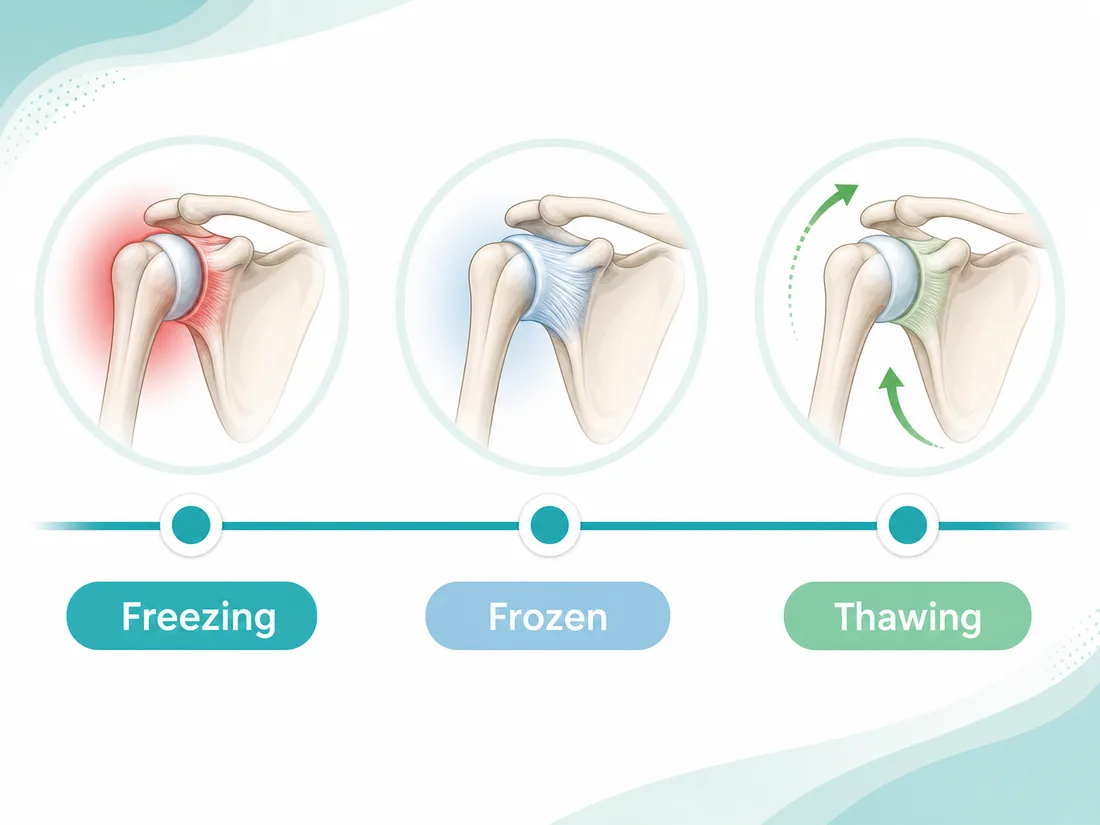
The three stages of a frozen shoulder, and why the treatment must change with each one
Stage 1, Freezing. Pain rules everything
This is the inflammatory stage, lasting roughly 2 to 6 months if untreated. Pain is the main event, sharp with movement, aching at rest, worst at night. Stiffness is starting but pain leads. This is the stage where aggressive stretching backfires badly, the capsule is angry, and forcing it makes it angrier. Treatment here is about calming pain, protecting the range you still have, and gentle movement inside the comfortable zone.
Stage 2, Frozen. Stiffness takes over
The pain settles somewhat, but the capsule has now contracted. The arm is simply stuck, roughly 4 to 12 months of it if nothing is done. This is where most people make the opposite mistake, the shoulder hurts less so they just live around it, and the capsule quietly tightens further. This stage is exactly when progressive stretching and joint mobilisation earn their money.
Stage 3, Thawing. The window to reclaim everything
The capsule slowly starts giving back range. Untreated, this stage alone can drift on for a year or more, and here is the part nobody mentions, shoulders that thaw on their own often do not thaw fully. People end up accepting 80 percent of an arm and calling it recovered. Structured physiotherapy in this stage speeds the thaw and, more importantly, reclaims the last ranges that self-recovery leaves behind.
Who gets frozen shoulder, and the diabetes link
Most frozen shoulders arrive without any injury, which is what makes the condition so confusing for patients. But it does have clear preferences.
It picks people between 40 and 60, women slightly more often than men. It follows periods of keeping the shoulder still, after a fracture, a surgery, or even a few weeks of a sling. And its strongest preference by far is diabetes. People with diabetes are several times more likely to develop frozen shoulder, their cases tend to be more stubborn, and it can visit both shoulders over time. Thyroid problems raise the risk too.
If you are diabetic and reading this with a shoulder that has been stiffening for a few weeks, please do not wait it out. Early-stage treatment is the difference between a short journey and a long one, and we see that play out at our Sector 52 clinic every month.
Why waiting it out keeps failing
By the time most people reach us, they have already tried the standard menu. It is worth being honest about why each item fails.
Why "it will resolve on its own" is bad advice
Because the price of that sentence is one to three years of your life. Sleep broken every night, dressing routines redesigned around one arm, and at the end of it, often a shoulder that settled for less than its full range. Self-resolution is real, full self-resolution is much rarer than people think.
Why painkillers and home remedies plateau
Painkillers dull the inflammation for a few hours, which has some value in the freezing stage, but no tablet on earth can stretch a contracted capsule. The mechanical block stays exactly where it was. Hot bags feel nice, and then the shoulder is just a warm stuck shoulder.
Why random stretching makes some shoulders worse
YouTube does not know what stage you are in. Aggressive wall-climbing exercises during the freezing stage inflame the capsule further and can genuinely set you back weeks. And too-gentle token exercises during the frozen stage let the capsule keep tightening. The stretch is the medicine, and like any medicine, the dose has to be right.
How we treat frozen shoulder at Dymend
Frozen shoulder is one of the most treatment-responsive conditions we see, provided the treatment respects the stage. Here is how it runs at Dynamics Mend.
First, confirming it and staging it
Dr. Purti checks your active range (you moving the arm) against your passive range (her moving it for you), the pattern of which directions are blocked, your pain behaviour and night pain, and your history, diabetes, thyroid, any period of immobilisation. That confirms it is truly frozen shoulder and not a rotator cuff problem wearing its costume, and it tells us which stage you are in, which decides everything that follows.
Then, stage-matched treatment
In the freezing stage, the work is calming, gentle joint mobilisation, pain-relieving techniques, and movement kept inside the tolerable zone so you lose as little range as possible while the inflammation settles.
In the frozen and thawing stages, the work gets progressively bolder. Hands-on capsular stretching and joint mobilisation to win range back direction by direction. Dry needling for the muscles around the shoulder that have knotted up from months of guarding, and cupping to improve circulation in the stiff tissue, both techniques Dr. Purti is certified in, and both genuinely useful in stubborn shoulders. Then strengthening as the range returns, because a shoulder that moves but cannot hold is only half fixed.

Strength work returns as the range comes back, guided band exercises in the clinic plus a short daily routine at home
And the daily home routine that does half the work
A capsule that gets stretched twice a week and ignored for the other five days barely changes. You get a short daily routine, ten to fifteen minutes, matched to your stage and updated as you progress. Patients who do this daily consistently beat the average timelines. That is not a motivational line, it is just what we observe.
How long a frozen shoulder takes to recover
Honest numbers, stage by stage. If you start in the freezing stage, expect a few weeks of pain-settling work before the bigger range gains begin. Starting in the frozen stage, most patients feel meaningful improvement in 6 to 8 weeks, reaching higher, sleeping better, dressing easier. A functional, usable shoulder typically arrives by 3 to 4 months, with the last stubborn ranges continuing to improve after that.
Diabetic shoulders run slower and need more patience, we say that upfront rather than let you feel you are failing at recovery. And across all cases, the pattern is the same, night pain improves first, then the everyday reaches, and the behind-the-back reach is almost always the last to return. Knowing that order keeps the journey sane.
What we never do is stretch the treatment out. As your range returns, sessions taper down and the home routine takes over. The moment you can maintain progress on your own, we tell you plainly.
Not sure if it is frozen shoulder?
Night pain, growing stiffness, trouble reaching overhead or behind your back. Tell us what it feels like, a quick free callback gives you an honest read on the stage and where to start.
A real frozen shoulder case from Noida
Take Rajesh. He is a 52-year-old bank employee from Sector 62, diabetic for eight years, and his right shoulder had been stiffening for five months by the time he came in. It started as a night ache he blamed on sleeping position. By month three he could not reach his back pocket, and his wife was helping him into shirts. A doctor had told him the famous line, it resolves on its own, give it time.
What finally brought him in was not the shirt or the pocket, it was the sleep. Five months of waking at 2 AM every time he rolled onto the right side had worn him down completely.
Dr. Purti's assessment placed him solidly in the frozen stage, passive range blocked in the classic pattern, night pain still active but past its peak, and a diabetic capsule that was going to need consistent work. She told him the honest version, this would take months, not weeks, and his daily routine would matter as much as the clinic sessions.
The plan ran twice a week, hands-on capsular stretching and mobilisation, dry needling for the guarded muscles around the shoulder blade, and a fifteen-minute daily routine at home. The night pain broke first, within three weeks he was sleeping through most nights, and that alone changed his whole outlook. By week eight he was reaching the overhead shelf. The back-pocket reach, true to pattern, came last, around month four.
That was six months ago. He still does a five-minute maintenance routine because of the diabetes risk to the other shoulder, and he sends us the occasional gratitude message at 7 AM, usually about sleeping like a normal person again.
Dr. Purti Shukla, who leads every frozen shoulder case at the clinic, holds a BPT and an MPT in Sports Physiotherapy, and is certified in dry needling and cupping, the exact combination stubborn shoulders tend to need.

Dr. Purti Shukla, BPT, MPT (Sports), certified in dry needling and cupping, leads every frozen shoulder case at Dynamics Mend, Sector 52 Noida
Honest pricing, in writing
Real numbers, no surprises. Your first 30-minute teleconsultation is free, so you get an honest read on the stage before paying anything. Every session includes assessment and the full treatment time.
| Service | Fee |
|---|---|
| First teleconsultation (30 min) | Free |
| In-clinic shoulder session assessment + hands-on capsular work + guided exercise | ₹500 to ₹800 |
| Dry needling / cupping (where the case needs it) included in the session plan | No separate charge |
| Home visit for shoulder rehab if travelling is difficult | ₹800 to ₹1,200 |
| Typical frozen shoulder journey 15 to 25 sessions, tapering as range returns | Honest quote after assessment |
No package pressure, no hidden cost. We tell you a realistic number of sessions after the first assessment, not before. See the full pricing page for all services, our dedicated frozen shoulder treatment page for how sessions work, and our home physiotherapy page if travel is the problem.
Want a free callback about your shoulder?
Tell us what it feels like. Dr. Purti will call back with an honest read on the stage. No pressure, no fixed package.
Frequently asked questions about frozen shoulder treatment in Noida
Can physiotherapy cure frozen shoulder?+
Yes, physiotherapy is the main treatment for frozen shoulder. The shoulder capsule (the tissue envelope around the joint) has tightened, and the only thing that reliably loosens it is graded stretching and mobilisation done at the right intensity for the right stage. At Dynamics Mend we match the treatment to your stage, gentle pain relief work in the freezing phase, and progressively stronger stretching once the shoulder moves into the frozen and thawing phases. Most patients get their usable arm back well before the "it resolves on its own in 2 to 3 years" timeline people are often told.
How long does a frozen shoulder take to heal?+
Left completely alone, a frozen shoulder can drag on for 1.5 to 3 years, which is why doing nothing is such an expensive choice. With structured physiotherapy, most patients at Dynamics Mend see meaningful improvement in 6 to 8 weeks, and a functional, usable shoulder in 3 to 4 months. The stage you start in matters, the earlier you begin, the shorter the whole journey tends to be.
Why does frozen shoulder happen? I never injured my shoulder.+
That is the strange part of this condition, most frozen shoulders start without any injury. The capsule around the joint becomes inflamed and then contracts, and we do not fully know why it picks certain people. What we do know is who it prefers, people between 40 and 60, women slightly more than men, people with diabetes or thyroid issues, and any shoulder that has been kept still for weeks after an injury, surgery or fracture.
Is frozen shoulder related to diabetes?+
Strongly, yes. People with diabetes are several times more likely to develop frozen shoulder, it tends to be more stubborn in diabetics, and it can affect both shoulders over time. If you are diabetic and your shoulder has been getting stiffer for weeks, do not wait for it to pass. Starting physiotherapy early makes a real difference to how far the shoulder freezes and how fast it comes back.
Should I stretch a frozen shoulder or rest it?+
Both, at the right time, and this is exactly where most people go wrong. In the early painful freezing stage, aggressive stretching makes the inflammation and pain worse. In the stiff frozen stage, too much rest lets the capsule tighten further. The honest answer is that the treatment has to match the stage, which is why a proper assessment first saves you months.
How many physiotherapy sessions does a frozen shoulder need?+
More than a simple muscle strain, fewer than people fear. Most frozen shoulders at Dynamics Mend need 2 to 3 sessions a week for the first few weeks, then taper down as the range comes back, roughly 15 to 25 sessions across the journey depending on the stage you start in and whether you are diabetic. Dr. Purti gives you an honest range after the first assessment, and your daily home routine does a lot of the work between visits.
What is the cost of frozen shoulder treatment in Noida?+
At Dynamics Mend in Sector 52 Noida, an in-clinic session costs ₹500 to ₹800, and the first 30-minute teleconsultation is free. Where the case needs it, dry needling and cupping are part of the session plan, not billed as surprise extras. If the shoulder is too painful to travel with, home visits are ₹800 to ₹1,200.
I cannot sleep on my shoulder at night. Is that frozen shoulder?+
Night pain and being unable to lie on that side are classic early frozen shoulder signs, especially with growing stiffness when reaching behind your back or overhead. But a rotator cuff problem (the set of stabilising muscles around the shoulder) can feel similar, and the treatments differ. A physical assessment separates the two in one visit, that is exactly what the free first consultation is for.
Ready to get your arm back?
Come in, get the shoulder properly staged, and hear exactly what your recovery looks like, honest timeline included. You do not have to give this thing two years of your life.
Open: 10 AM to 9:30 PM, Friday closed · E-132, E-Block, Sector 52, Noida 201301