

Why knee pain keeps coming back
Knee pain in most cases improves significantly with physiotherapy in 4 to 8 weeks, without surgery. The most common causes are weak quadriceps (the big thigh muscle that protects the knee), a kneecap that tracks crookedly, and early cartilage wear. At Dynamics Mend in Sector 52 Noida, Dr. Purti Shukla uses hands-on therapy, targeted strengthening and dry needling to fix the actual cause, and sessions start at ₹500 to ₹800.
That is the short answer. Now the honest version.
Knee pain is sneaky. It does not just hurt your knee, it quietly changes how you live. You start taking the lift instead of the stairs. You skip the evening walk you used to enjoy. You think twice before sitting cross-legged at a family function, and that sharp catch when you stand up from a chair, you have started bracing for it before it comes.
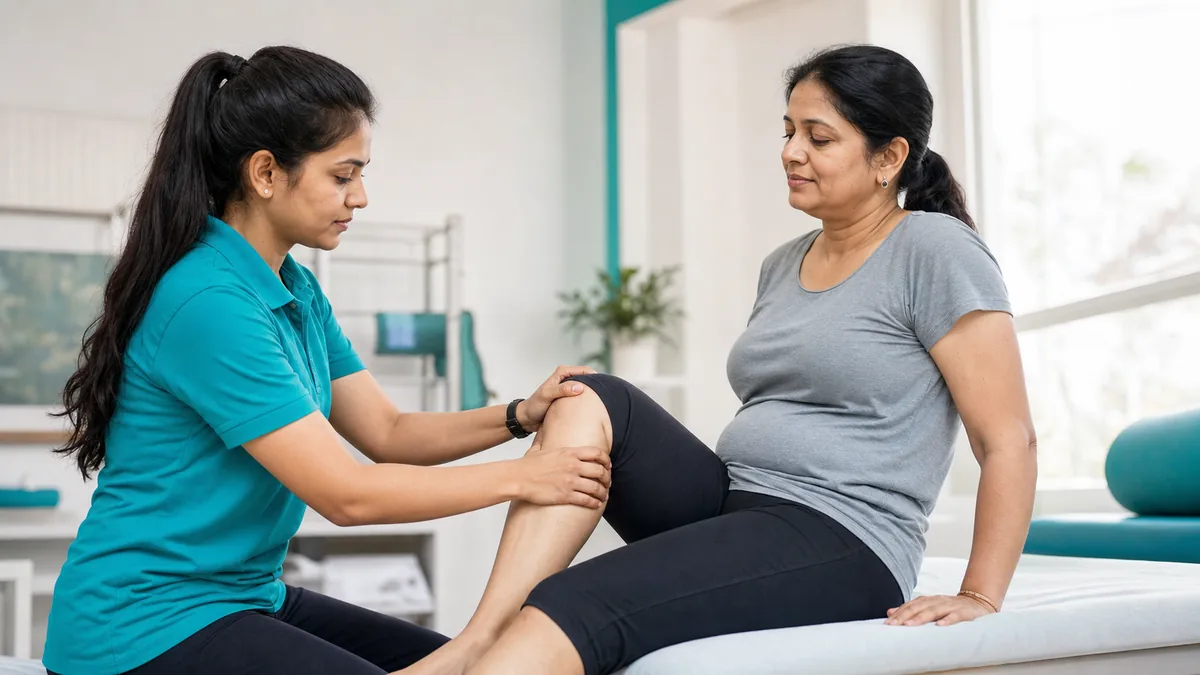
A knee assessment at Dynamics Mend, Sector 52 Noida, finding the real cause before treating anything
Maybe you are an IT professional whose knee stiffens after eight hours at a desk in Sector 62. Maybe you are 55 and the stairs at home have slowly become the enemy. Maybe you are a weekend cricketer who twisted it months ago and it never fully came back. And you have probably already tried the usual things, rest, a painkiller, a knee cap, some YouTube exercises for a week. It helped a little, then came right back.
We hear this story constantly at our Sector 52 clinic. So this guide gives you the honest picture, what is actually causing the pain, why the usual fixes keep failing, what arthritis on an X-ray really means, and what a proper fix looks like, with real timelines and real costs.
If you are past the reading stage and want the knee looked at properly, our knee pain physiotherapy treatment in Noida page walks through the assessment, the session plan and what it costs.
What is actually causing your knee pain
Your knee is a hinge, but it is a hinge that depends heavily on the muscles around it to stay stable and pain-free. When that support system weakens, the joint takes a beating it was never designed for. Here are the three culprits we see most often in Noida.
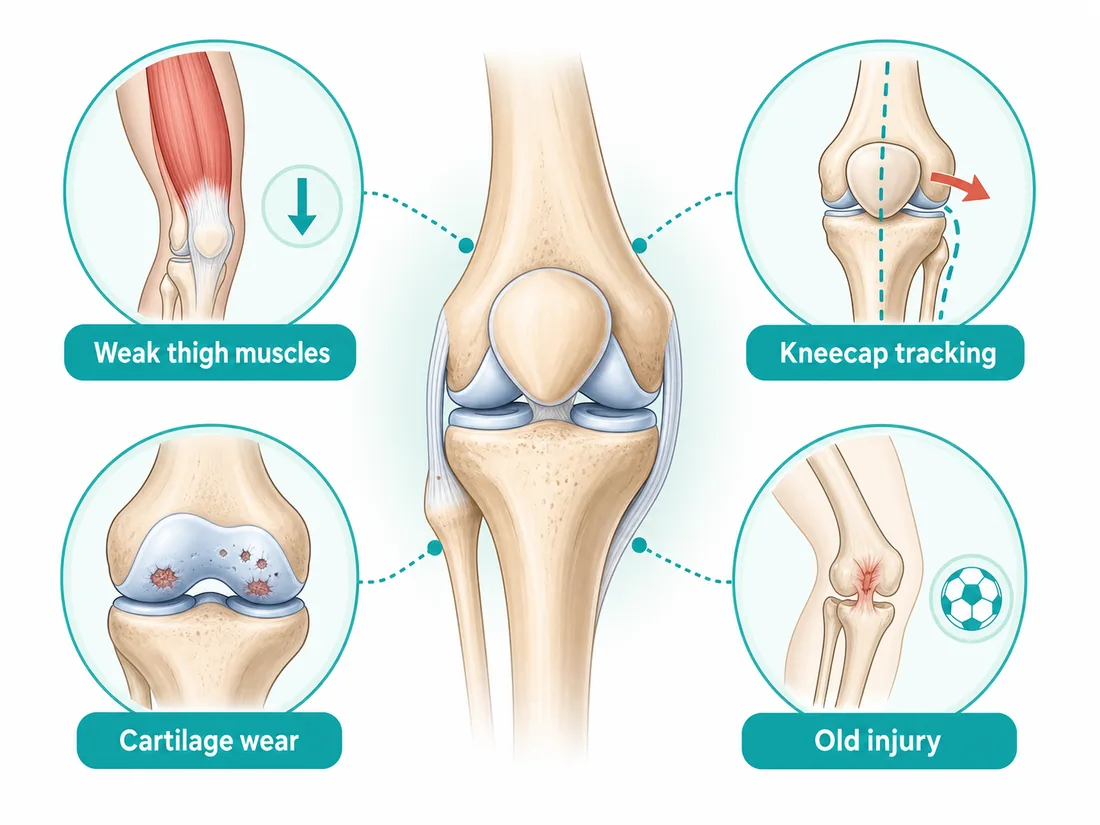
The usual suspects behind knee pain, and notice that most of them are about muscles and alignment, not the joint itself
Weak thigh muscles, the quadriceps
Think of your quadriceps (the big muscle on the front of your thigh) as the shock absorber for your knee. Every time you go down the stairs or stand up from a chair, that muscle is supposed to control the load like a brake.
Desk jobs and low activity make this muscle weak surprisingly fast. And when it is weak, the load transfers straight into the knee joint and kneecap. That is the pain you feel getting up or going down. It is not the knee failing, it is the muscle not doing its job.
A kneecap that tracks crookedly
Your kneecap (patella) is meant to glide in a smooth groove every time you bend the knee. If your hip muscles are weak or your feet roll inward, the kneecap gets pulled slightly off its track. Bend the knee a few thousand times a day with that crooked tracking, and the tissue around it gets irritated and sore. This is one of the most common knee problems in younger and middle-aged people, and it never shows up on an X-ray.
Cartilage wear and early arthritis
Cartilage is the smooth cushion between the bones. Over the years, or after an old injury, it can thin out. The bones start loading each other more directly and you get stiffness, a grinding feeling, and pain after activity.
Here is the part most people never get told. Plenty of people have visible wear on their X-ray and zero pain, because their muscles are strong enough to protect the joint. The wear matters less than the protection around it. Our job is to build that protection.
Old injuries that never healed properly
A twisted ligament from cricket, a meniscus (the knee's cushion pad) strain that was rested but never rehabbed, these leave the knee slightly unstable. The body compensates for months, and then the pain shows up, sometimes far from the original injury. If you suspect an old ligament issue is behind your knee trouble, our guide on ligament tear treatment goes deeper.
Why stairs hurt more than walking
This is the single most common thing knee patients ask us, so it deserves its own section. Walking loads your knee with roughly your body weight. Going down stairs loads it with three to four times that, and the quadriceps has to control every bit of it while lengthening, which is the hardest kind of work a muscle does.
So if your thigh muscle is even a little weak, stairs are where it shows up first. Down is worse than up, the first few steps are worse than the rest, and a railing suddenly feels necessary. Sound familiar?
The good news is that this pattern is one of the most fixable things we treat. It is a strength problem wearing a joint-pain costume. Build the brake back up, and the stairs stop being an event.
Why rest and painkillers keep failing
Before you spend more months in the same loop, it is worth understanding why the common fixes have not held.
Why rest alone fails
Rest calms an angry knee, yes. But rest also makes the thigh muscle weaker, and a weaker muscle means the pain comes back the moment you return to normal life. You end up in a cycle, rest, feel better, resume, hurt again, rest. The knee never gets stronger, so it never gets truly better.
Why painkillers do not fix it
A painkiller turns off the alarm. It does nothing about why the alarm went off. The weak muscle is still weak, the tracking is still off. Take the tablet away and the pain returns, because the actual problem was never touched. Painkillers have a place for a bad flare, but as a plan, they are just an expensive pause button.
Why random internet exercises can backfire
The exercise that fixed your friend's knee might be wrong for yours, because the cause is different. Deep squats on a badly tracking kneecap can inflame it further. Without someone checking your specific movement, generic routines are a gamble, and we regularly see knees that got worse on borrowed exercise plans.
Arthritis on the X-ray, does it mean surgery
If a report has told you "degenerative changes" or "osteoarthritis" and you have been quietly googling knee replacement since, take a breath. This is where honest information helps most.
X-rays show bones, not pain. Studies and everyday clinic experience both show the same thing, the amount of wear on an X-ray matches poorly with how much a knee actually hurts. We regularly see scary-looking X-rays on people with mild pain, and clean-ish X-rays on people who can barely walk. The difference, almost always, is muscle strength and how the joint is being loaded.
Knee replacement is a genuinely good operation for the right knee at the right time, usually end-stage arthritis where the joint space is gone and life has shrunk badly. But it is a last step, not a first one. The honest sequence is simple, build the muscle, fix the loading, give the knee 6 to 8 weeks of proper work, and then see how much surgery talk is even left. In our experience at Sector 52, most of it evaporates.
How we treat knee pain at Dymend
A knee session at Dynamics Mend is not a heat pack and a generic exercise sheet. It runs with a clear structure, and it starts with finding the real cause.
First, a real assessment
Before we treat anything, Dr. Purti assesses the whole chain, not just the sore spot. Your quadriceps and hip strength, how the kneecap tracks when you bend, your walking pattern, any swelling or instability, and which daily movements trigger the pain. Very often the knee is the victim, not the villain, weak hips or stiff ankles are pulling it out of line. Finding that is the difference between a fix that lasts and one that fades.
Then, hands-on treatment and the right strengthening
Once we know the cause, the plan is built for your knee, not a template. Hands-on therapy eases the irritated tissue and frees up a stiff joint so you can move without that catch. Where the muscles around the knee are knotted and tight, dry needling releases those trigger points fast, and Dr. Purti is certified in it.
And then the heart of the fix, progressive strengthening. We rebuild the quadriceps and hip strength that protects your knee, step by step, at a load your knee can handle that week. This is the part that makes results last after you stop coming in. We also retrain how you climb stairs, squat and walk, so daily life stops feeding the problem.
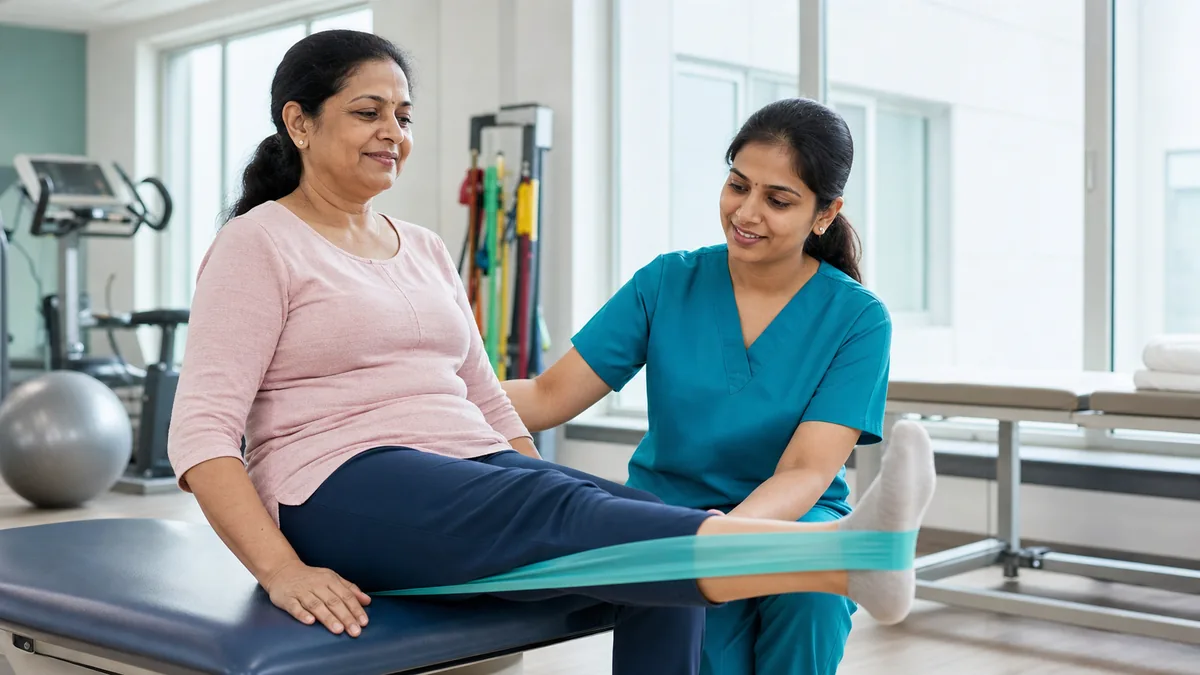
Strengthening is the heart of a lasting knee fix, guided and progressed week by week, never a photocopy exercise sheet
And a short home routine that actually gets done
You get a small daily routine, ten minutes, not an hour, matched to your stage. We would rather give you three exercises you will actually do than ten you will abandon by Thursday. Between sessions, that daily work is what turns slow progress into real progress.
How long knee recovery takes
Honest expectations, because that is the deal on this page. Most knee patients feel 60 to 70 percent better within 3 to 4 weeks. A full recovery for a typical knee runs 8 to 10 weeks, depending on how long you have had the problem and how consistent you are with the home routine.
Long-standing arthritic knees are a slightly different journey. They improve steadily, but they also do best with a small maintenance routine after the main rehab, a few minutes of strength work to keep the protection up. Post-surgery knees, like after a replacement, follow their own staged timeline of several weeks, and we have written a full week-by-week guide to physiotherapy after knee replacement for exactly that journey.
What we never do is stretch treatment out to keep you coming. The moment your knee is strong enough to need fewer visits, we tell you plainly and shift you to the home routine. The goal is to make ourselves needed less, not more.
Not sure what is going on with your knee?
Tell us what it feels like, stairs, sitting, walking, or an old injury acting up. A quick free callback gives you an honest read on the cause and where to start.
A real knee case from Noida
Take Meena. She is a 56-year-old school teacher from Sector 51 who came to us barely managing the stairs to her first-floor flat. Getting up from the floor after prayers had become a two-hands-on-the-wall struggle. Her X-ray said "early osteoarthritis" and a relative had already scared her with knee replacement stories. She had tried two months of rest, a knee cap, and a drawer full of pain gels.
When Dr. Purti assessed her, the real story was different. Months of avoiding movement had wasted her thigh muscles, and her hips were weak, so her kneecap was grinding on every step. The arthritis was there, but it was not the main driver of her pain. The missing protection was.
We started gentle. Hands-on work to settle the irritated knee, dry needling for the locked-up muscles around it, and a careful strengthening plan that progressed a little every week. Nothing heroic, just the right work in the right order.
Six weeks in, Meena was climbing her stairs one leg after the other, no wall, no wincing. By week ten she was back to her morning walks in the park and sitting on the floor without planning her exit first. That was four months ago. She still does her ten-minute routine most days, and the replacement conversation has not come up again.
Dr. Purti Shukla, who leads every knee case at the clinic, holds a BPT and an MPT in Sports Physiotherapy and is certified in dry needling and cupping. Knees like Meena's are routine at our Sector 52 clinic, not exceptions.

Dr. Purti Shukla, BPT, MPT (Sports), certified in dry needling and cupping, leads every knee case at Dynamics Mend, Sector 52 Noida
Honest knee physio pricing, in writing
Real numbers, no surprises. Your first 30-minute teleconsultation is free, so you get an honest read on your knee before paying anything. Every session includes assessment and the actual treatment time, never a rushed ten minutes.
| Service | Fee |
|---|---|
| First teleconsultation (30 min) | Free |
| In-clinic knee session assessment + hands-on treatment + guided exercise | ₹500 to ₹800 |
| Dry needling (where the case needs it) included in the session plan | No separate charge |
| Home visit for knee rehab if travelling is too painful | ₹800 to ₹1,200 |
| Typical simple knee case A block of sessions set after assessment | ₹3,000 to ₹8,000 |
No package pressure, no hidden cost. We tell you a realistic number of sessions after the first assessment, not before. See the full pricing page for all services, our dedicated knee pain physiotherapy treatment in Noida for how sessions work, and our home physiotherapy page if travel is the problem.
Want a free callback about your knee?
Tell us what it feels like. Dr. Purti will call back with an honest plan. No pressure, no fixed package.
Frequently asked questions about knee pain treatment in Noida
Can knee pain be cured without surgery?+
In most cases, yes. The majority of knee pain we see in Noida comes from weak thigh muscles, a kneecap tracking crookedly, or early arthritis, and all three respond very well to physiotherapy. Surgery is genuinely needed in only a minority of severe cases, like a fully torn ligament in a young athlete or end-stage arthritis. At Dynamics Mend we always exhaust the physio route first, and we tell you honestly if your knee is one of the rare ones that needs a surgeon.
Why does my knee hurt more going downstairs than upstairs?+
Going downstairs loads your knee with several times your body weight, and your quadriceps (the big thigh muscle) is supposed to control that load like a brake. When that muscle is weak, the force goes straight into the kneecap instead, which is why down hurts more than up. Strengthening the quadriceps and the hip muscles usually fixes this pattern within a few weeks.
My X-ray shows arthritis. Is physiotherapy still worth it?+
Absolutely, and this is the most misunderstood part of knee pain. Many people have visible wear on their X-ray and zero pain, because strong muscles protect the joint. Physiotherapy builds that protection, reduces the load on the worn part, and very often delays or completely avoids a knee replacement. The X-ray shows the joint, it does not show your pain.
How many physiotherapy sessions do I need for knee pain?+
Most knee patients at Dynamics Mend see clear improvement over a few weeks. Long-standing arthritis or post-surgery rehab takes longer, usually several weeks with clear goals along the way. Dr. Purti gives you an honest range after the first assessment, and we never sell a fixed long package before we have even examined the knee.
How much does knee pain physiotherapy cost in Noida?+
At Dynamics Mend in Sector 52 Noida, an in-clinic session costs ₹500 to ₹800, and your first 30-minute teleconsultation is free. If travelling is too painful, a home visit is ₹800 to ₹1,200. Simple knee cases usually need a short block of sessions, so you are looking at a few thousand rupees for a lasting fix, not lakhs like surgery.
Is walking good or bad for knee pain?+
Usually good, in the right dose. Complete rest makes the thigh muscles weaker, which loads the knee more, not less. But pushing through sharp pain on long walks can inflame the joint further. The honest answer is that it depends on what is causing your pain, which is why an assessment first matters. As a rule, walking that leaves the knee feeling the same or better the next morning is safe.
Do you treat knee pain at home in Noida?+
Yes. If your knee is too painful to travel, or you are recovering from a knee replacement and cannot manage stairs yet, we do home visits across Sector 50, 51, 52, 62, 63 and nearby sectors. The physiotherapist brings a portable kit and runs the same assessment and treatment you would get at the clinic. See our home physiotherapy page or just call and ask.
What happens at my first knee assessment at Dynamics Mend?+
We check the whole chain, not just the sore spot. That means your quadriceps and hip strength, how your kneecap moves when you bend, your walking pattern, any swelling or instability, and what daily movements trigger the pain. By the end of the first visit you know what is actually causing your knee pain, what the plan is, and a realistic timeline in plain words.
Ready to trust your knee again?
Come in, get a proper assessment, and hear exactly what is causing your pain and how long the fix will take. No scary verdicts, no rush to surgery, just a clear plan. Most knees have a lot more life left in them than people realise.
Open: 10 AM to 9:30 PM, Friday closed · E-132, E-Block, Sector 52, Noida 201301