
The operation is half the job
Physiotherapy after a knee replacement runs about 10 to 12 weeks, starts within days of surgery, and is the single biggest factor in how good your new knee becomes. Rough targets: walking with support in week 1, a 90 degree bend by week 2 to 3, stairs by week 3 to 4, and a 110 to 120 degree bend with confident walking by week 6 to 10. At Dynamics Mend in Noida we run this journey both at home and at our Sector 52 clinic, home sessions from ₹1,200.
That is the short answer. Now the honest version.
Nobody tells you this clearly before a knee replacement: the surgery gives you a new joint, not a working knee. On day one, the thigh muscle that moves that joint has switched itself off. The knee is swollen, the leg does not feel like yours, and the staircase you climbed into the hospital suddenly looks like a mountain.
That gap, between a perfect implant and a knee that actually works, is exactly what physiotherapy closes. And the window for closing it properly is the first 10 to 12 weeks. Get those weeks right and the operation becomes one of the best decisions you ever made. Drift through them, and a lakhs-worth implant ends up moving like the old, worn knee it replaced.
If your knee pain is not post-surgery and you are still working out what to do about it, our knee pain physiotherapy treatment in Noida page covers assessment, session plans and costs.
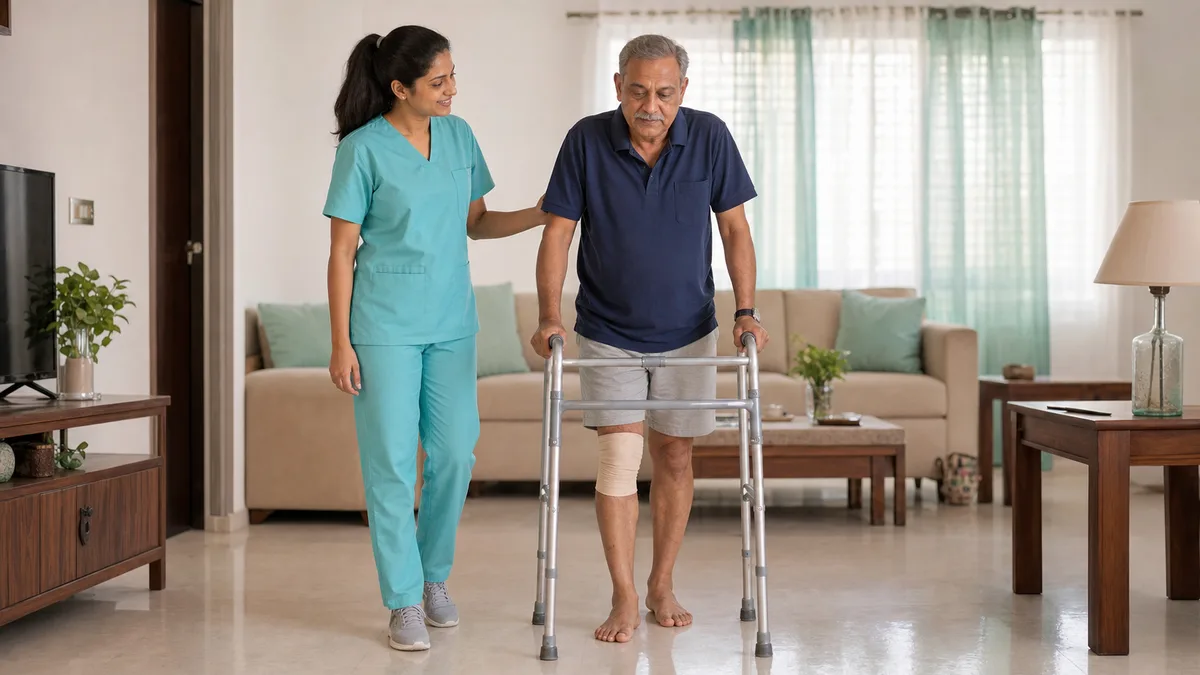
The first weeks after a TKR usually happen at home, guided walking, swelling control and waking the thigh muscle back up
Why physiotherapy decides your result
Three things are happening inside a freshly replaced knee, and all three are on a timer.
First, scar tissue. The body heals every cut by laying down scar, and inside a joint, scar tissue tightens. In the first weeks it is soft and stretchable. By month three or four it matures and becomes far harder to change. Every degree of bend you win early is cheap. The same degree at month five is expensive, and sometimes not available at all.
Second, the quadriceps, the big thigh muscle. Surgery and swelling put it to sleep, a thing physios call muscle inhibition. It does not wake up on its own with rest. It wakes up with specific, repeated work, and until it does, the knee feels wobbly and untrustworthy no matter how good the implant is.
Third, your walking pattern. After months or years of limping on an arthritic knee, your body has forgotten what a normal walk feels like. Without retraining, people limp on the new knee out of pure habit, and that limp loads the hip, the back and the other knee.
Physiotherapy is not massage and a heat pack after an operation like this. It is managing those three timers, in the right order, at the right dose. That is why every surgeon writes physio on the discharge card, and why the patients who take that line seriously get the knees everyone else envies.
Week-by-week: what recovery actually looks like
Every knee is different, and your surgeon's protocol always comes first. But after years of TKR rehab across Noida, this is the honest shape of a typical recovery.
Week 1 to 2: protect, move, wake the muscle
This phase usually happens at home. The goals are simple and non-negotiable: control the swelling with position and ice, get the quadriceps firing again with static holds and straight-leg work, bend the knee a little further each day, and walk short, frequent rounds with a walker. Ankle pumps guard against clots. It is unglamorous work, ten minutes at a time, several times a day, and it sets up everything that follows.
By the end of week 2, most patients are walking more upright, sleeping better, and bending near 90 degrees, enough for a chair and the front seat of a car.
Week 3 to 6: bend, strength, stairs
Now the real building starts. The bend is pushed from 90 towards 110 degrees and beyond, before the scar window narrows. The walker gives way to a stick, then to nothing. Stairs enter the plan, one step at a time with the railing, up with the un-operated leg first, down with the operated one. Strength work moves from lying-down exercises to standing ones, sit-to-stand practice, step-ups, supported squats to a chair.
Most patients shift from home sessions to the clinic somewhere in this phase, once travelling stops being the hardest part of the day.
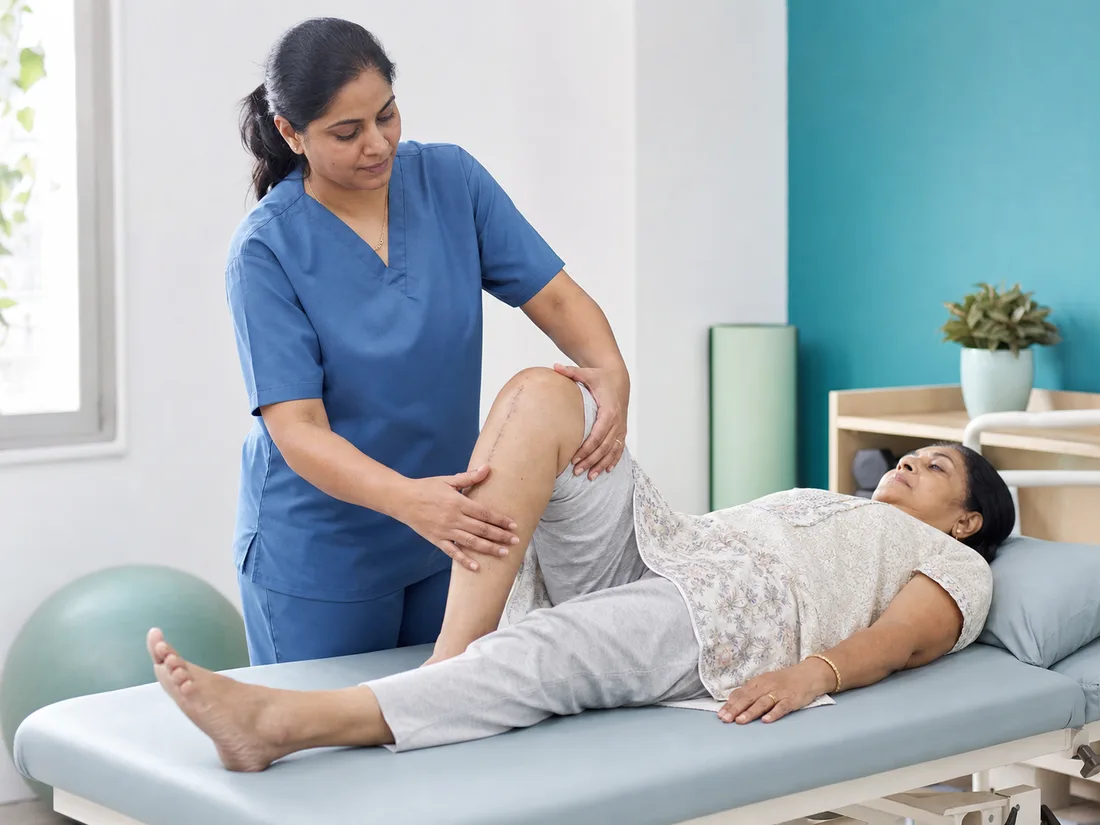
The bend is won degree by degree in the first weeks, while the scar tissue is still soft enough to change
Week 7 to 12: confidence and a normal life
The last phase turns a healing knee into a knee you forget about. Walking distance stretches from rounds of the flat to proper outings. Stairs go foot-over-foot. Strength work gets heavier on purpose, because your quadriceps needs reserves, not just enough for today. We also train the un-operated side, which has quietly carried you for years and often needs as much help as the new knee.
By week 10 to 12, most of our TKR patients walk unaided, manage stairs normally, and have stopped planning their day around the knee. Improvement continues for a full year, but from here it runs on a small home routine rather than supervised sessions.
How much will the knee bend, honestly
This is the question every TKR patient in Noida asks us, usually in the first five minutes. Here are the real numbers.
Around 90 degrees by week 2 to 3. That covers sitting on a chair, the car, and the western toilet. Then 110 to 120 degrees by week 6 to 8, which covers stairs, getting up easily, travel, and almost all of daily life. Some knees go further, towards 125 to 130, depending on the implant, the swelling, and how much bend the knee had before surgery.
And floor sitting? Chair-height life comes back fully for almost everyone. Deep cross-legged and full squat positions depend on your implant and your surgeon's advice, and many surgeons suggest keeping them occasional rather than daily even when they become possible. If floor sitting matters to you, for prayers or family meals, say so in the first session. We then chase the maximum safe bend for your knee instead of stopping at the textbook number.
One warning worth underlining: a bend that has stopped improving for two weeks straight, or is going backwards, is not a wait-and-watch situation. That is the scar window closing. It needs skilled, active work now, while the tissue can still change.
What is normal, what is not
A new knee produces a lot of sensations, and half the anxiety of recovery is not knowing which ones matter. So, plainly:
Normal, even for months: warmth around the knee, swelling that grows by evening and settles overnight, clicking without pain, numbness on the outer side of the scar, night aches after an active day, and stiffness after sitting long. All of this fades slowly and none of it means something is wrong.
Not normal, get assessed: calf pain with new swelling in the lower leg, fever with a hot and increasingly painful joint, pain that worsens week on week instead of easing, a wound that opens or leaks, or a bend that is clearly reducing. The first two need a doctor the same day. The others need an honest review soon, not months of hoping.
TKR physiotherapy at home in Noida
For the first 2 to 3 weeks after discharge, home physiotherapy is not a luxury, it is usually the sensible option. A fresh TKR plus a car ride plus a clinic staircase is a hard morning, and energy spent travelling is energy not spent recovering.
Our physiotherapists run home TKR sessions across Noida, Sector 50 to 72 and nearby areas, with a portable kit, the same assessment-led approach as the clinic, and no travel charge. Post-surgery home rehab costs ₹1,200 to ₹1,800 per session. Same-day visits are usually possible in the sectors close to our Sector 52 clinic. The full details, sector by sector, are on our physiotherapy at home in Noida page.
Once you are walking comfortably, we shift you to the clinic, where the equipment lets us load the knee properly, and the session cost drops to ₹500 to ₹800. That home-first, clinic-later pattern gives the best of both, and it is how most of our post-surgical rehab patients run their recovery.
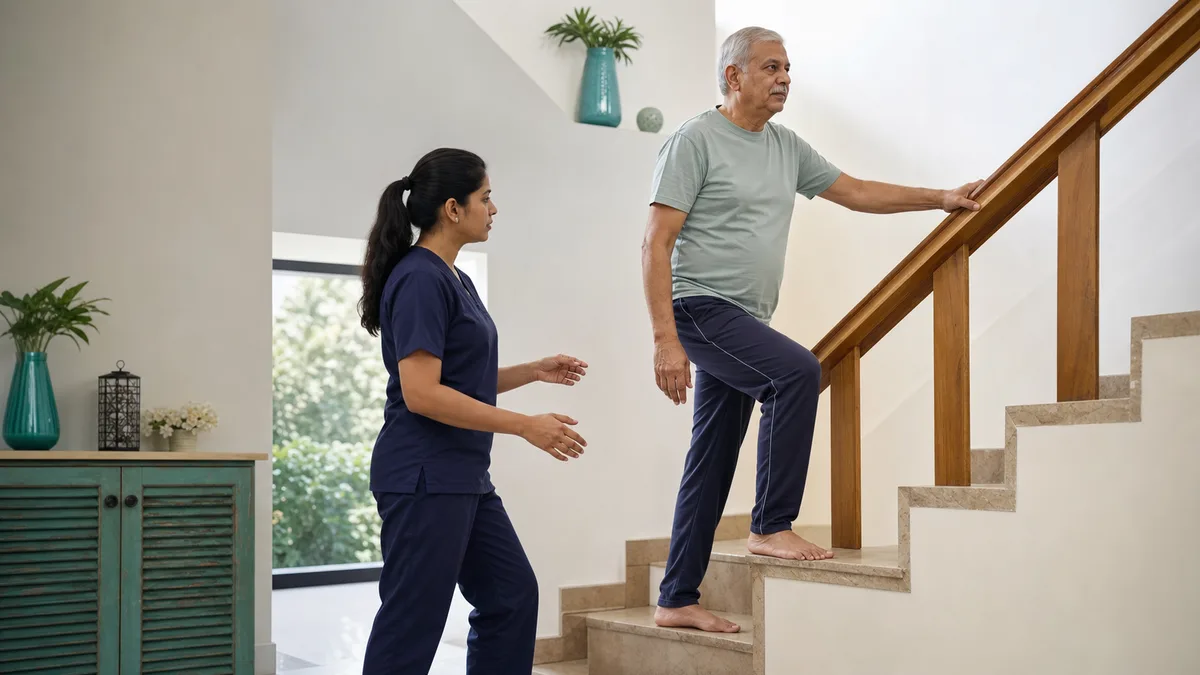
Stairs are trained deliberately, railing first, one step at a time, then foot-over-foot as the thigh muscle returns
The 5 mistakes that slow TKR recovery
We see the same handful of mistakes derail good operations, and every one of them is avoidable.
1. Resting too much. The family means well, "aap aaram karo", but a TKR recovering on bed rest is a TKR going stiff. Movement, in the right dose, is the medicine.
2. Skipping the bend work because it hurts. The bend exercises are uncomfortable, and they are also the ones on a deadline. Avoiding them for comfort in week 3 buys a stiff knee in month 6.
3. Comparing with someone else's recovery. Your neighbour's knee bent 120 in a month, yours is at 95. Different implant, different starting knee, different swelling. The only comparison that matters is you versus last week.
4. Stopping at week 6 because it "feels okay". Week 6 is when the knee stops hurting and the muscle is still at half strength. Stop there and you keep a limp and a wobble for years. The strength phase is the part that makes the knee yours again.
5. Ignoring the other knee. It carried you through the arthritis years and it is usually the next one to complain. A little strength work for it now is the cheapest knee treatment you will ever do. If it already aches, our knee pain causes guide explains what actually helps.
A real TKR case from Noida
Take Sushila. She is 63, from Sector 61, and had her left knee replaced at a Noida hospital in March. The surgery went well. The plan after discharge was vague, a photocopy of exercises and "walk a little". Two weeks later her family called us because the knee was stuck around 70 degrees, the walker was still doing all the work, and she had started saying the operation was a mistake.
Dr. Purti assessed her at home the next morning. The implant was fine. The problem was everything around it, a sleeping quadriceps, a swollen joint nobody was managing, and two lost weeks of bend work. We started daily home sessions, swelling control, muscle activation, and honest, careful bend work that she hated and did anyway.
By week 5 she was at 100 degrees and walking with a stick to the mandir at the corner. By week 9, at the clinic now, she climbed our stairs foot-over-foot, slightly stunned at herself. She finished at 118 degrees, walking unaided, and the operation she called a mistake is now the knee she trusts more than the other one. Her right knee, incidentally, is doing strength work with us so it never needs the same surgery.
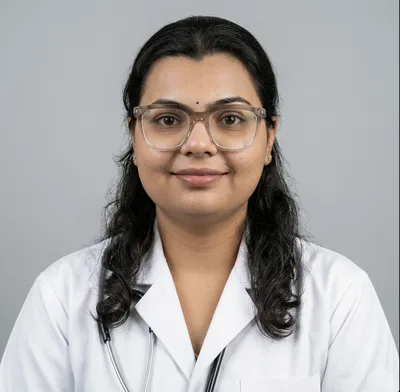
Dr. Purti Shukla, who leads every post-surgical case at Dynamics Mend, holds a BPT and an MPT in Sports Physiotherapy, is certified in dry needling and cupping, and has guided hundreds of Noida patients through post-operative recovery at the clinic and at home.

Dr. Purti Shukla, BPT, MPT (Sports), leads every TKR rehab case at Dynamics Mend, Sector 52 Noida, at the clinic and at home
Honest TKR rehab pricing, in writing
You have already spent a serious amount on the operation. The rehab that decides its result costs a fraction of it, and we put the numbers in writing so nobody is guessing.
| Service | Fee |
|---|---|
| First teleconsultation (30 min) | Free |
| Home TKR session in Noida first 2 to 3 weeks, portable kit, no travel charge | ₹1,200 to ₹1,800 |
| In-clinic session once travelling is comfortable | ₹500 to ₹800 |
| Typical 10 to 12 week TKR programme home phase + clinic phase, tapering frequency | Quoted after first assessment |
No fixed packages sold before we have seen the knee. After the first assessment you get a realistic session count and a written estimate. See the full pricing page, and our home physiotherapy page for sector-wise home visit details.
Knee replacement done or scheduled? Get a free callback.
Tell us the surgery date and how the knee is doing. Dr. Purti will call back with an honest read on where your recovery stands.
Frequently asked questions about physiotherapy after knee replacement
How long does physiotherapy take after a knee replacement?+
A typical total knee replacement (TKR) rehab runs 10 to 12 weeks of structured physiotherapy. The first 2 to 3 weeks usually happen at home, then most patients shift to clinic sessions as walking gets easier. You keep improving for a full year, but the guided part of the journey, where a physiotherapist actively progresses you, is those first 3 months. Skipping or shortening it is the single most common reason a good operation ends in a disappointing knee.
When should physiotherapy start after knee replacement surgery?+
Day one or day two, while you are still in the hospital, and the hospital team usually handles that part. The mistake happens after discharge, when many patients wait 2 or 3 weeks "for the stitches to heal" before starting proper physiotherapy. That gap is exactly when the knee stiffens. Home physiotherapy should begin within a couple of days of reaching home, and at Dynamics Mend we regularly start home TKR sessions in Noida the same week as discharge.
How much should my knee bend after replacement?+
Rough targets: around 90 degrees by week 2 to 3, and 110 to 120 degrees by week 6 to 8, which covers stairs, chairs, car seats and most of daily life. The exact number varies by implant and by how swollen the knee is. What matters most is the trend. If your bend has stopped improving for 2 weeks, or is getting worse, do not wait, that is the scar-tissue window closing and it needs active work now.
Is pain 3 months after knee replacement normal?+
Some things are completely normal at 3 months: mild warmth, occasional night aches, stiffness after sitting long, a clicking sensation, and tiredness around the knee after a big day. What is not normal is pain that is getting worse month on month, sharp pain on every step, a knee that is losing bend, or new calf pain and swelling. Those need assessment, not patience. An honest physiotherapy review can usually tell the difference in one visit.
Can I climb stairs after a knee replacement?+
Yes, and stairs training is a planned part of rehab, not something you figure out alone. Early on you climb one step at a time with the railing, leading up with the un-operated leg and down with the operated one. Most patients manage stairs in this pattern by week 3 to 4, and climb normally, foot over foot, somewhere between week 6 and 10 as quadriceps strength returns.
Do you provide physiotherapy at home after knee replacement in Noida?+
Yes, and for the first 2 to 3 weeks it is usually the right choice, because travelling with a fresh TKR is genuinely hard. Post-surgery home rehab at Dynamics Mend costs ₹1,200 to ₹1,800 per session, with no travel charge, across Sector 50 to 72 and nearby areas. The physiotherapist brings a portable kit, and once you are walking comfortably, most patients shift to clinic sessions at ₹500 to ₹800 to use the full setup.
Will I be able to sit cross-legged or on the floor after TKR?+
The honest answer: chair-height life comes back fully for almost everyone, sitting, stairs, walking, travel. Deep floor sitting and full cross-legged positions depend on your implant type and how much bend you recover, and many surgeons advise against making them a daily habit even when possible. Tell us your goals in the first session. If floor sitting matters for prayer or family meals, we build the maximum safe bend for it rather than a generic routine.
What happens if I skip physiotherapy after knee replacement?+
The implant only works as well as the muscles moving it. Without rehab, scar tissue tightens the joint into a stiff knee, the thigh muscle stays switched off, and you walk with a limp on a perfectly good implant. Some of that stiffness becomes permanent after the first few months, which is the truly unfair part. A lakhs-worth operation deserves the few thousand rupees of rehab that decides its result.
Give your new knee the recovery it paid for
Whether the surgery is next month or was three months ago, an honest assessment tells you exactly where the knee stands and what it still has left to gain. Home visits across Noida, clinic sessions at Sector 52, and a plan in plain words.
Open: 10 AM to 9:30 PM, Friday closed · E-132, E-Block, Sector 52, Noida 201301