
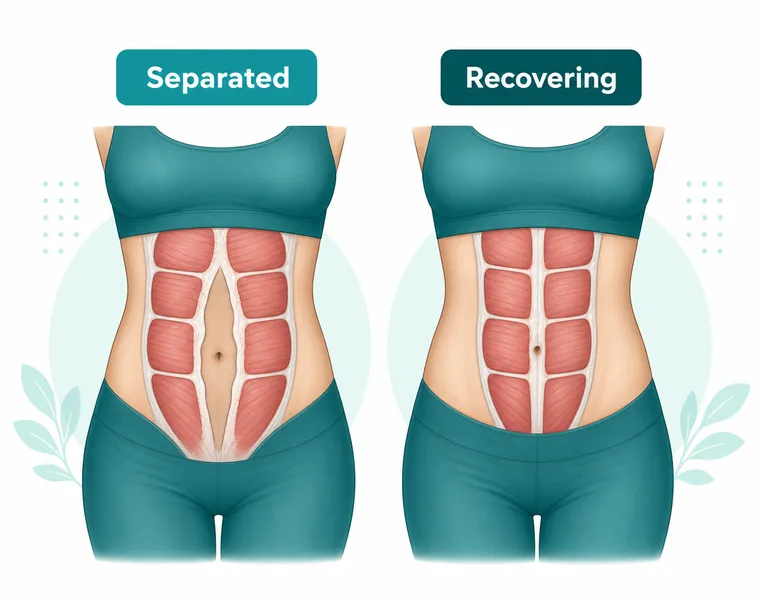
Diastasis recti is one of the most common problems after pregnancy, and one of the least talked about. The two long halves of the rectus abdominis, the six-pack muscle, get pushed apart as the baby grows, and the band of tissue between them stretches thin. After delivery, that gap does not always close on its own.
The result is familiar to a lot of mothers. A belly that still looks four months pregnant a year later. A soft ridge that pops up along the middle when you sit up in bed. A lower back that aches because the core is not doing its share. And months of crunches that somehow made the belly look worse, not better.
None of that means your body is broken. It means the deep core needs retraining in a specific order, and that is exactly what this programme does.
How to Check Yourself for Diastasis Recti
You can do a reasonable first check at home in under a minute. Lie on your back with knees bent, feet flat on the floor. Put your fingers flat on your belly just above the belly button, fingertips pointing down toward your pelvis. Lift your head and shoulders slightly off the floor, like the start of a crunch, and feel along the midline.
- A gap of 1 finger width or less between the muscle edges is normal
- 2 fingers or more, felt above, at, or below the belly button, suggests diastasis recti
- A soft bulge or ridge that pushes up along the midline when you sit up is another strong sign
- Also check just below the belly button, the gap is often widest there
The finger test is a screening check, not a diagnosis. Depth of the gap and how much tension the tissue can generate matter as much as the width, and those need hands-on assessment. If you felt 2 fingers or more, or your belly domes when you sit up, get it assessed properly before starting any ab workout.
Why Crunches and Planks Make It Worse
This is the part that frustrates almost every woman who walks in with diastasis recti. The exercises people reach for to flatten the belly, crunches, sit-ups, planks, leg raises, are exactly the ones that push the gap wider when the deep core is not ready.
Here is why. Those exercises build high pressure inside the abdomen. A healthy deep core, mainly the transverse abdominis, the corset muscle that wraps around your waist, contains that pressure. After pregnancy, that corset is stretched and switched off. So the pressure takes the path of least resistance, straight out through the thin tissue at the midline. Every rep bulges the gap outward instead of pulling it together.
That is why months of gym effort can leave the belly looking worse. It is not a willpower problem. It is an order-of-operations problem.
How We Treat Diastasis Recti at Dynamics Mend
Assessment
We measure the gap at three points, check its depth and tension, test your pelvic floor and breathing pattern, and look at your posture and daily lifting habits. You get a clear picture of your starting point and a realistic timeline before any exercise begins.
Deep Core Reconnection
Breathing-led activation of the transverse abdominis and pelvic floor, so they fire together again. This stage looks gentle and feels like almost nothing, but it is the foundation. Skipping it is the reason internet plans fail.
Tension and Gradual Loading
Once the deep core responds, we teach it to create tension across the midline, then load it through real positions, carrying, bending, getting off the floor with a baby in your arms. The gap starts narrowing because the muscles are finally pulling toward the middle.
Full Strength
Real strength work returns, including the exercises that were off-limits earlier, reintroduced at the right time. You leave with a core that holds you through lifting, running, and daily life, plus a maintenance plan so the result lasts.
Not sure if your gap needs treatment?
Do the finger test, then talk to us. The first 30-minute teleconsultation with Dr. Purti is free, and you will know exactly where you stand.
Cost of Diastasis Recti Treatment in Noida
Sessions at our Sector 52 clinic are ₹500 to ₹800, everything included. Most women do 2 sessions a week for the first 4 to 6 weeks, then taper as the home programme takes over. A typical full programme is set after assessment and runs over a few months, and you do simple daily work at home between sessions, because daily practice is what closes the gap.
If stepping out with a newborn is hard, home sessions across Noida start at ₹800 with no travel charge.
| Service | Hospitals / Premium Clinics | Dynamics Mend |
|---|---|---|
| Assessment + gap measurement | ₹800 – ₹2,000 | Included |
| Guided deep-core rehab session | ₹1,000 – ₹2,500 | ₹500 – ₹800 |
| Home exercise programme | Often charged separately | Included |
| Progress re-measurement | ₹500 – ₹1,000 | Included |
| Home physiotherapy (Noida) | ₹2,000 – ₹3,500 | From ₹800 |
Note: Indicative pricing. Actual cost depends on your assessment, frequency, and whether sessions are home-based or clinic-based.
When Diastasis Recti Needs More Than Physio
⚠️ Get medical help first if you notice any of these
- Emergency, call 112 or go to the nearest hospital now: A painful, hard bulge that cannot be pushed back in, especially with vomiting (possible trapped hernia)
- Emergency, call 112 or go to the nearest hospital now: After delivery: chest pain, breathlessness, a severe persistent headache or vision changes, fever, or swelling in one leg
- Emergency, call 112 or go to the nearest hospital now: Heavy bleeding, such as soaking one or more pads in an hour
- Urgent, same-day medical assessment: A C-section wound that is opening, discharging, or getting redder or more painful. Contact your maternity team or doctor
- See a doctor: A feeling of something bulging at the vaginal opening, or persistent leaking of urine or stool. This needs a gynaecology or pelvic-health assessment, and physio can be part of the plan
These are rare, but we screen every patient for them in the first visit. If anything looks beyond physiotherapy, we refer you to the right specialist instead of experimenting.
Why Women Choose Dynamics Mend for This
Female physiotherapist-led. Dr. Purti Shukla, MPT (Sports), handles assessment and treatment herself. No awkward conversations with a male stranger.
Private assessment room. Nothing is rushed, and nothing is examined without your consent.
Measured progress. The gap is re-measured as you go, so you see the change in numbers, not just in the mirror.
Whole-picture care. Pelvic floor, back pain, and posture are treated together, because after pregnancy they are the same problem.
Home sessions across Noida from ₹800, useful in the newborn months.
Transparent pricing, one fee per session, no add-on charges.
Dr. Purti Shukla · MPT (Sports)
"So many mothers are told the belly is just what happens after a baby. Most of the time it is not. It is a muscle problem with a muscle solution, and watching a woman get her core back, and her confidence with it, is one of the best parts of this job."
Frequently Asked Questions
Honest answers to what mothers across Noida ask us most about diastasis recti.
1. Can diastasis recti be fixed without surgery?+
2. How long does it take to close the ab gap?+
3. My delivery was 2 years ago. Is it too late to fix?+
4. How do I check my ab gap at home?+
5. When can I start after a C-section?+
6. Which exercises should I avoid right now?+
7. Is there a female physiotherapist for this in Noida?+
8. Do you treat diastasis recti at home?+
Get Your Core Back
Sector 52, Noida. At our clinic or at your doorstep. Free 30-minute callback with Dr. Purti. Honest assessment, no upselling.