

You searched for women's health physio for a reason
Women's health physiotherapy treats the problems most women are quietly told to just live with after childbirth. A core that will not switch back on. A lower back that aches every time you lift the baby. An ab gap that will not close. A pelvic floor that leaks when you sneeze, laugh or jump. At Dynamics Mend in Sector 52 Noida, Dr. Purti Shukla, a female physiotherapist, treats all of this with a structured, private plan, and most women feel a real shift within the first few weeks.
That is the short answer. Now the honest version.
You probably did not plan to search for this. Most likely your body has been telling you something for a while. The belly that still looks pregnant months later. The little leak that you now carry a spare pant for. The back that screams every time you bend over the cot. And the thing nobody warned you about, the feeling that your own body became a stranger after the baby arrived.

Dr. Purti Shukla, female physiotherapist, guiding a postpartum recovery session at Dynamics Mend, Sector 52 Noida
Here is what you were probably told instead. It is normal. Give it time. This is just what happens after a baby. Some of that is kind, but a lot of it leaves you stuck, doing random ab workouts from the internet that quietly make things worse.
This guide tells you what women's health physiotherapy actually covers, how postpartum recovery is meant to work, what diastasis recti and the pelvic floor really are, and why having a female physiotherapist genuinely makes a difference here. By the end you will know exactly what your body needs, and whether our Sector 52 Noida clinic is the right place to get it.
What women's health physiotherapy actually is
Women's health physiotherapy is a focused area of physiotherapy for the things that affect women specifically, mostly around pregnancy, childbirth, the pelvic floor, and hormonal stages of life.
It is not a massage. It is not a quick spa add-on. It is a proper, assessment-led plan that retrains the deep muscles of your core and pelvis to work together again, the way they did before pregnancy stretched and loaded them for nine months.
At Dynamics Mend, the most common reasons women come in are postpartum recovery, an ab gap that will not close (diastasis recti), a pelvic floor that leaks or feels heavy, and back or hip pain that started during or after pregnancy. We also help with painful periods, pelvic pain, and many menopause-related issues like joint aches and a weakening pelvic floor. The full list is on our women's physiotherapy in Noida page, and if you are pregnant now, see pregnancy physiotherapy in Noida.
The common thread is simple. Your core and pelvic floor are a team. Pregnancy and delivery break that teamwork, and physiotherapy is how you rebuild it, safely and in the right order.
Postpartum recovery, done properly
The biggest myth about postpartum recovery is that it just happens on its own if you wait long enough. For some women it partly does. For many, the deep core and pelvic floor stay switched off for months or years, and the body just works around them, which is where the back pain and the leaking come from.
Real recovery happens in a sensible order, and the order matters more than the exercises.
First, breathing and reconnection
Before any sit-ups or planks, your deep core has to wake up again. That means your diaphragm (your main breathing muscle), your transverse abdominis (the deep corset muscle that wraps around your waist), and your pelvic floor learning to fire together on a breath. This part looks gentle and feels like nothing dramatic, but it is the foundation everything else sits on.
Then, gentle loading
Once the deep core responds, we slowly add load. Getting up from a chair, carrying the baby, going up stairs, all the real movements your day is already full of. We make those movements safe first, then strong.
Finally, real strength
This is where most online plans wrongly start. Once the foundation is back, we build genuine strength so you can lift, carry, run and pick up a toddler without your back or pelvic floor paying for it. Skipping straight to this stage is exactly what makes an ab gap worse.
If your main complaint is back pain after delivery, it often links to the same weak-core pattern, and our guide to slip disc and back pain is a useful companion read.
Diastasis recti: the ab gap after pregnancy
Diastasis recti is when the two long halves of your front ab muscle (the rectus abdominis, the six-pack muscle) separate down the middle during pregnancy. The growing baby pushes them apart, and the band of tissue between them stretches thin.
You might notice it as a soft, doming belly that still looks a few months pregnant, a gap you can feel with your fingers above or below the belly button, or a feeling that your middle is weak and cannot hold you.
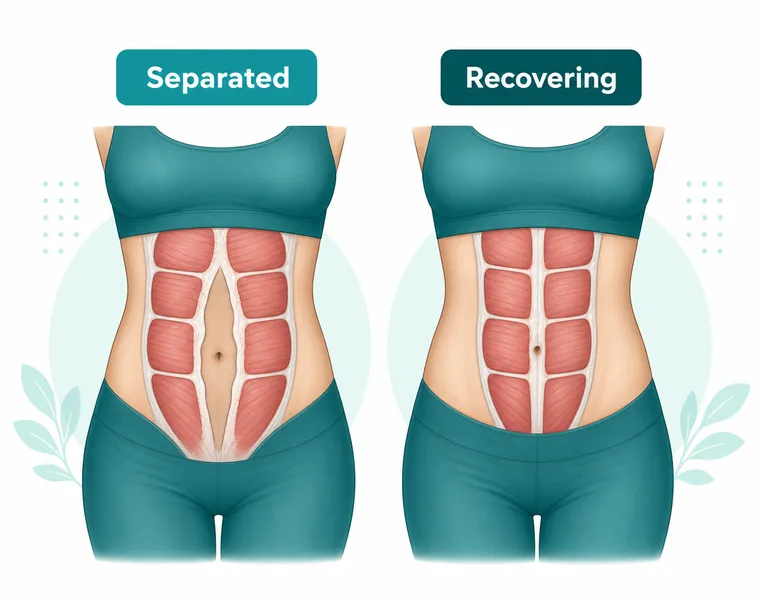
Diastasis recti: the front ab muscles separate during pregnancy, and guided core work helps the gap narrow again
Here is the part that frustrates so many new mothers. Crunches, sit-ups and planks, the exact things people reach for to flatten the belly, push the gap wider when the deep core is not ready. Months of effort, and the belly looks worse, not better.
The good news is that for the large majority of women, the gap narrows without surgery when the work is done right. We retrain the deep core to create tension across that thinned tissue, then build up gradually so the muscles draw back toward the middle. Surgery is reserved for a small number of severe cases, and it is rarely the first answer.
If you want the treatment side in detail, the self-check, the phases, the charges and honest timelines, see our dedicated page on diastasis recti treatment in Noida.
How long it takes depends on how wide the gap is and how long it has been there, but most women see a clear change within 6 to 8 weeks of guided work.
Pelvic floor physiotherapy, in plain words
Your pelvic floor is a sling of muscles at the base of your pelvis. Picture a small hammock running front to back, holding up your bladder, uterus and bowel, and helping you control when you pee and pass gas.
Nine months of carrying a baby stretches that hammock. A vaginal delivery stretches it further, and even a C-section does not spare it, because the pregnancy itself loaded it for months. After all that, the muscles often end up weak, poorly coordinated, or stuck tight, and any of those can cause problems.
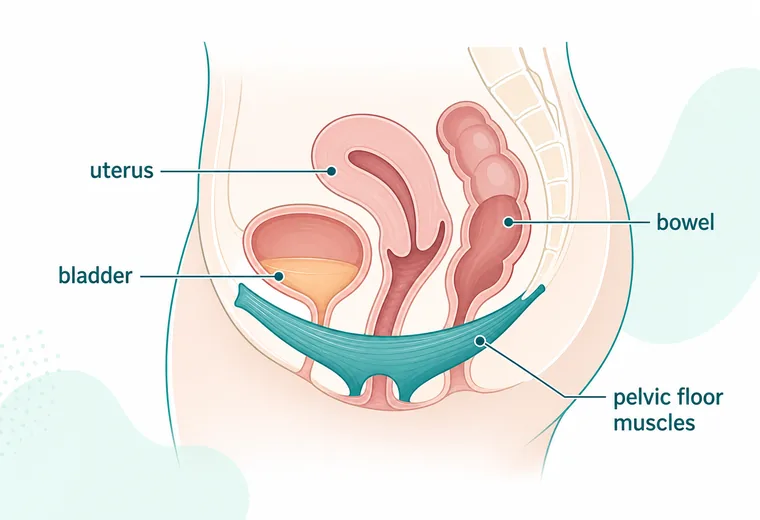
The pelvic floor is a sling of muscles supporting the bladder, uterus and bowel, and physiotherapy retrains it to work in time
Pelvic floor physiotherapy teaches those muscles to work properly again. This is gentle, external and fully clothed, and we do not do internal examinations. We use breathing, simple cues and feedback to help you find the muscles, contract them at the right time, and just as importantly, fully relax them.
That last point surprises people. A pelvic floor that is too tight can cause as much trouble as a weak one, including pain and a constant urge to pee. Strong is not the goal. Coordinated is.
Leaking, heaviness and pelvic pain
Let us name the things women usually whisper about, because there is nothing shameful here and all of them respond well to physiotherapy.
Leaking when you sneeze, laugh, cough or jump
This is called stress incontinence, and it is one of the most common things we treat. It happens when the pelvic floor cannot brace fast enough against a sudden push of pressure. It is common, but it is not something you have to accept forever. Most women see a clear improvement in a few weeks of targeted training.
A heavy or dragging feeling down below
That sense of pressure, like something is sitting low or might slip, can be an early sign of pelvic organ prolapse, where the support under the bladder or uterus weakens. Caught early, physiotherapy often manages it well and helps you avoid it getting worse. This is one to get assessed rather than ignore.
Pelvic pain, or pain during intimacy
Often this is the other side of the coin, a pelvic floor that is too tight and tense rather than weak. Releasing and retraining those muscles, along with breathing work, eases the pain for many women. This is a real medical issue, not something in your head.
One thing to always rule out first. If you have fever, heavy unusual bleeding, or severe sudden pain, that needs your gynaecologist, not just physiotherapy. We work alongside your doctor, never instead of them.
Why a female physiotherapist matters here
For a lot of women, this is the real reason they put off getting help. Talking about leaking, an ab gap, pelvic heaviness or pain feels deeply personal, and doing it with a stranger can feel like too much.
At Dynamics Mend, all women's health cases are led by Dr. Purti Shukla, a female physiotherapist. That means a woman is assessing you, explaining things to you, and guiding the hands-on work, in a private room, at a pace you set.
It changes the whole experience. You can describe what is actually happening without softening it. You can ask the question you were too embarrassed to ask your last doctor. And the sessions stay calm, private, and free of any judgement about your body or how long it has been since your delivery.
This is not a small detail. The number of women who finally book once they hear a female physiotherapist will see them tells you everything about how much it matters.
How many sessions you actually need
Most women feel a real difference within the first 3 to 4 sessions. That is the honest, repeatable pattern we see.
A typical postpartum or pelvic floor plan runs 6 to 8 sessions over 6 to 8 weeks. We space them so your body has time to adapt between visits, and every plan comes with a short daily home routine, because the home work is what makes the progress stick.
The exact number depends on your delivery, how wide the ab gap is, your symptoms, and how your body responds in the first couple of weeks. A fresh, mild case may need fewer. A long-standing one that has been ignored for a few years may need more.
What we will never do is hand you a fixed 20-session package on day one. We tell you a realistic range after the first assessment, and we tell you clearly when you are strong enough to carry on alone.
Not sure if it is too late to fix this?
Whether your baby is 3 months or 3 years old, the body responds to the right work. Book a free callback and a female physiotherapist will tell you honestly where to start.
A case from our Sector 52 clinic
Illustrative example based on cases we commonly see at the clinic. Name and details changed.
Take Neha. She is a 31-year-old marketing professional from Sector 76 Noida, five months past a C-section delivery of her first baby. She came in with three things she thought were unrelated, a belly that still looked pregnant, a lower back that ached every time she lifted the baby, and a little leak whenever she sneezed.
She had been doing daily crunches and planks from a fitness app for two months, frustrated that her belly was getting softer in the middle, not firmer. She had almost convinced herself this was just her body now.
At the first visit, the assessment told the real story. She had a two-finger-wide diastasis recti above and below the navel, her deep core was barely switching on, and her pelvic floor had lost its timing. The crunches were the worst possible choice, they were pushing the gap wider every single day.
The plan was simple and in order. Stop the crunches and planks completely. Start breathing and deep-core reconnection for two weeks, then add pelvic floor training and gentle loading, then build real strength around lifting and carrying the baby. A five-minute daily home routine tied it together.
By week four her sneeze leak was gone. By week eight the ab gap had closed to a single finger, her back pain had settled, and she could lift her daughter without bracing for it. That was a few months ago, and she has kept the gains because we fixed the cause, not just the look.
Dr. Purti Shukla, who leads the clinic, is a female physiotherapist, BPT and MPT (Sports Physiotherapy), and she handles women's health cases personally. Every postpartum and pelvic floor plan at Dynamics Mend is built on that base, never added on top of a generic exercise sheet.
What your first visit at Dymend looks like
No surprises, no rushed sales talk, no judgement about your body or your timeline.
You walk in. We spend the first 10 minutes on your story, your delivery, your symptoms, your sleep, how you are lifting and feeding the baby, and what you are most worried about. Everything is private, and a female physiotherapist is with you the whole time.
Then a gentle assessment. We check your breathing pattern, your deep core, the width of any ab gap, your posture and your back, and where relevant and only with your comfort, the pelvic floor. We explain what we are checking and why, before we check it.
By the end you walk out with a clear picture of what is going on, the first two or three things to start at home, and a realistic plan. That home routine takes about five minutes a day, and it is what turns the sessions into lasting change.
Honest pricing, in writing
Real numbers, no surprises. Here is exactly what women's health physiotherapy costs at Dynamics Mend, Sector 52 Noida. Your first 30-minute teleconsultation is free, so you can hear an honest take from a female physiotherapist on where to start before paying anything. Everything below includes a proper assessment and the time we actually spend with you.
| Service | Fee |
|---|---|
| First teleconsultation (30 min) | Free |
| In-clinic physiotherapy session assessment + all modalities | ₹500 to ₹800 |
| Postpartum recovery session deep core + back | ₹800 to ₹1,000 |
| Pelvic floor physiotherapy session | ₹1,000 |
| Diastasis recti rehab session | ₹1,000 |
| 6 session postpartum recovery pack saves ₹600 | ₹4,800 |
| Home visit physiotherapy Sector 50, 51, 52, 62, 63 | ₹800 to ₹1,200 |
No package pressure, no hidden cost. We tell you a realistic number of sessions after the first assessment, not before. See our full pricing page for all services. We also offer home physiotherapy across the nearby sectors, ideal for new mothers who cannot travel easily.
Is it safe, and when to start?
Yes, when it is done by a trained physiotherapist and matched to your stage of recovery.
Gentle breathing and deep-core reconnection can usually begin within the first couple of weeks after delivery, even after a C-section, because it is light and protective rather than strenuous. Loaded exercise and full pelvic floor training usually start around the 6-week mark, once your doctor has cleared you. We always plan around your delivery type and your own healing, never a fixed calendar.
A few things mean we go slower or check with your doctor first. If you have heavy or unusual bleeding, signs of infection, a wound that is not healing well, severe pain, or a complicated delivery, tell us at the first visit so we adjust the plan safely.
The golden rule here is the same one that runs through this whole clinic. We meet your body where it actually is, not where a generic timeline says it should be. Getting you strong, dry, pain-free and confident again is the point.
Want a 30 minute callback from a female physiotherapist?
Tell us what is going on. Dr. Purti will call back with an honest plan. Private and judgement-free.
Frequently asked questions about women's health physiotherapy in Noida
Is pelvic floor physiotherapy painful or invasive?+
No. It is gentle, external and fully clothed. We do not do internal examinations. We teach you how to find, contract, and relax the pelvic floor (the sling of muscles that supports your bladder, uterus and bowel) using breathing and simple cues, not anything uncomfortable. At Dynamics Mend in Sector 52 Noida, Dr. Purti Shukla, a female physiotherapist, works only at a pace you are comfortable with, in a private room, and explains every step before it happens.
How soon after delivery can I start postpartum physiotherapy?+
Gentle breathing and core reconnection can usually start within the first couple of weeks, even after a C-section, because it is light and protective. Loaded exercise and full pelvic floor training usually begin around the 6-week mark, after your doctor has cleared you. We always plan around your delivery type and your own recovery, never a fixed calendar. The safest first step is a free callback so we can tell you exactly what is right for your stage.
Can diastasis recti (the ab gap) close without surgery?+
In most cases, yes. Diastasis recti is when the two halves of your front ab muscles separate during pregnancy, leaving a gap and a soft, domed belly. With the right deep-core and breathing work, the gap narrows and the tissue between them tightens for the large majority of women. Surgery is only considered for a small number of severe cases. Crunches and planks too early can actually make it worse, which is why guided physiotherapy matters.
I leak urine when I sneeze, laugh or jump after my baby. Is that normal?+
It is common, but common does not mean you have to live with it. Leaking when you sneeze, cough, laugh or lift is usually a sign your pelvic floor lost strength and coordination during pregnancy and delivery. Pelvic floor physiotherapy retrains those muscles, and most women see a clear improvement within a few weeks. You do not need to accept it as a permanent part of motherhood.
Do you have a female physiotherapist for women's health?+
Yes. Dr. Purti Shukla is a female physiotherapist, BPT and MPT (Sports Physiotherapy), and she leads all women's health cases personally at Dynamics Mend, Sector 52 Noida. Many women feel more comfortable discussing postpartum, pelvic floor, leaking or pain with a woman, and that is exactly the setting we offer. Sessions are private, calm, and judgement-free.
How many sessions will I need for postpartum recovery?+
Most women feel a real shift within the first 3 to 4 sessions. A typical postpartum or pelvic floor plan runs 6 to 8 sessions over 6 to 8 weeks, paired with a short daily home routine. The exact number depends on your delivery, how big the ab gap is, and your symptoms. We give you a realistic range after the first assessment, never a fixed long package on day one.
Where can I find women's health physiotherapy near me in Sector 52 Noida?+
Dynamics Mend Physiotherapy at E-132, E-Block, Sector 52 Noida offers women's health physiotherapy with Dr. Purti Shukla, a female physiotherapist. This covers postpartum recovery, diastasis recti, pelvic floor training, and back pain after childbirth. We are easy to reach from Sector 50, 51, 62, 63, 76 and Greater Noida West, and the first 30-minute consultation is free.
Can I get women's health physiotherapy at home in Noida?+
Yes. Dynamics Mend offers home physiotherapy across Sector 50, 51, 52, 62, 63 Noida, which is ideal for new mothers who cannot travel easily with a newborn. The female physiotherapist comes to you, does the full assessment at home, and runs the same postpartum and pelvic floor programme as the clinic, in your own private space.
Does physiotherapy help with period pain or menopause symptoms?+
It can help more than most women expect. Physiotherapy supports painful periods, pelvic pain, and many menopause-related issues like joint aches, weak pelvic floor and bone health through targeted exercise, breathing and strengthening. It is not a replacement for your gynaecologist, but it works alongside that care. If this is your main concern, tell us at the first visit and we will build the plan around it.
Ready to feel like yourself again?
Come in for a real assessment with a female physiotherapist. Postpartum, ab gap, leaking or pelvic pain, we will tell you honestly what your body needs. No pressure, no judgement.
Open: 10 AM to 9:30 PM, Friday closed · E-132, E-Block, Sector 52, Noida 201301