
That sound. That exact moment. Whether it was a cricket match, a gym session, or just a bad step off the kerb — if you have torn or sprained a ligament, you probably remember exactly when it happened. One second you were fine. The next, swelling, instability, and a knee that feels like it might give way at any moment.
And now you are searching, wondering: do I need surgery? Will this heal on its own? Is my knee ever going to feel normal again?
Here is the honest answer: most ligament tears do not need surgery. Grade 1 and Grade 2 injuries almost always recover fully with structured physiotherapy. Even some Grade 3 complete tears do well without going under the knife. What they all need, however, is the right treatment started at the right time.
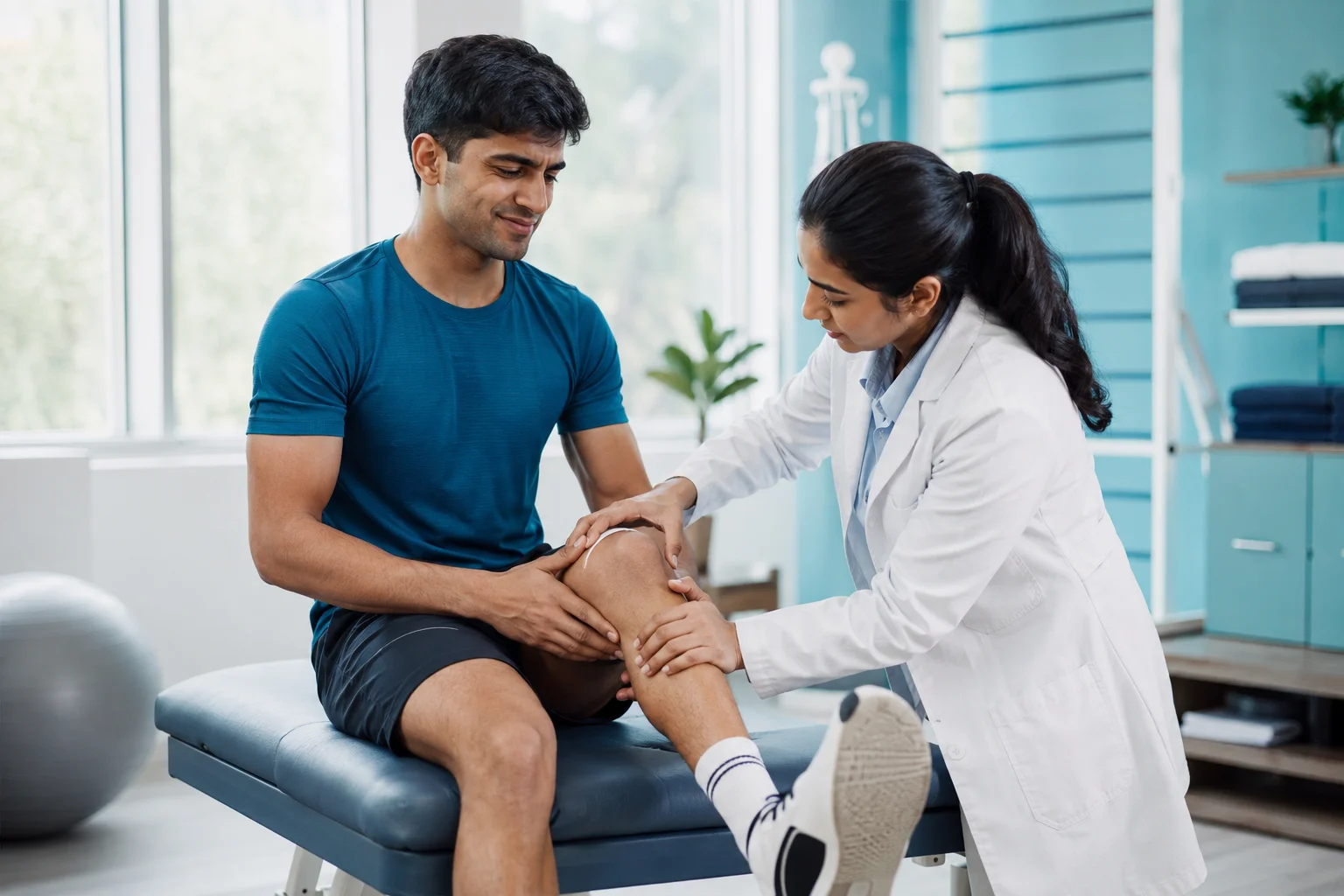
Dr. Purti Shukla assessing a sports injury patient at Dynamics Mend, Sector 52 Noida
“Ligament injuries don't heal the way a cut on your skin heals. Left alone, they scar over. That scar tissue is weaker, stiffer, and much more prone to re-injury than the original ligament.”
We hear the same story constantly at our Sector 52 Noida clinic. Patients come in four, six, sometimes ten weeks after the injury, frustrated that it should have healed by now. They have tried rest, an ice pack, a painkiller from the chemist, maybe a knee brace. The swelling went down. But the knee still does not feel right.
That is because rest alone does not rebuild a ligament. It just gives it time to heal badly. Dr. Purti Shukla holds an MPT in Sports Physiotherapy and has treated hundreds of ligament injuries in Noida. The pattern she sees consistently: patients who start proper rehab early do dramatically better than those who wait.
What Is Actually Happening Inside Your Knee
Your knee has four major ligaments — strong, fibrous ropes that keep your thigh bone and shin bone connected properly during every movement, whether you are running, turning, jumping, or squatting.
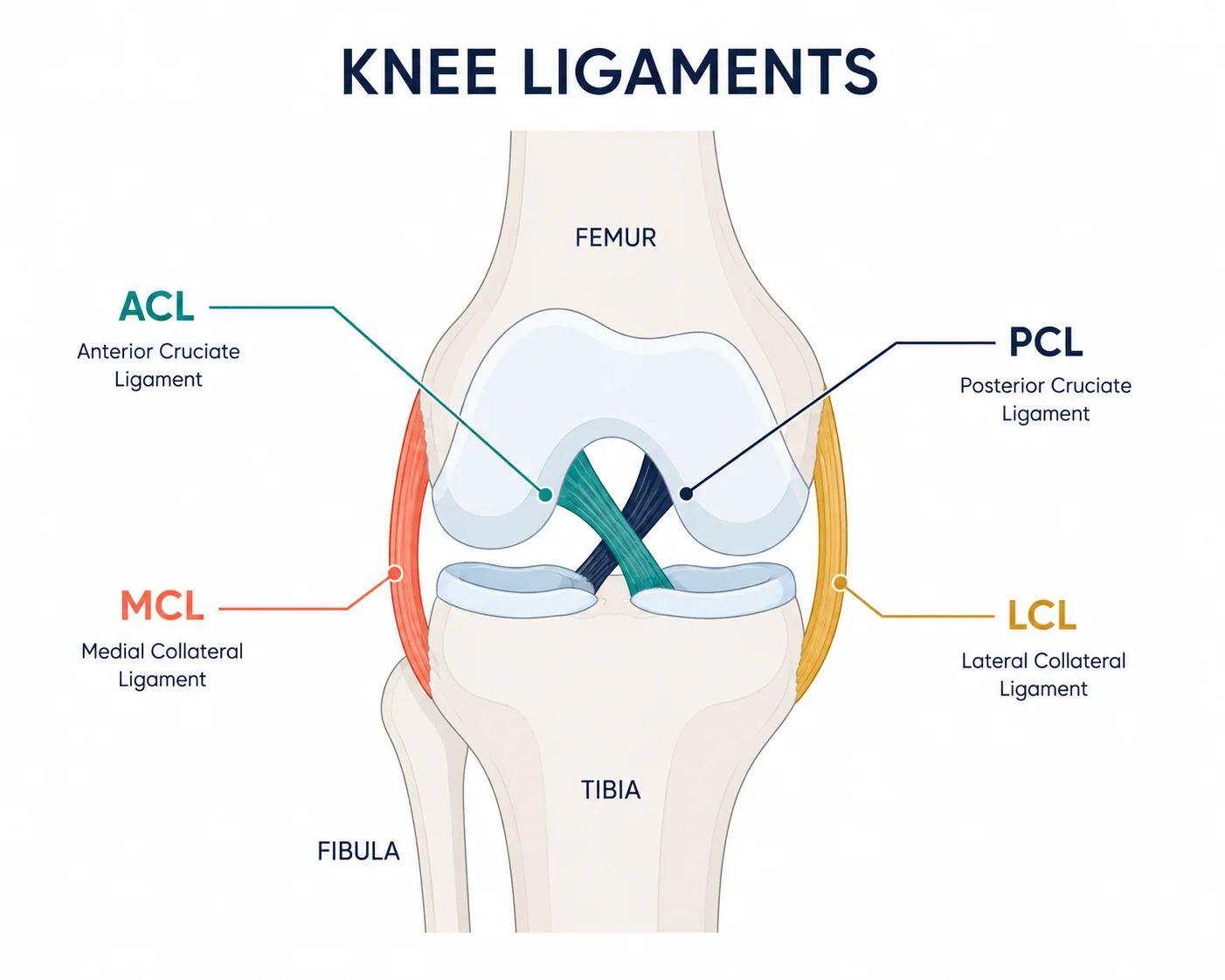
The four knee ligaments: ACL, PCL, MCL and LCL, each protecting a different direction of movement
ACL (Anterior Cruciate Ligament) runs diagonally through the centre of the knee. It controls forward sliding and rotational movement. The most commonly torn ligament in sports, usually from a sudden stop, pivot, or hard landing.
PCL (Posterior Cruciate Ligament) also runs through the centre and controls backward movement. Usually injured by direct impact, like falling forward onto a bent knee.
MCL (Medial Collateral Ligament) sits on the inner side of the knee. Gets injured when the knee is forced inward. Common in football, hockey, and falls.
LCL (Lateral Collateral Ligament) runs along the outer side of the knee. Less commonly torn, usually from direct force to the inner knee pushing the joint outward.
When any of these gets stretched or twisted beyond its limit, you get an injury. How serious it is depends on how many fibres are actually broken.
Grade 1, Grade 2, Grade 3: What Is the Difference?
The grade tells us exactly what is torn, how much, and what treatment you need.
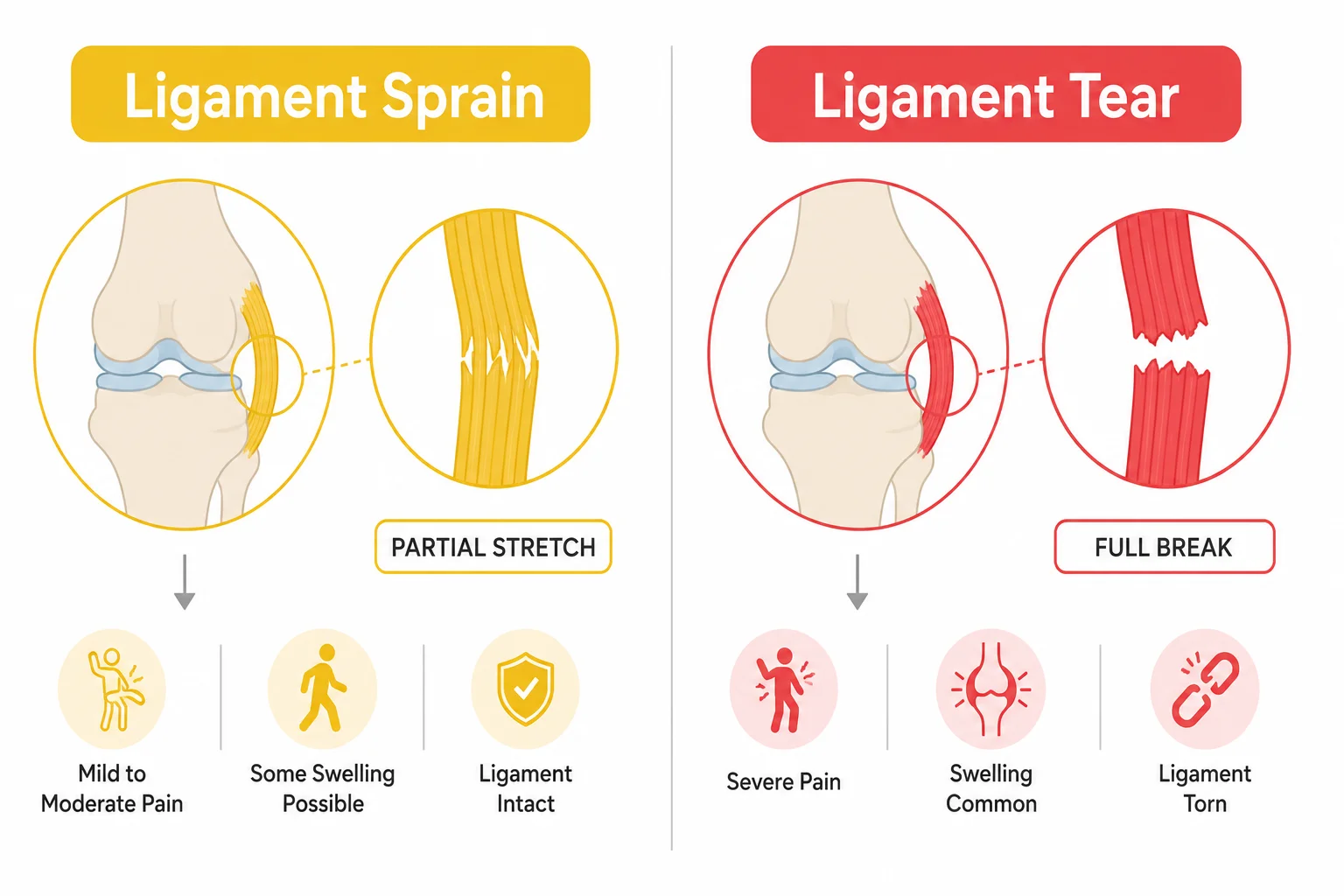
Ligament sprain (partial stretch) vs ligament tear (full break): the difference determines your recovery path
Overstretched but Intact
What happened? The ligament fibres were stretched under force but none of them actually broke. The joint is stable. You will have pain and some swelling, but the knee holds your weight normally.
What You Will Feel
- Mild to moderate pain around the joint
- Slight swelling, possibly warmth
- Tenderness on pressing the ligament
- Knee feels stable, no giving way
- Can usually still walk
Physiotherapy Focus
- Reduce swelling with ice and compression
- Gentle range-of-motion exercises from day 2
- Quadriceps and hamstring activation
- Balance and proprioception drills
- Return to sport in 3 to 4 weeks
Some Fibres Are Broken
What happened? A portion of the ligament fibres have actually torn. The joint has some instability. This is the most common type we treat at our Noida clinic. Sports injury treatment at this grade needs a structured plan, but surgery is almost never required.
What You Will Feel
- Significant swelling within the first hour
- Pain with weight bearing and stairs
- Instability when changing direction
- Bruising may appear after 24 to 48 hours
- Difficulty fully bending or straightening
Physiotherapy Focus
- Controlled swelling management in week 1
- Progressive strengthening from week 2
- VMO and hamstring activation
- Proprioception and balance retraining
- Sport-specific return-to-play protocol
Full Rupture of the Ligament
What happened? The ligament has completely ruptured. There is significant instability, often with a loud pop at the time of injury and rapid swelling. Surgery is discussed at this grade, but many patients recover fully with intensive conservative physiotherapy, especially those without extreme athletic demands on the knee.
What You Will Feel
- Loud pop at the time of injury
- Rapid, severe swelling within 30 minutes
- Significant joint instability or giving way
- Inability to bear weight immediately
- Positive clinical stress tests on assessment
Physiotherapy Focus
- Orthopaedic review to decide surgery vs conservative
- Swelling control and joint protection for 2 weeks
- Progressive loading from week 3 onward
- Neuromuscular control and strength rebuild
- Return to sport testing before full clearance
Why the Usual Fixes Do Not Work
Rest Alone Does Not Rebuild a Ligament
Rest reduces pain. That is all it does. It does not repair the ligament, it does not rebuild the muscle strength around the joint, and it does not restore the knee's ability to sense and control its own position. Without active rehabilitation, the muscles that protect your knee weaken fast. A weak quadriceps puts far more load on a healing ACL than a strong one.
Painkillers Mask the Problem
NSAIDs help with inflammation, yes. But taken too aggressively in the early healing phase, they can slow the biological repair process. More importantly, they mask the pain signal. Patients feel better, move more than they should, and re-aggravate the injury without realising it.
Generic YouTube Exercises Can Make It Worse
Not all knee exercises are safe for all types of ligament injuries. A full-range quad exercise that is fine for a Grade 1 MCL sprain can cause significant damage to a Grade 2 ACL partial tear. Without a proper grade-specific assessment, you are making decisions blindly.
Do's and Don'ts During Ligament Tear Recovery
✓ Do During Recovery
- Start physiotherapy within the first week of injury
- Apply ice for 15 minutes, 3 times a day in week 1
- Keep the leg elevated when resting to reduce swelling
- Do your home exercises every single day
- Wear a supportive brace only if your physio advises it
- Get an MRI if swelling does not reduce in 5 to 7 days
✕ Do Not During Recovery
- Do not skip sessions because it is feeling better
- Do not return to sport before your physio clears you
- Do not rely on bracing as a substitute for strengthening
- Do not follow exercises from the internet without assessment
- Do not massage directly over a swollen, fresh injury
- Do not use heat on an acute swollen knee
Not sure what grade your tear is?
Come in for an assessment. We grade the injury, review your MRI if you have one, and give you an honest plan. No commitment needed after the first session.
How We Treat Ligament Tears at Dynamics Mend
A structured, stage-by-stage rehabilitation plan — not a generic one. Here is exactly what recovery looks like when you come to our sports injury clinic in Sector 52 Noida.
Assess and Protect
Full ligament stress testing, range of motion grading, swelling measurement, and gait analysis. We tell you exactly which ligament, what grade, and whether you need an orthopaedic review first.
Reduce Swelling, Restore Movement
Manual therapy, cupping therapy for joint swelling and muscle guarding, and gentle graded exercises to keep muscles active without stressing the healing tissue. This is where most patients go wrong by doing too much or too little.
Rebuild Strength and Stability
Progressive resistance for the VMO, hamstrings, and glutes. Balance and proprioception drills. Dry needling for tight compensatory muscle groups that do not release well with stretching alone.
Return to Sport or Full Function
Sport-specific cutting, deceleration, and landing mechanics for athletes. Stair climbing, sustained walking, and daily activity confidence for everyone else. Cleared only when objective tests confirm readiness.
Warning Signs Your Ligament Is Torn, Not Just Sprained
These signs mean you need a proper assessment, not more rest and ice.
Arjun's Recovery: From a Cricket Ground to Full Match Fitness
Arjun is 27 years old, a software engineer in Sector 62 Noida. He plays weekend cricket — nothing competitive, just a weekly match with office friends. In February, he landed badly while fielding a ball. Heard the pop. The knee swelled up within the hour.
An orthopaedic near his office confirmed a Grade 2 ACL partial tear and told him to rest for six weeks, then start physiotherapy. He rested. The swelling went down. But at week five, the knee still felt wrong. Unstable when he tried to jog. Clicking on stairs. Weak.
That is when he came to Dynamics Mend.
Dr. Purti's assessment found that the ligament fibres were healing on schedule, but his VMO — the teardrop-shaped muscle just above the inner knee — had almost completely switched off from disuse. That muscle is the knee's primary stabiliser. Without it working, the ACL was taking load it should never be taking. That is what was causing the instability, not the ligament itself.
Eight sessions in, the instability was gone. By week ten from the original injury, Arjun was jogging again. Week twelve, he was back on the cricket pitch.
He messaged a photo from his last match a month later. That is what proper sports injury rehabilitation in Noida looks like when the diagnosis is accurate and the timing is right.
Ready to stop guessing what is wrong?
Book an assessment at our Sector 52 Noida clinic. We tell you exactly what is torn, what grade it is, and the realistic path to full recovery.
Cost of Ligament Tear Treatment in Noida
Ligament rehabilitation in Noida varies widely depending on the clinic. At Dynamics Mend, one session fee covers everything — assessment, manual therapy, dry needling, supervised exercises. No separate charges.
| Treatment Component | Hospitals / Premium Clinics | Dynamics Mend |
|---|---|---|
| Ligament Assessment and Grading | ₹800 to ₹2,000 | Included |
| IFT / TENS / Ultrasound | ₹300 to ₹800 per session | Included |
| Manual Therapy | ₹500 to ₹1,500 | Included |
| Dry Needling (if required) | ₹800 to ₹2,000 | Included when needed |
| Supervised Rehabilitation Exercises | Often charged separately | Included |
| Per-Session Cost (Clinic) | ₹1,200 to ₹3,500+ | ₹600 to ₹900 |
| Home Physiotherapy (Noida) | ₹2,000 to ₹3,500 | From ₹800 |
Indicative pricing. Grade 1 typically needs 8 to 10 sessions. Grade 2 needs 12 to 18 sessions. Grade 3 conservative rehab runs 20 to 30 sessions over 12 to 16 weeks.
Why Patients Choose Dynamics Mend for Sports Injury Treatment in Noida
Sports physio expertise: Dr. Purti holds an MPT in Sports Physiotherapy. Ligament injuries are her speciality, not a side service.
One fee, no surprises: Assessment, manual therapy, dry needling, rehab exercises. All included in the session cost.
Accurate grading on day one: We tell you the exact grade and which ligament before we start any treatment.
Sector 52 Noida location: Easy to reach from Sector 50, 51, 53, 41, 62, 70, Indirapuram, and Greater Noida West.
Dry needling certified: For tight VMO, IT band, and hamstring trigger points that slow down ligament rehab.
Realistic timelines: We tell you upfront how many sessions you need and what the return-to-sport date looks like.
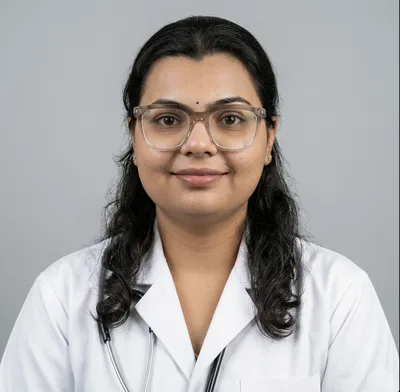
Dr. Purti Shukla · MPT (Sports)
“The thing about ligament tears is that the injury is never just the ligament. By the time a patient walks in, there is muscle weakness, compensatory tightness, fear of movement, and weeks of wrong loading patterns already built in. Fixing all of that is what brings full recovery. Not just waiting for the ligament to heal on its own.”
Frequently Asked Questions
Honest answers to the questions our team gets most often from ligament tear patients across Noida, Sector 52, and surrounding areas.
Dr. Purti Shukla
Dr. Purti Shukla holds an MPT in Sports Physiotherapy and leads the clinical team at Dynamics Mend, Sector 52, Noida. She specialises in ACL, MCL, and PCL rehabilitation, dry needling, and sports injury recovery for athletes and active patients across Noida and NCR.