
The short answer first
A sports injury treated properly is a temporary problem. A hamstring pull, an ankle sprain, a shoulder strain from the bench press, these heal fully with structured physiotherapy, usually in 2 to 12 weeks depending on the tissue and the grade. Very few need surgery, and almost none need months of sitting at home.
Here is the part that actually decides your future in the sport. Injuries that are only rested come back. Injuries that are rehabilitated and then tested do not. That single sentence is most of sports physiotherapy, and the rest of this guide is the evidence and the method behind it.
We see the pattern every week in Noida. The weekend cricketer who pulled a hamstring sprinting a second run, rested three weeks, felt fine, and tore it again in his first match back. The badminton player whose ankle has now twisted four times in two years. The gym-goer whose shoulder pinches every time he benches, because he took two weeks off and went straight back to his old weights.
None of them did anything stupid. They did what everyone told them to do, rest it, ice it, wait. The problem is that advice stops halfway.
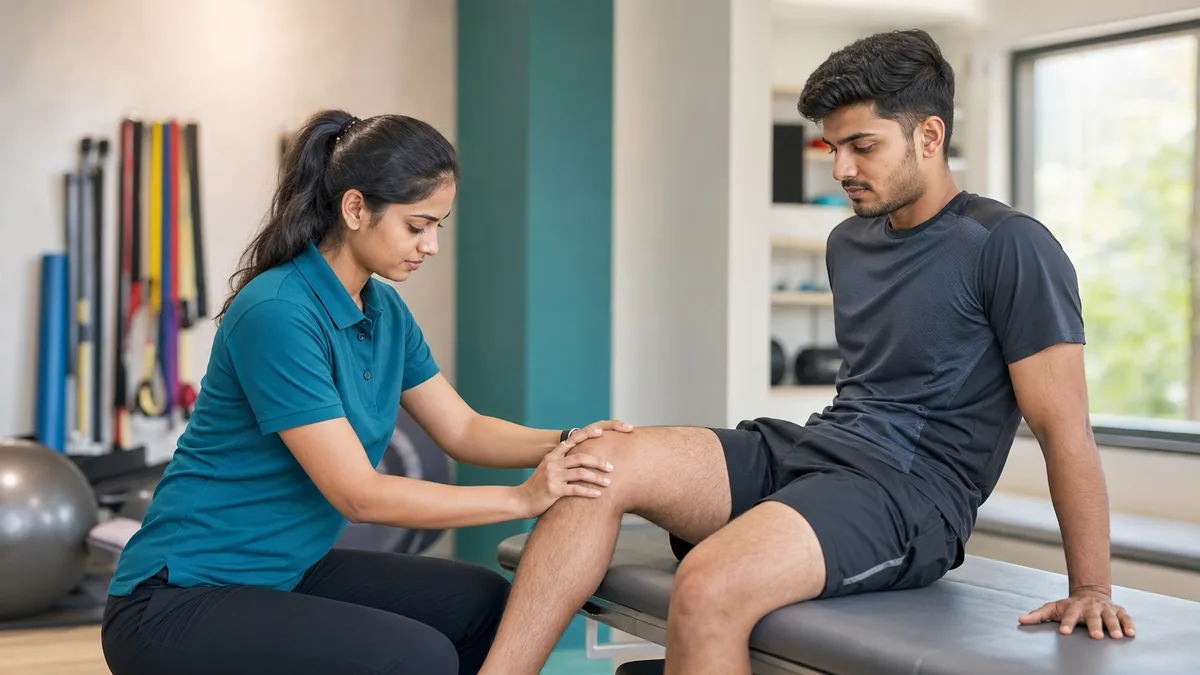
Sports injury assessment at Dynamics Mend, Sector 52 Noida, the grade of the injury decides the plan, not a generic protocol
The injuries we see most in Noida
Noida plays more sport than people realise. Box cricket and turf football bookings every evening, badminton courts full by 7 AM, running groups on the expressway service roads, and a gym in practically every market. With that comes a very predictable injury list at our clinic:
- Hamstring pulls, mostly cricket, that sudden sprint between wickets after a desk-bound week
- Ankle sprains, badminton lunges, football on uneven turf, or simply landing badly
- Knee ligament injuries, ACL and MCL sprains from twisting on turf, covered in depth in our ligament tear grades guide
- Shoulder and rotator cuff strains, bench press, overhead presses, bowling and smashing
- Tennis elbow and wrist pain, racquet sports and pull-up heavy gym routines
- Shin splints and runner's knee, sudden jumps in running distance, old shoes, hard surfaces
- Lower back strains, deadlifts and squats with form that broke down on the last rep
Each of these has a different tissue, a different healing clock, and a different comeback plan. Which is exactly why the same three weeks of rest cannot be the answer to all of them.
Why rest and ice alone leave you weak
Rest has one real job, protecting the tissue in the first few days while the bleeding and swelling settle. After that, its usefulness runs out fast, and continuing to rest starts working against you.
Healing tissue needs load to rebuild strong
When a muscle or ligament heals, the body patches it with scar tissue. Scar that forms without any loading is laid down like bricks dumped in a pile, weak, stiff and in no particular direction. Scar that forms while you do carefully graded exercise gets organised along the lines of pull, like bricks laid in a wall. Same injury, completely different repair quality. This is why sports medicine quietly retired the old rest-heavy formulas years ago, the modern protocols literally have load built into them.
The rest of you is detraining while you wait
While the injured tissue slowly heals on the sofa, the muscles around it are losing strength week by week, and your overall conditioning drops with them. So the day you return, the injured spot is weaker, its neighbours are weaker, and your body control is rusty. You have effectively engineered the perfect conditions for the next injury.
Pain switching off is not the finish line
Pain usually fades at around 40 to 60 percent of healing. It is the halfway marker, not the finish line. The gap between "it does not hurt any more" and "it can survive a full-speed sprint" is exactly where re-injuries live, and the only way across that gap is progressive strength work. Painkillers deserve a mention here too, they mute the alarm so you can sleep and move early on, but nobody ever strengthened a hamstring with a tablet.
The real enemy: coming back too early
This is where the research gets blunt, so we will be blunt with it.
Hamstring injuries have one of the worst repeat records in sport. Clinical reviews report that roughly one third of hamstring injuries recur within the first year of returning to sport, and the highest-risk window is the first two weeks back. Read that again, the most dangerous fortnight for your hamstring is right after everyone congratulates you on recovering.
Ankles are no kinder. Epidemiology studies show up to 40 percent of ankle sprains progress to chronic ankle instability, the ankle that twists over and over on nothing. The ligament healed, but the balance system that stops you rolling it was never retrained, so the ankle keeps failing the same exam.
And for the biggest one, the ACL, the numbers are almost unbelievable. A landmark cohort study found that passing simple strength and hop test criteria before returning cut re-injury risk by 84 percent after ACL reconstruction, and every month return was delayed up to nine months cut the re-injury rate by about half again. The difference between the athletes who got hurt again and the ones who did not was not luck. It was whether anyone tested them before letting them play.
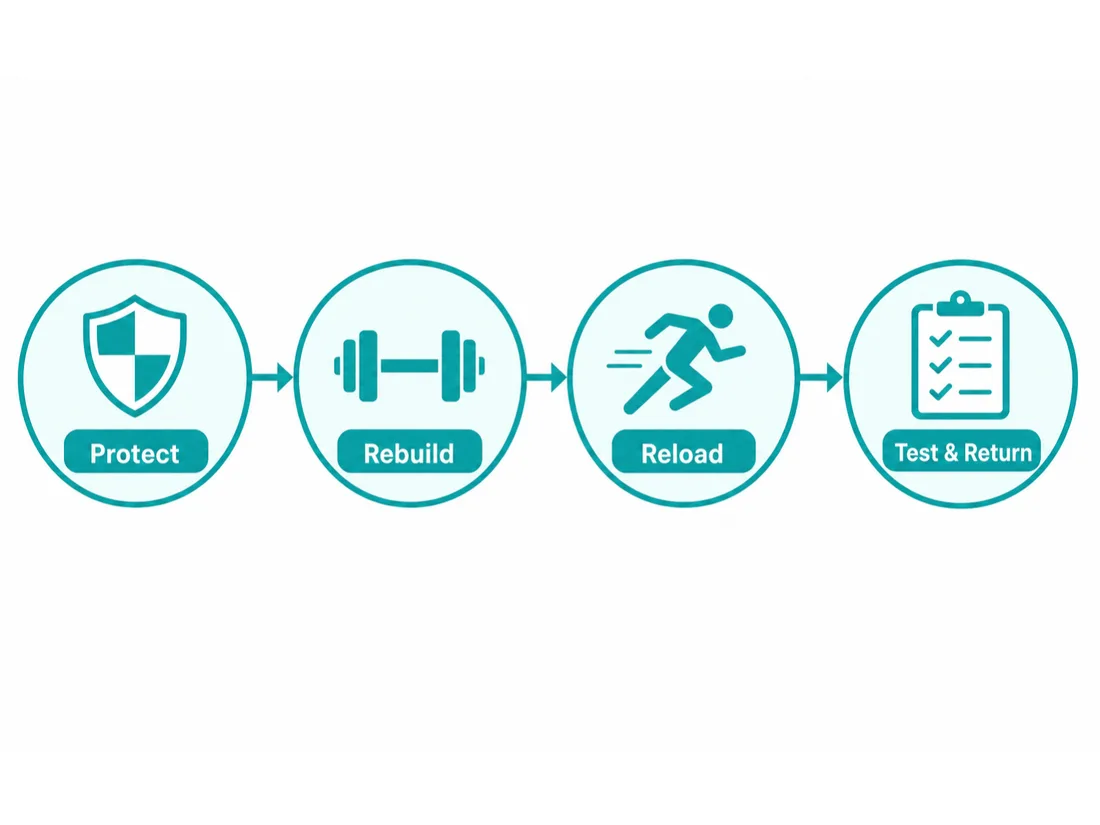
The comeback has phases, protect, rebuild, reload, test, and skipping the last two is how injuries become recurring characters
How we treat sports injuries at Dymend
Sports rehabilitation is Dr. Purti's actual specialisation, her Master's degree is in Sports Physiotherapy, and the clinic's method follows the same structure used with competitive athletes, scaled to whatever your sport is, even if your sport is Sunday box cricket.
First, grade the injury and find out why it happened
The first session establishes two things. What exactly is injured and how badly, which tissue, which grade, tested hands-on and against your scans if you have them. And why it happened, because most sports injuries have a backstory. A hamstring that tears often sits below weak glutes that made it do double duty. An ankle that rolls usually belongs to someone whose balance reactions were slow before the injury. Treat only the sore spot and the backstory writes a sequel.
Then, calm it down and start rebuilding early
The early phase controls pain and swelling and protects the healing tissue, hands-on manual therapy for the joints and muscles that have gone into guard mode, and dry needling, which Dr. Purti is certified in, for the deep knots and protective spasm around the injury. Cupping helps training-heavy patients recover between sessions. But loading starts almost immediately, gentle, pain-guided exercise from the first week, because that is what makes the repair strong.
Then, progressive loading, the part that actually decides your comeback
Week by week the exercise gets heavier and faster, isometrics to controlled strength work, eccentric loading, the type that protects hamstrings and tendons best, then power, hopping, sprinting and cutting drills that look more like training than therapy. This is deliberate. Your sport will not politely load you at 50 percent, so your rehab cannot stop there either.
Finally, return-to-sport testing, not a return-to-sport date
Before we clear you, you pass tests. Strength within touching distance of the uninjured side, single-leg hop tests that match, sport movements at full speed without pain or hesitation. If the numbers are not there, you get two more weeks of targeted work, not a shrug. This is the step the research above keeps pointing at, and it is the step almost nobody in Noida does. Our sports injury rehabilitation guide walks through what this journey looks like week by week if you want the longer version.
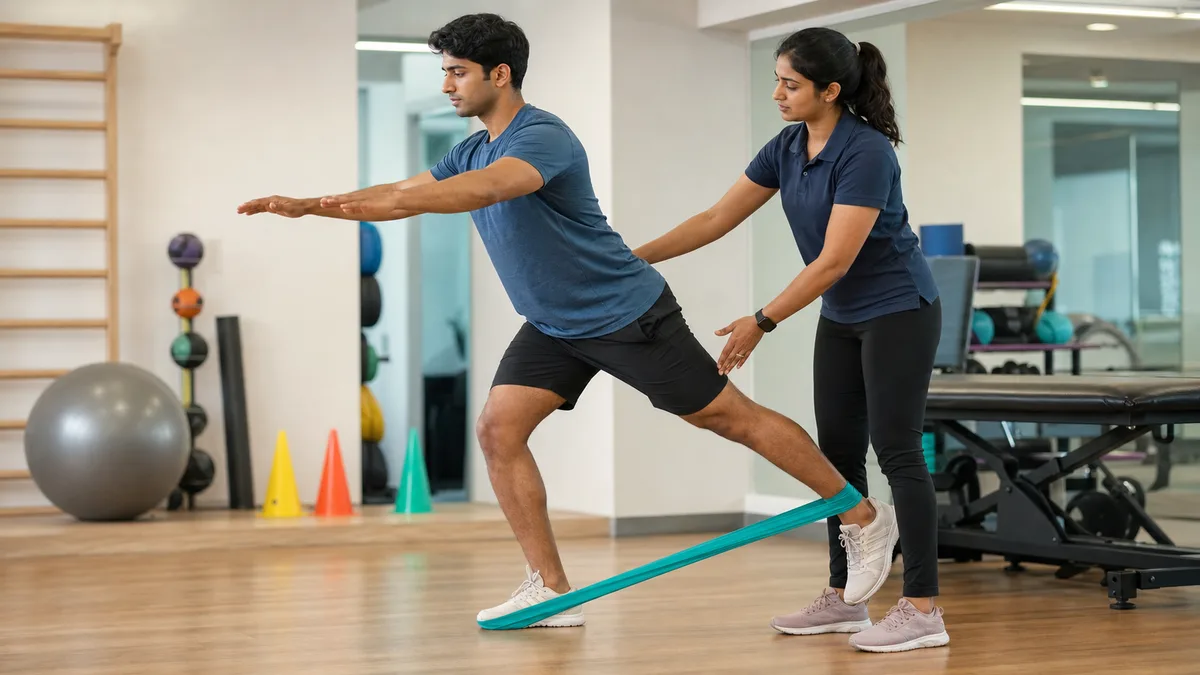
Late-stage rehab looks like training on purpose, if your comeback plan never gets harder than walking, it is not a comeback plan
Honest recovery timelines
Real ranges from the clinic, assuming treatment starts within the first week or two. A mild muscle strain takes 2 to 4 weeks to return to sport, a moderate one 4 to 8 weeks. Ankle sprains run from 2 weeks for a mild one to 8 to 12 weeks for a bad one, with balance retraining continuing beyond that. Tendon problems like tennis elbow respond over 8 to 12 weeks of loading, they reward patience and punish shortcuts. Post-surgery timelines are longer, ACL reconstruction runs 9 to 12 months to safe return, and that nine-month floor is not caution for its own sake, it is where the re-injury data points.
Two honest footnotes. Starting late stretches every one of these numbers, the six-week-old "it will go on its own" injury arrives with stiffness, weakness and compensations that all need undoing first. And a small flare somewhere in the middle is normal, an ambitious session, a hard landing, it settles and the plan continues. Panic is optional.
Injured mid-season and worried about the comeback?
Tell us what happened, what sport, and where it hurts. A free callback gets you an honest read on the injury grade and a realistic return date before you pay anything.
A case from Noida
Illustrative example based on cases we commonly see at the clinic. Name and details changed.
Take Arjun. He is a 26-year-old software developer from Sector 63 who plays weekend cricket, a turf league on Saturdays and the office tournament every quarter. Sprinting a second run one Saturday, he felt the classic snap in the back of his right thigh, a grade 2 hamstring strain. He did what most people do. Rested three weeks, felt no pain, went straight back for the next league match, and re-tore it in his second over of fielding, worse than the first time.
That second tear is what brought him to Dynamics Mend, frustrated and half-convinced his cricket was over at 26. The assessment told the fuller story. His glutes were weak and slow to fire, his hamstring flexibility was fine but its strength was far below his left side, and he had never done a single strengthening session between the two tears, only rest.
The plan ran twice a week for eight weeks. Dry needling in the early sessions to release the guarded, knotted muscle. Then a steady climb of loading, isometric holds, bridges and hip hinges, eccentric hamstring work with Nordic curls, then running drills that progressed from jogging to stride-outs to full sprints between cones set a cricket pitch apart, deliberately.
Before clearing him, Dr. Purti tested both legs. Strength within 10 percent of each other, single-leg hops matching, twenty-metre sprints at full effort with no fear and no pull. He went back to the league in week nine, that was last season. He has played the full season since, no recurrence, and his sprint between wickets is faster than before the injury, which he mentions more often than is strictly necessary.
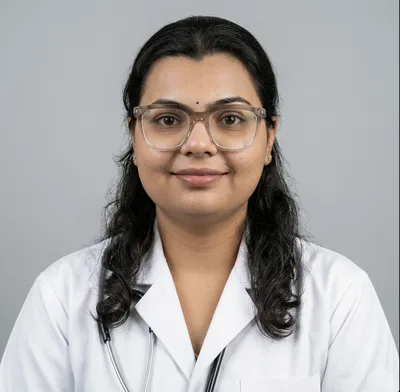
Dr. Purti Shukla, who leads every sports injury case at the clinic, holds a BPT and an MPT in Sports Physiotherapy and is certified in dry needling and cupping, the exact combination stubborn, spasm-guarded injuries respond to.

Dr. Purti Shukla, BPT, MPT (Sports), certified in dry needling and cupping, leads every sports injury case at Dynamics Mend, Sector 52 Noida
Honest pricing, in writing
Real numbers, no packages pushed at you in the first five minutes. Your first 30-minute teleconsultation is free, describe the injury and get an honest direction before paying anything.
| Service | Fee |
|---|---|
| First teleconsultation (30 min) | Free |
| In-clinic sports injury session assessment + manual therapy + guided loading | ₹500 to ₹800 |
| Dry needling / cupping (where the case needs it) included in the session plan | No separate charge |
| Home visit in the acute phase if travelling is difficult in the first days | ₹800 to ₹1,200 |
| Typical sports injury journey A block of sessions set after assessment, tapering as you progress | Honest quote after assessment |
No hidden costs, and no dragging sessions out. We tell you a realistic number after the first assessment, not before. See the full pricing page, our sports injury treatment in Noida page for what sessions include, and our home physiotherapy page if travel is the problem early on.
Want a free callback about your injury?
Tell us the sport, what happened, and where it hurts. Dr. Purti will call back with an honest read on the grade and your fastest safe route back. No pressure, no fixed package.
Frequently asked questions about sports injury treatment
Should I see a doctor or a physiotherapist for a sports injury?+
For most muscle pulls, ligament sprains and overuse pains, a sports physiotherapist is the right first stop, we assess the tissue, grade the injury and start treatment the same day. See an orthopaedic doctor first if there is a visible deformity, you cannot put any weight on the limb, the joint is locked, or there was a loud pop with immediate heavy swelling. Those need imaging before anything else, and we will tell you honestly at assessment if your case is one of them.
How long does a sports injury take to heal?+
It depends on the tissue, not the calendar. A mild muscle strain typically settles in 2 to 4 weeks, a moderate one in 4 to 8 weeks. Ligament sprains run 2 to 12 weeks depending on grade. Tendon problems like tennis elbow need 8 to 12 weeks of progressive loading. ACL reconstruction rehab runs 9 to 12 months before safe return to sport. At Dynamics Mend you get a realistic timeline after the first assessment, based on your injury grade, not a feel-good guess.
Can I keep going to the gym with an injury?+
Usually yes, and we actively encourage it. The rule is train around the injury, not through it. A hamstring strain does not stop upper body work, a shoulder problem does not stop legs. Staying in the gym keeps your fitness, your habit and your head in a good place while the injured tissue is rebuilt on a plan. What you should not do is test the injured area yourself every few days to see if it still hurts, that resets the clock.
My ankle keeps twisting again and again. Why does it never fully heal?+
Because the first sprain was never rehabilitated, only rested. Research shows up to 40 percent of ankle sprains progress to chronic ankle instability. When a ligament is injured, you lose more than tissue, you lose the joint position sense that tells your brain where your foot is mid-step. Rest returns the tissue, it does not return that control. Balance and hop retraining does, and it is the part almost everyone skips. That is exactly what we rebuild at the clinic.
I have an ACL tear. Is surgery always needed?+
No, not always. The decision depends on your sport, your age, how unstable the knee actually feels, and what you want to return to. Cutting and pivoting sports usually push the decision towards reconstruction, straight-line activities often do well without it. Two honest truths either way: some people cope well without surgery on a proper strengthening programme, and even with surgery the rehab quality decides the outcome more than the operation does. We help you test and decide, not guess.
Do you use dry needling for sports injuries?+
Yes, where the case needs it. Dr. Purti is certified in dry needling, and for sports injuries it is used on the muscle knots and protective spasm that sit around an injury, a clamped calf after an ankle sprain, a rock-hard quad guarding a knee. Releasing those lets the joint move and the strengthening work actually happen. It is one tool inside the plan, never the whole plan, and it is included in the session fee, not billed extra.
What does sports injury physiotherapy cost in Noida?+
At Dynamics Mend in Sector 52 Noida, an in-clinic session costs ₹500 to ₹800, and the first 30-minute teleconsultation is free, so you can describe the injury and get an honest direction before paying anything. Dry needling and cupping are included in the session plan where needed. If you genuinely cannot travel in the first days after an injury, home visits are ₹800 to ₹1,200. The number of sessions varies with the injury, and we quote the realistic number after assessment.
When can I return to playing after an injury?+
When you pass the tests, not when a date arrives. Before clearing you we look for near-equal strength on both sides, pain-free sport movements at full speed, and for lower limb injuries, hop and change-of-direction tests that match your other leg. Feeling fine in daily life is a low bar, sport asks for much more. This testing step is the difference between a comeback and a re-injury, and the research on ACL patients shows passing criteria like these cuts re-injury risk dramatically.
Ready to come back properly this time?
Come in, get the injury graded honestly, and leave with a plan that ends in a fitness test, not a guess. The fastest route back to your sport is the one you only have to travel once.
Open: 10 AM to 9:30 PM, Friday closed · E-132, E-Block, Sector 52, Noida 201301