

You searched for back pain treatment for a reason
Back pain treatment with physiotherapy helps most people get real, lasting relief in about 4 to 6 weeks, without surgery and without depending on painkillers. The common causes are a weak deep core, stiff joints in the spine, too many hours of sitting, and sometimes a slip disc irritating a nerve. At Dynamics Mend in Sector 52 Noida, Dr. Purti Shukla treats the actual cause, not just the pain, and most patients feel a clear shift within the first few sessions.
That is the short answer. Now the honest version.
You did not search for this at a good time. Nobody does. You searched because the back that used to just carry you around has started running your day. You think about it before you bend to tie your shoes. You shift in your chair every few minutes in meetings. You dread the first step out of bed in the morning, because that is when it bites the hardest.

Dr. Purti Shukla treating a patient's lower back during a physiotherapy session at Dynamics Mend, Sector 52 Noida
And you have probably already heard the unhelpful version of advice. Take rest. It will settle on its own. Everyone has back pain these days. Some of that is true, and some of it is exactly why people stay stuck for months, popping a tablet whenever it flares and hoping it goes away for good.
This guide tells you what is really going on in a painful back, why the usual fixes keep failing, how we actually treat it at our Sector 52 Noida clinic, and how long it honestly takes. By the end you will know whether you are dealing with a simple tired back, a slip disc, or sciatica, and what the right next step is.
What is actually causing your back pain
Here is the part most people never get explained properly. Back pain is rarely about one single thing that broke. It is usually a few things stacking up over time until your back finally complains loud enough that you listen.
Think of your spine like a tall stack of coins. As long as the stack is balanced and the muscles around it are doing their job, it holds up fine all day. The trouble starts when the support around that stack gets lazy, and the coins start taking the load they were never meant to take.
A deep core that switched off
Deep in your belly and around your spine sits a layer of muscle that works like a built-in corset. Its whole job is to brace your spine before you move, lift or twist. Years of sitting, stress and shallow breathing quietly switch this corset off. Once that happens, your back muscles and joints start doing the bracing instead, and they get overworked and angry.
Too much sitting, too little moving
This is the big one for Noida. Long hours at a desk shorten the muscles at the front of your hips, the hip flexors, and they start tugging on your lower back all day like a tight rope. Add a soft chair, a slouched posture, and a screen at the wrong height, and your lower back ends up loaded for eight, ten, twelve hours straight. No muscle was built for that.
Stiff joints and tight muscles
When parts of your spine stop moving freely, the segments above and below have to move more to make up for it. Those overworked segments get inflamed, and the muscles around them clamp down to protect the area. That clamp is the deep, nagging tightness you feel, the knot that no amount of stretching at home seems to loosen.
A slip disc or nerve irritation
Sometimes there is a structural reason on top of all this. A disc, the soft cushion between two spine bones, can bulge and press on a nearby nerve. When that happens the pain often shoots down into the buttock or leg, and that is a different pattern that needs a careful, specific plan. More on that further down.
The point is this. In most backs, it is not one villain, it is a team of small problems. Fix only the pain, and the team is still there waiting to flare again. Fix the team, and the pain has no reason to come back.
Why rest, painkillers and belts don't fix it
You have probably tried at least two of these already. They feel like they should work. Here is why they keep letting you down.
Why rest alone fails
A day or two of taking it easy when the pain is sharp is sensible. But beyond that, rest works against you. The deep core gets even weaker, the stiff joints get stiffer, and the longer you avoid moving, the more your brain learns to fear the movement. People who lie low for weeks waiting for the pain to vanish usually come back worse, not better.
Why painkillers don't fix it
A painkiller turns down the volume on the pain for a few hours. It does nothing about the weak core, the tight hips or the stiff joints underneath. So the moment it wears off, the pain is right where you left it. Tablets have their place in the first rough few days, but if you are reaching for them every week, your back is telling you the cause was never treated.
Why random internet exercises can backfire
This one quietly makes people worse. You search for back pain exercises, you find a video, and you start doing crunches or aggressive stretches that were never meant for your particular back. If you have a slip disc, certain forward bends can push the disc the wrong way. If your core is switched off, jumping into hard exercise just loads an already overworked back. The right exercise is brilliant medicine. The wrong one, done at the wrong stage, sets you back weeks.
How we treat back pain at Dynamics Mend
We do not hand everyone the same exercise sheet. Two people with lower back pain can have completely different reasons behind it, and treating them the same is how people end up frustrated. So every back starts the same way here, with a proper look at what is actually going on.
First, a real assessment, not a guess
At the first visit we watch how you move. How you bend, how you sit, how you stand up from a chair, where exactly the pain lives, and whether it travels into the leg. We check your deep core, your hip mobility, the joints of your spine, and your posture. We are looking for the cause, not just the sore spot, because the sore spot and the cause are often in two different places.
A good example. Plenty of people walk in sure their lower back is the problem, when the real driver is stiff hips or a core that quit. Treat only the back, and it keeps flaring. Treat the cause, and the back finally calms down.
Then, hands-on relief to settle it down
Early on, the priority is bringing the pain and stiffness down so you can move again. We use hands-on therapy to free up the stuck joints, and where there are stubborn muscle knots feeding the pain, dry needling. Dry needling uses a very thin needle to release a tight trigger point in the muscle, the kind of deep knot that massage just rolls over. For a lot of back patients it gives faster relief than anything they have tried.
Where it helps, we also use cupping to ease tight, overworked muscles and bring fresh blood to the area. Dr. Purti is certified in both dry needling and cupping, which is a rare combination to find in one Sector 52 clinic.

Dr. Purti Shukla, BPT, MPT (Sports), certified in dry needling and cupping, leads every back pain case at Dynamics Mend, Sector 52 Noida
Then, rebuilding the support so it lasts
This is the part that separates relief that lasts from relief that fades. Once the pain settles, we wake the deep core back up, free the tight hips, and slowly rebuild the strength your spine needs for real life, lifting, bending, sitting, carrying. We do it in the right order, gently first, then strong. This is also where your short daily home routine comes in, because the five minutes you do at home is what keeps the pain from coming back.
If your back pain is tied to long desk hours, our guide on desk-job back pain and neck pain is a useful companion read, and if it is a disc issue, the slip disc recovery guide goes deeper on that.
Slip disc and sciatica, in plain words
These two words scare people more than any others, so let us strip the fear out of them.
A slip disc does not actually slip out. Between each pair of spine bones sits a soft cushion called a disc, a bit like a jam doughnut. When the outer ring weakens, some of the soft centre can bulge out and press against a nearby nerve. The medical name is a prolapsed or herniated disc, sometimes written as PIVD.
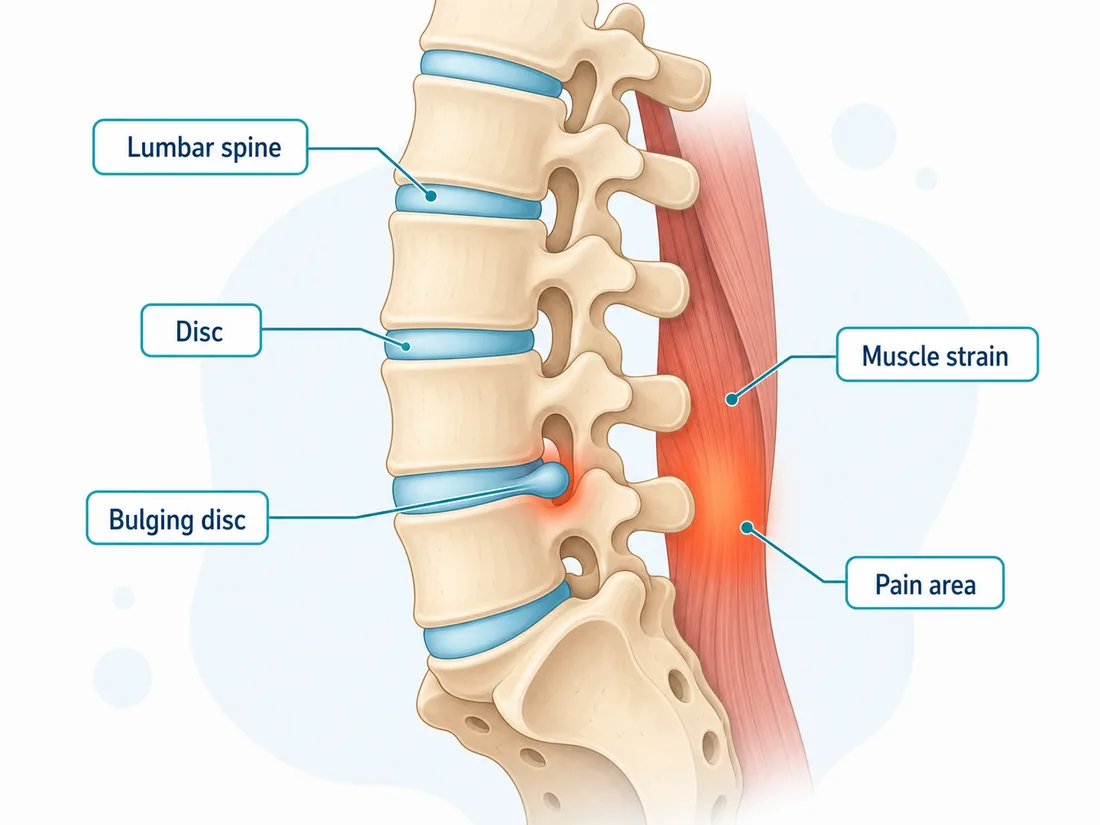
A slip disc is when the soft cushion between two spine bones bulges and presses on a nerve, which can send pain down the leg
When that bulging disc presses on the sciatic nerve, you get sciatica. That is the sharp, shooting or burning pain that runs from your lower back into the buttock and down the leg, sometimes with pins and needles or a heavy, weak feeling in the leg. The pain in the leg can be louder than the pain in the back, which confuses a lot of people.
Here is the reassuring truth. The large majority of slip disc and sciatica cases settle without surgery. The body can reabsorb a bulging disc over time, and the right physiotherapy speeds that along by calming the nerve, opening up the space around it, and rebuilding the core that takes pressure off the disc. We also teach you which movements to avoid in the early weeks so you stop poking the angry nerve without realising it.
Surgery is only on the table for a small number of cases, usually where there is real nerve damage, and even then it is rarely the first thing we reach for. Starting the right treatment early is what keeps most people well clear of the operating table.
How long recovery actually takes
This is the question everyone wants answered honestly, so here it is without the sugar-coating.
Most people feel a real difference within the first few sessions. That early shift matters, because it tells you the plan is working and your back can be trusted again. A typical back pain plan is set after assessment and runs over a few weeks, with a short home routine between visits.
A fresh, simple back, the kind that flared up last week from a bad lift or a long drive, often clears faster than that. A long-standing back that has been grumbling for a year, or a genuine slip disc with leg pain, usually takes a bit longer and a more careful build-up. We will always tell you which one you are after the first assessment, and we will not pretend a stubborn back is a quick fix.
What we will never do is sell you a fixed 20-session package on day one and keep you coming forever. We give you a realistic range, we adjust it as your back responds, and we tell you plainly when you are strong enough to keep it going on your own.
Not sure if it is serious or just a tired back?
Whether the pain started last week or last year, a quick honest assessment tells you exactly what you are dealing with. Book a free callback and we will tell you where to start.
A case from our Sector 52 clinic
Illustrative example based on cases we commonly see at the clinic. Name and details changed.
Take Amit. He is a 34-year-old software engineer in Sector 62 Noida who spends ten hours a day at his desk and a couple more in the car. His lower back pain crept in slowly over a year, until he could not sit through a single meeting without shifting around and wincing.
He had tried the usual things. Rest on weekends, a lumbar belt he wore all day, painkillers before big meetings, and a stack of back exercises from YouTube that honestly made it feel worse. He had half convinced himself this was just what his back was going to be from now on, and he was quietly scared it was a disc that would need surgery.
At the first visit the picture was clear. His back was not the real problem. His hip flexors were locked tight from all the sitting, his deep core had switched off, and his lower back was taking the full load all day, every day. The belt was actually making it worse, because it let those core muscles get even lazier. There was no slip disc, just a back doing a job three other muscles had quit.
The plan was simple and in order. Hands-on work and a couple of dry needling sessions to settle the angry muscles first. Then waking the deep core back up, freeing the hips, and changing how he sat and stood through his workday. A five-minute daily home routine tied it together.
By week three he was sitting through full meetings again without thinking about his back. By week six the pain was gone, the belt was in a drawer, and he knew exactly how to keep it that way. That was a few months ago, and he has stayed well, because we fixed the cause instead of just quietening the pain.
Dr. Purti Shukla, who leads the clinic, is a physiotherapist with a BPT and an MPT in Sports Physiotherapy, and she is certified in dry needling and cupping. Back pain cases like Amit's are handled on that base, never bolted onto a generic exercise sheet.
What your first visit at Dymend looks like
No rushed sales talk, no scary verdicts, no fixed package pushed on you before we have even looked properly.
You walk in. We spend the first ten minutes on your story. When the pain started, what makes it worse, whether it travels into the leg, how you sleep, how you sit at work, and what you are most worried about. Everything stays private and unhurried.
Then a proper assessment. We check how you move and bend, your deep core, your hip mobility, the joints of your spine, and we test for any nerve involvement if the pain goes into the leg. We explain what we are checking and why, before we check it, so nothing feels like a mystery.
By the end you walk out with a clear picture of what is actually going on, the first two or three things to start straight away, and a realistic plan with honest timelines. That home routine takes about five minutes a day, and it is what turns a few clinic sessions into a back that stays well.
Honest pricing, in writing
Real numbers, no surprises. Here is exactly what back pain treatment costs at Dynamics Mend, Sector 52 Noida. Your first 30-minute teleconsultation is free, so you can get an honest read on your back before paying anything. Everything below includes a proper assessment and the time we actually spend with you.
| Service | Fee |
|---|---|
| First teleconsultation (30 min) | Free |
| In-clinic physiotherapy session assessment + all modalities | ₹500 to ₹800 |
| Back pain & spine rehab session core + manual therapy | ₹800 to ₹1,000 |
| Dry needling session for stubborn muscle knots | ₹500 to ₹800 |
| Slip disc / sciatica rehab session | ₹1,000 |
| 6 session back pain pack saves ₹600 | ₹4,800 |
| Home visit physiotherapy Sector 50, 51, 52, 62, 63 | ₹800 to ₹1,200 |
No package pressure, no hidden cost. We tell you a realistic number of sessions after the first assessment, not before. See our full pricing page for all services. We also offer home physiotherapy across the nearby sectors, ideal when your back is too painful to travel.
When back pain needs more than physio
Almost all back pain is mechanical, which means it comes from muscles, joints and discs, and physiotherapy is exactly the right answer. But a small number of warning signs mean you should see a doctor quickly rather than wait.
Get urgent medical help if you have any of these along with your back pain. Loss of control over your bladder or bowel. Numbness around the groin or inner thighs. Sudden severe weakness in a leg that is getting worse. A back injury from a serious fall or accident. Or back pain with fever, unexplained weight loss, or pain that is much worse at night and does not ease with any position.
These are uncommon, but they matter. At your first visit we screen for all of them, and if anything looks like it needs a doctor or a scan first, we tell you straight and point you in the right direction. We work alongside your doctor, never instead of them. For everything else, which is the vast majority of backs, the right physiotherapy is the safest and most lasting way out.
Want a 30 minute callback about your back pain?
Tell us what is going on. Dr. Purti will call back with an honest plan. No pressure, no fixed package.
Frequently asked questions about back pain treatment in Noida
How long does physiotherapy take to fix back pain?+
Most people with back pain feel a real difference within the first few sessions, and a typical plan is set after assessment and reviewed as you progress. Simple, recent back pain often clears faster, while a long-standing problem or a slip disc takes a bit longer. At Dynamics Mend in Sector 52 Noida, Dr. Purti Shukla gives you a realistic range after the first assessment, not a fixed long package on day one.
Can a slip disc be treated without surgery?+
In the large majority of cases, yes. Most slip disc and sciatica patients recover well with the right physiotherapy and never need an operation. We reduce the nerve irritation, free up the stiff joints around it, and rebuild the core that protects your spine. Surgery is only considered for a small number of cases with severe nerve damage, and even then it is rarely the first step. The earlier you start the right treatment, the better it usually goes.
Is back pain physiotherapy painful?+
No, it should not be. Good physiotherapy works inside your comfort, not by forcing through pain. The hands-on work, the dry needling and the early exercises are all matched to what your back can handle that day. You might feel a little worked the next morning, the way you do after light exercise, but sharp pain is never the goal. We explain every step before we do it.
Why does my lower back hurt after sitting at my desk all day?+
Long sitting switches off the deep core and tightens the hip flexors, so your lower back ends up doing work it was never meant to do. Over weeks that turns into a dull ache by evening, then stiffness in the morning. It is one of the most common patterns we see in Noida IT professionals. The fix is not just rest, it is waking up the right muscles and changing how you sit and move through the day.
How many physiotherapy sessions will I need for back pain?+
Most patients at Dynamics Mend see clear improvement over a few weeks, paired with a short daily home routine. The exact number depends on the cause, how long you have had it, and how your back responds in the first two weeks. We never hand you a fixed 20-session package upfront. You get an honest range after the first visit, and we tell you clearly when you are strong enough to carry on alone.
Physiotherapy or painkillers for back pain, which is better?+
Painkillers quieten the pain for a few hours but they do nothing about why your back hurts, so the pain keeps coming back. Physiotherapy fixes the cause, the weak core, the stiff joints and the tight muscles, so the relief actually lasts. Medication can help you get through the first few rough days, but on its own it is not a treatment. The two work best together early on, then you taper off the tablets as the back gets stronger.
Do you offer back pain physiotherapy at home in Noida?+
Yes. Dynamics Mend offers home physiotherapy across Sector 50, 51, 52, 62, 63 Noida, which is ideal when your back is too painful to travel or you cannot sit in a car comfortably. The physiotherapist comes to you, does the full assessment at home, and runs the same back pain programme as the clinic. Many people start at home for the first week or two, then shift to the clinic once moving gets easier.
Where can I find back pain treatment near Sector 52 Noida?+
Dynamics Mend Physiotherapy at E-132, E-Block, Sector 52 Noida treats back pain, slip disc, sciatica and desk-job back pain with Dr. Purti Shukla. We are easy to reach from Sector 50, 51, 62, 63, 76 and Greater Noida West, open 10 AM to 9:30 PM, Friday closed. The first 30-minute consultation is free, so you can get an honest read on your back before paying anything.
Ready to stop planning your day around your back?
Come in for a real assessment. Lower back pain, slip disc, sciatica or desk-job pain, we will tell you honestly what is causing it and exactly what your back needs. No pressure, no scary verdicts. See the full back pain treatment in Noida page for sessions, fees and what to expect.
Open: 10 AM to 9:30 PM, Friday closed · E-132, E-Block, Sector 52, Noida 201301