

You searched this for a reason
A slip disc can be treated without surgery in the vast majority of cases. Studies on disc herniation consistently show that 60 to 90 percent of patients recover with conservative care, and only around 2 to 10 percent ever need an operation. At Dynamics Mend in Sector 52 Noida, the surgery-free route is not the backup plan, it is the plan.
That is the short answer. Now the honest version, because we know exactly where you are sitting right now.
There is probably an MRI report on the table in front of you. Somewhere on it is a line like "L4-L5 disc herniation with nerve root compression," words heavy enough to ruin a week. Maybe a relative has already told you about someone who had the operation. Maybe you have already googled what spine surgery costs, and closed the tab quickly.
Take a breath. Most people who walk into our clinic holding that exact report never see the inside of an operation theatre. The disc calms down, the nerve settles, and they get back to their desk, their morning walk, their life. This guide walks you through how that happens, step by step, with the research to back it and no sugar-coating on the parts that need patience.
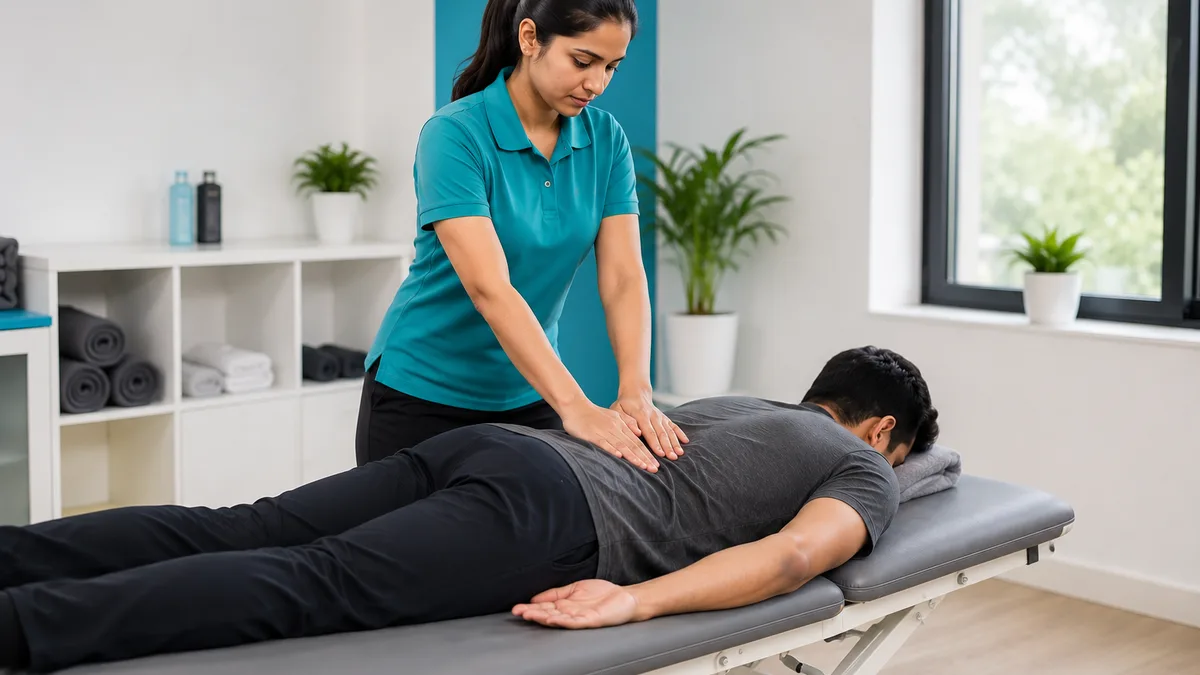
Hands-on slip disc treatment at Dynamics Mend, Sector 52 Noida, the pressure comes off the nerve without any operation
What a slip disc actually is, and why it can heal
The name is misleading, and the fear starts right there. Your disc does not slip out of place like a coin sliding out of a stack. It cannot, it is anchored to the bones above and below it.
Think of the disc as a jam doughnut sitting between two vertebrae. What actually happens in a "slip disc" is that the soft jam in the centre pushes against the outer dough wall, and sometimes bulges or leaks out enough to press on a nearby nerve. That nerve pressure is what fires pain, tingling or numbness down your leg. The back pain is bad, but it is usually the leg symptoms that scare people, and rightly bring them in.
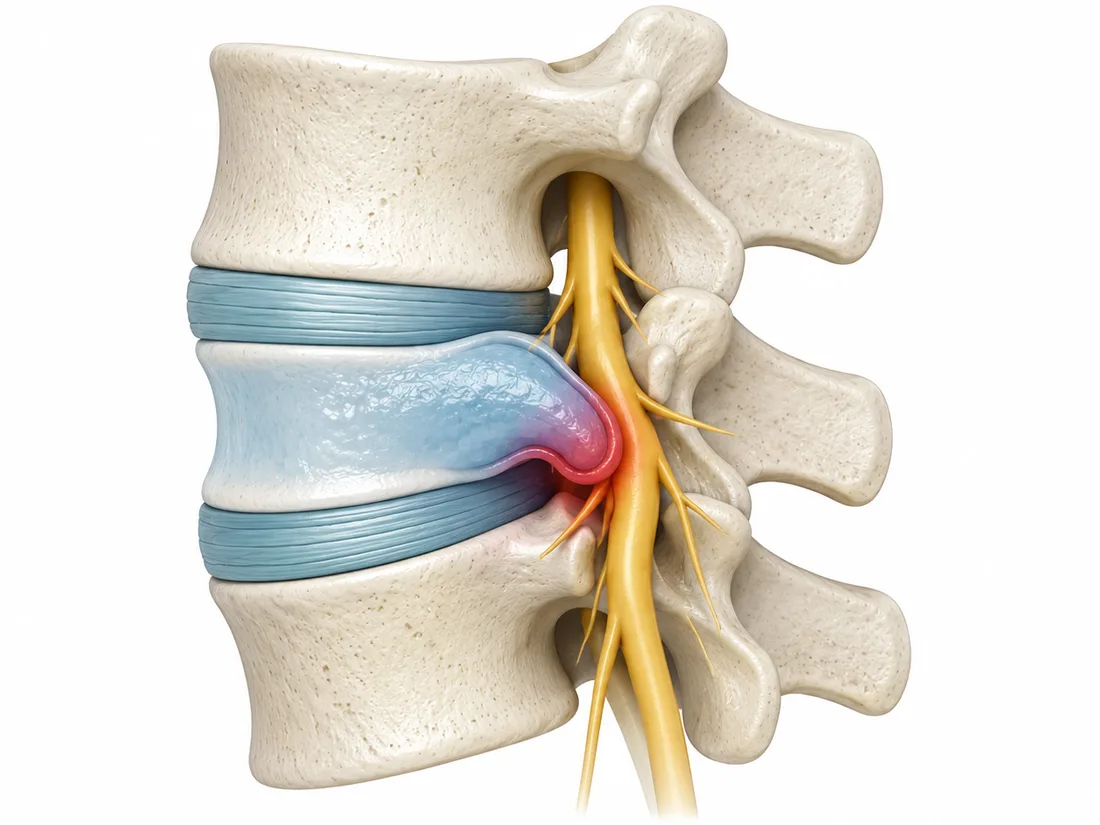
The bulged disc material presses the nerve, and over months the body treats it like debris and cleans most of it up
Now the part almost nobody tells you in the scan centre. The body treats that leaked disc material like any other debris it wants to clean up. It sends in cells to break it down and reabsorb it. A systematic review found that around 76.6 percent of herniated disc material was reabsorbed over time with conservative treatment. Read that again. The thing on your MRI that terrified you is, in most cases, something your own body is already dismantling.
Your job, with a physiotherapist's help, is to control the pain and protect the nerve while that natural process runs. That is the entire logic of non-surgical treatment, and it is why this is not wishful thinking, it is biology.
This is also an extremely common problem, especially here. A large analysis put the lifetime prevalence of low back pain in India at about 66 percent, and the long sitting hours of Noida's IT and office crowd do the disc no favours. If you want the deeper anatomy of how a disc progresses, our guide to the 4 stages of slip disc (PIVD) covers each stage in detail.
When surgery is genuinely needed
Being pro-physiotherapy does not mean being anti-surgery. There are situations where an operation is the right call, and you deserve the list plainly, because knowing it removes the fear from everything else.
Get an urgent surgical opinion if you have loss of bladder or bowel control, numbness in the inner thighs or private area, or muscle weakness that is getting worse, a foot that slaps the floor or drags when you walk. These signs suggest serious nerve compression, and delay costs function. No physiotherapist worth their degree will hold you back from a surgeon in these cases, and neither will we.
Outside of those red flags, surgery becomes a consideration, not an emergency, and usually only after severe pain has failed to respond to a proper 6 to 12 week course of conservative care. That is exactly the small 2 to 10 percent minority the research describes. Everyone else, which is very likely you, has earned the right to try the route that involves no anaesthesia, no scar and no lakhs-deep hospital bill.
And one more honest point. Even people who do have surgery need rehabilitation afterwards to rebuild strength. The muscle work is not optional in either path, so starting it now loses you nothing.
Why rest, painkillers and belts keep failing
By the time most slip disc patients reach us, they have already spent weeks on the standard menu. It is worth being honest about why each item disappoints.
Why bed rest backfires after two days
Old advice said lie flat until it passes. We now know discs rely on movement to stay nourished, they have almost no direct blood supply and feed through gentle motion, like a sponge being squeezed and released. Beyond the first day or two of a bad flare, rest starves the disc, stiffens the spine and wastes the very muscles that are supposed to protect it. The longer the bed rest, the weaker the comeback.
Why painkillers alone hit a ceiling
Painkillers dull the alarm, they do not touch the cause. The tablet has some value in the early angry phase, it lets you move and sleep, but no tablet decompresses a nerve or rebuilds a core. People who ride painkillers for months are usually in the same place when they stop, minus a few months.
Why belts and YouTube exercises disappoint
A lumbar belt is a crutch, useful for an hour of unavoidable travel, harmful as a lifestyle. Live in it and your own deep core muscles hand over their job and weaken. As for YouTube, the problem is direction. Most discs have a direction preference, movements one way calm the leg pain, the same movements the other way flare it. A video cannot know which way your disc prefers. That is why the same famous exercise heals one neighbour and floors the other.
How we treat a slip disc without surgery at Dymend
Slip disc is one of the most common conditions we treat at Dynamics Mend, and the process is systematic, not a random mix of machines and massage.
First, a proper assessment, because your MRI is not the whole story
Dr. Purti checks how you actually move, which positions bring the leg pain on and which ease it, how the nerve responds to specific tension tests, and what your sitting, driving and sleeping habits are doing to the disc. Two people with identical MRI reports can need opposite treatment plans. The assessment finds your disc's direction preference, which becomes the backbone of your exercise plan.
Then, the treatment stack that does the work
Hands-on manual therapy eases the stiff, guarded joints around the problem level and takes mechanical pressure off the irritated nerve. Nerve mobilisation, slow, precise movements, gets an angry nerve gliding freely through its tunnel again instead of catching with every step. Dry needling, which Dr. Purti is certified in, releases the deep muscle spasm that clamps around a painful spine, the guarding that keeps you locked forward like a question mark.
Then comes the part that makes the fix last, direction-specific exercise matched to your assessment, progressing into core and back strengthening so the disc carries less load with every week. And because most Noida disc patients sit for nine hours a day, we correct the desk, the car seat and the sleeping position too, otherwise the workday quietly undoes the clinic work. Our desk job back and neck pain guide shows the setup and the hourly routine we use.

Direction-specific exercise, then progressive core strengthening, the muscles take over the load so the disc can settle
And the home routine that does half the work
You get a short daily routine, ten to fifteen minutes, matched to your direction preference and updated as you improve. A disc that gets treated twice a week and loaded badly the other five days barely moves forward. Patients who do the daily routine consistently beat our average timelines, that is not motivation talk, it is just the pattern we see. If the acute pain makes travelling to Sector 52 impossible in the first week or two, home physiotherapy visits cover the gap until you can come in.
How long recovery takes without surgery
Honest numbers, phase by phase. The first one to two weeks are about calming the pain and finding your safe movements, most people feel the first real relief here, usually the leg pain starting to shrink back up the leg. That retreating pattern, ankle to calf to thigh, is called centralisation, and it is the single best sign that the plan is working.
Most patients feel a clear difference within the first few weeks. Research on conservative care shows meaningful improvement in pain and function typically lands within 6 to 12 weeks, and that matches what we see in the clinic. The strengthening phase continues after the pain leaves, because pain gone is not the same as problem solved, the muscles that let the disc get overloaded in the first place still need rebuilding.
Expect a small flare or two somewhere along the way, a bad chair, a long drive, an ambitious weekend. Flares are a normal part of disc recovery, not proof of failure, and knowing that in advance keeps the panic away. If your main symptom is the leg pain rather than the back itself, our sciatica pain relief guide goes deeper into that side of the story.
Worried your disc needs surgery?
Send us your MRI report and tell us where the pain goes. A free callback gives you an honest read on whether the surgery-free route fits your case, and where to start.
A real slip disc case from Noida
Illustrative example based on cases we commonly see at the clinic. Name and details changed.
Take Deepak. He is a 38-year-old IT project manager from Sector 76, nine to ten hours a day at a desk, and his trouble started as a stiff lower back he ignored for a month. Then one Monday, bending for his laptop bag, the pain shot down his right leg to the calf. The MRI two days later read L4-L5 disc herniation compressing the nerve root, and a surgeon told him, operate if it gets worse.
He came to us frightened in the specific way disc patients are frightened, not just of the pain, but of the word surgery sitting in his future. He could not sit through a single meeting, he was standing at the back of conference rooms, and putting on socks had become a planned event.
Dr. Purti's assessment found a strong direction preference, his leg pain eased with specific extension movements and flared with sitting and bending. No red flags, full muscle power, a nerve that was irritated but not damaged. In other words, a textbook candidate for the non-surgical route, whatever the report's scary vocabulary suggested.
The plan ran twice a week, manual therapy and nerve mobilisation, dry needling for the spasm that had his back muscles in a permanent clench, extension-based exercises matched to his preference, and a strict fifteen-minute home routine. His desk setup got rebuilt in one session, laptop raised, hips above knees, a timer to stand every 40 minutes.
By week three the calf pain had retreated to the thigh, centralisation doing exactly what it should. By week six he was sitting through full workdays with a standing break, and the leg pain was gone. By week ten he was back in the gym, deadlifting light with a form check from Dr. Purti, and discharged with a maintenance routine. That was four months ago. The surgeon's number is still in his phone, unused.
Dr. Purti Shukla, who leads every slip disc case at the clinic, holds a BPT and an MPT in Sports Physiotherapy and is certified in dry needling and cupping, the combination that stubborn, spasm-heavy backs tend to need.

Dr. Purti Shukla, BPT, MPT (Sports), certified in dry needling and cupping, leads every slip disc case at Dynamics Mend, Sector 52 Noida
Honest pricing, in writing
Real numbers, no surprises, and worth setting against the lakhs a spine surgery costs. Your first 30-minute teleconsultation is free, so you get an honest read on your MRI and your options before paying anything.
| Service | Fee |
|---|---|
| First teleconsultation (30 min) | Free |
| In-clinic slip disc session assessment + manual therapy + guided exercise | ₹500 to ₹800 |
| Dry needling / cupping (where the case needs it) included in the session plan | No separate charge |
| Home visit for acute disc pain if travelling is difficult | ₹800 to ₹1,200 |
| Typical slip disc journey A block of sessions set after assessment, tapering as you improve | Honest quote after assessment |
No package pressure, no hidden cost. We tell you a realistic number of sessions after the first assessment, not before. See the full pricing page for all services, our slip disc treatment in Noida page for how sessions work, and our physiotherapy at home in Noida page if travel is the problem, and the back pain physiotherapy in Noida page if the pain is mostly in the back rather than the leg.
Want a free callback about your disc?
Tell us where the pain goes and what your MRI says. Dr. Purti will call back with an honest read on your options. No pressure, no fixed package.
Frequently asked questions about slip disc treatment without surgery
Can a slip disc heal without surgery?+
Yes, and this is the norm, not the exception. Research shows roughly 60 to 90 percent of disc herniation patients recover with conservative care like physiotherapy, and the herniated material itself often shrinks, a systematic review found around 76.6 percent of it gets reabsorbed by the body over time. Physiotherapy controls the pain and protects the nerve while that natural process happens. At Dynamics Mend in Sector 52 Noida, surgery-free recovery is the standard path we plan for, and most patients complete it.
How long does slip disc recovery take with physiotherapy?+
Most patients at Dynamics Mend notice a real change within the first few weeks, usually the leg pain retreating first. Solid, dependable improvement in pain and function typically lands within 6 to 12 weeks of starting structured care, which matches what the research shows for conservative treatment. A back that is strong enough to trust again takes a few more weeks of strength work after that. Dr. Purti gives you an honest timeline after the first assessment, not a guess.
Is walking good for a slip disc?+
For most people, yes, walking is one of the best things you can do. Discs have poor blood supply and rely on movement to stay nourished, so gentle, regular walking usually helps recovery rather than hurting it. The exception is the very acute phase where even standing is difficult, there we build up to it. What we do not recommend is pushing through sharp, worsening leg pain, that is your cue to get assessed rather than walk harder.
Which exercises should I avoid with a slip disc?+
Early on, avoid loaded forward bending, toe touches, heavy deadlifts and sit-ups, and any exercise that makes pain travel further down your leg. But the honest answer is that the safe list is personal. Most discs have a direction preference, movements in one direction calm the nerve while the opposite direction flares it, and that preference differs from person to person. This is exactly why exercises copied from YouTube help some people and set others back by weeks.
When is surgery actually necessary for a slip disc?+
In a small minority of cases, roughly 2 to 10 percent in the research. The clear red flags are loss of bladder or bowel control, numbness in the inner thighs or private area, and progressive muscle weakness like a foot that slaps or drags. Those need urgent surgical review, no debate. Outside of those, surgery is usually considered only when severe pain has not responded to a proper 6 to 12 week course of conservative care, and even then it is a choice, not an emergency.
My MRI says disc bulge. Is that the same as a slip disc?+
Not quite, and this matters more than people realise. A bulge is the disc pushing out slightly and evenly, a herniation is the inner material pushing through the outer wall. Here is the part nobody tells you, disc bulges show up on MRI scans of huge numbers of people who have zero pain. A scary looking report does not automatically mean the disc is the cause of your pain, and it definitely does not mean surgery. We treat what the assessment finds, not what the report says alone.
What is the cost of slip disc physiotherapy in Noida?+
At Dynamics Mend in Sector 52 Noida, an in-clinic session costs ₹500 to ₹800, and your first 30-minute teleconsultation is free, so you get an honest read on your case before paying anything. Where the case needs it, dry needling and cupping are included in the session plan, not billed as extras. If the acute pain makes travelling impossible, home visits are ₹800 to ₹1,200. Compare that to the lakhs a spine surgery costs and the maths speaks for itself.
Can a slip disc come back after recovery?+
It can, which is why the last phase of our treatment exists. Recurrence usually happens when someone stops at pain relief, the disc has calmed down but the core and back muscles that protect it were never rebuilt, and the sitting habits that loaded the disc never changed. Patients who finish the strengthening phase and keep a short maintenance routine have a much better long-term record. We would rather see you once a year for a check than every year with a flare-up.
Ready to skip the operation theatre?
Come in, get the back properly assessed, and hear exactly what your surgery-free recovery looks like, honest timeline included. For most discs, the smart route runs through patient, structured physiotherapy, not the knife.
Open: 10 AM to 9:30 PM, Friday closed · E-132, E-Block, Sector 52, Noida 201301