

The short answer first
PIVD physiotherapy exercises work, but only when they are matched to the stage your disc is in. The acute stage needs unloading positions and short walks. The mobility stage needs direction-specific movement, often McKenzie-style extension work. The strengthening stage needs progressively harder core and hip training. The return stage needs loaded, real-life movement, lifting, bending, sport. Do them in that order and most people are back to normal life in 8 to 12 weeks without surgery.
Do them out of order and you get the classic PIVD story: someone Googles "slip disc exercises", finds a core workout, does it in week one, and spends the next month wondering why the leg pain got worse.
There is good reason for optimism here. The disc itself can heal: a systematic review of imaging studies found that a large proportion of lumbar disc herniations spontaneously regress over time, and counterintuitively, the biggest herniations regress most often. Your job during those months is not to shrink the disc by force. It is to keep the nerve calm, rebuild the support system around the spine, and be strong and confident by the time the disc has done its part.

Stage-wise PIVD exercise progression at Dynamics Mend, Sector 52 Noida, the stage decides the exercise, not the other way around
3 rules before you start any exercise
Rule 1: navigate by the leg, not the back
In PIVD, pain location is your compass. If an exercise makes pain move out of the leg and towards the centre of the back, that is centralisation, and it means the movement suits your disc, even if the back itself feels worked. If pain runs further down the leg, that movement is wrong for you this week. This single rule filters every exercise on the internet better than any list can.
Rule 2: stages are passed, not waited out
You do not graduate from a stage because two weeks passed. You graduate because you meet criteria, leg pain centralised, walking tolerance back, strength targets hit. Some people pass stage 1 in four days, some need three weeks. Both recover fully. The calendar is a rough guide, the criteria are the actual gate.
Rule 3: an assessment comes first
The same disc bulge behaves differently in different people, and a small share of cases genuinely should not follow a standard exercise route at all. One assessment tells us your direction of preference, your nerve irritability and your starting stage, after that, exercising at home is safe and encouraged. Guessing your own stage from a blog, even this one, is where most self-treatment goes wrong. Fair warning given.
Stage 1: calm the acute pain (week 1 to 2)
The disc has just herniated, the nerve is inflamed and everything around it is in spasm. The goal here is simple: reduce nerve irritation and keep gentle movement alive. Nothing in this stage looks like a workout, and that is the point.
- Prone lying, lie flat on your stomach 5 to 10 minutes, several times a day, letting the back settle into gentle extension
- Prone on elbows, if flat lying is comfortable, prop onto forearms for 30 to 60 seconds at a time, only if the leg pain does not increase
- Short frequent walks, 5 to 10 minutes on flat ground, three to five times a day, this beats one long walk in this stage
- Ankle pumps and knee slides in bed, to keep the nerve gliding and the leg circulation moving
- Positional relief, lying on your back with calves resting on a chair when the pain flares badly
Avoid in this stage: toe touches, sit-ups, any twisting exercise, lifting anything heavier than a kettle, long sitting on soft sofas, and complete bed rest beyond the first day or two. Bed rest feels protective, but a disc under total rest gets stiffer, weaker neighbours and a more sensitised nerve, the full explanation is in our slip disc treatment without surgery guide.
You pass stage 1 when: the leg pain has begun to centralise, you can sit 20 to 30 minutes, and you can walk 15 to 20 minutes without the leg protesting.
Stage 2: restore movement (week 2 to 5)
The fire is smaller now. Stage 2 restores the spine's tolerance for its own movements, and this is where direction-specific work earns its keep. For most PIVD patients that direction is extension, the McKenzie approach, whose effectiveness for chronic low back pain is supported in systematic reviews, and which Dr. Purti is formally trained in.
- McKenzie press-ups, from prone, push the chest up while hips stay on the floor, 10 repetitions, several sessions a day, only while pain keeps centralising
- Standing back extensions, hands on hips, gentle lean back, your desk-hours counterweight (part of our 2-minute desk routine)
- Cat-camel, slow, comfortable-range spinal mobility on all fours
- Glute bridges, wake up the hip muscles that should be sharing the spine's load
- Bird-dog, early version, opposite arm and leg, slow and controlled, no sagging back
- Walking progression, building towards 30 to 40 continuous minutes
Avoid in this stage: loaded forward bending, gym classes, running, and long unbroken sitting. Sitting is not banned, but it is dosed, get up every 30 to 40 minutes.
You pass stage 2 when: leg symptoms are largely gone or fully centralised, daily movements no longer need thought, and single positions no longer set you off.
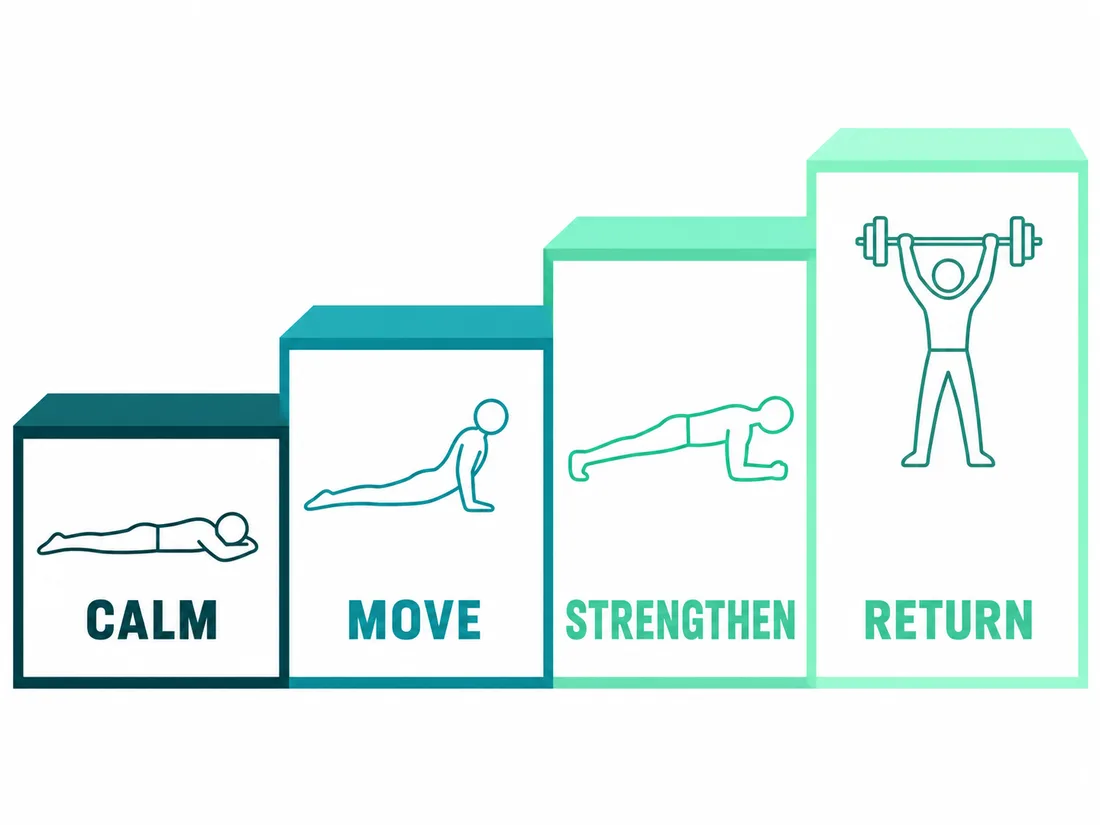
The four-stage exercise ladder, each stage earns the next, and skipping a rung is how relapses happen
Stage 3: build real strength (week 4 to 10)
This is the longest stage, the least dramatic, and the one that decides whether your PIVD is a one-time story or an annual event. Pain is mostly gone by now, which is exactly why most people quit here. Do not. A pain-free back with a weak core is a relapse on a timer.
- Dead bugs, core control without spine bending, the safest serious core exercise after PIVD
- Bird-dog, full version, longer holds, slow tempo, perfect control
- Side planks, from knees first, building to full, the obliques and deep stabilisers in one move
- Front planks, once side planks are solid
- Hip hinge training, learning to bend from the hips with a neutral spine, first bodyweight, then with a light kettlebell
- Squat pattern, box squats to a chair, building depth and load gradually
- Suitcase carries, walking with a weight in one hand, real-world core strength
Progression is the entire point of this stage. The plank that challenged you in week five should feel easy by week eight, and the load should have grown to match. This is also where sessions at the clinic space out, you train more at home and we progress, correct and test.
You pass stage 3 when: you hold planks and side planks comfortably, hip hinge with load and perfect form, and get through full work days plus home exercise with no symptom flare.
Stage 4: return to full function (week 8 to 12 and beyond)
Stage 4 answers the question every PIVD patient eventually asks: can I live normally again, lift my child, deadlift, play cricket, take the long car trip? Yes, and this stage is where we prove it, movement by movement.
- Deadlift and squat re-training, light bar, rebuilt technique, progressed like a beginner even if you were not one
- Loaded carries and lifting drills, floor-to-shelf lifts that mirror actual life
- Impact reintroduction, brisk walking to jogging to running, one step at a time
- Sport-specific movement, twisting, reaching and swinging drills for cricket, badminton and golf players
- A maintenance habit, 2 to 3 short strength sessions a week, permanently
Two honest notes. First, on surgery worry: a randomised trial comparing early surgery with prolonged conservative care for sciatica found no difference in outcomes at five years, surgery mainly buys early speed, not a better destination, so patience with this staged route is evidence-backed, not wishful. Second, on maintenance: the strength you build in stages 3 and 4 is your insurance policy, and it only pays out while the premiums, those two or three weekly sessions, keep getting paid.
Mistakes and red flags
The five mistakes we undo most often at the clinic: starting core strengthening in the acute week, stopping all exercise the day pain disappears, treating one YouTube routine as a full plan, testing the back every few days with a toe touch to see if it still hurts, and pushing through increasing leg pain because "no pain no gain". That last one deserves repeating, in PIVD, increasing leg pain is never the price of progress, it is the signal to change the exercise.
Stop exercising and get assessed urgently if: you develop increasing weakness in the leg or foot, a foot that slaps or drags when walking, numbness in the inner thighs or around the sitting area, or any change in bladder or bowel control. These are rare, but they are the situations where a surgical opinion genuinely matters, and we will tell you plainly if your case is one of them.

McKenzie press-ups under guidance, direction-specific movement is stage 2's core tool, and the direction comes from assessment, not habit
A real case from Noida
Take Deepak, a 38-year-old sales manager from Sector 51 who spends half his week driving between Noida and Gurgaon. Bending for a suitcase one morning, his back seized, and by evening a familiar line of pain ran down his left leg. An MRI confirmed an L4-L5 disc herniation. He did the standard circuit: two weeks of bed rest, a lumbar belt, painkillers, and a WhatsApp forward of "10 exercises for slip disc", which he attempted in week two. The crunches and toe touches in that list took his leg pain from the knee down to the ankle.
By the time he reached Dynamics Mend six weeks in, he was worse than week one and convinced surgery was inevitable. Assessment told a different story: his pain centralised beautifully with extension, his nerve signs were irritable but intact, and his deep core and glutes had been switched off well before the injury, years of driving will do that.
His plan ran exactly the stages above. One week of unloading positions and short walks turned the ankle pain back into knee pain, then thigh, then back. Three weeks of McKenzie work and bridges cleared the leg entirely. Then the long, boring middle: eight weeks of dead bugs, side planks, hinge training and carries, twice weekly at the clinic tapering to once, with dry needling in the early sessions for the spasm that guarded his spine.
Week eleven, he deadlifted a light bar with a rebuilt hinge. Week twelve, he drove to Jaipur and back, his personal fitness test, with no flare. That was this February. He still does his three weekly maintenance sessions, and his MRI, which he keeps on his phone, no longer gets shown to anyone, which for Deepak is the truest sign of recovery.
Dr. Purti Shukla, who designed and supervised every stage of that plan, holds a BPT and MPT (Sports Physiotherapy), is trained in the McKenzie Method and Mulligan Concept, and is certified in dry needling and cupping, the exact toolkit stubborn PIVD cases need.

Dr. Purti Shukla, BPT, MPT (Sports), McKenzie-trained, leads every PIVD case at Dynamics Mend, Sector 52 Noida
Honest pricing, in writing
Real numbers, no surprises. Your first 30-minute teleconsultation is free, describe your MRI findings and symptoms, and get an honest read on your stage before paying anything.
| Service | Fee |
|---|---|
| First teleconsultation (30 min) | Free |
| In-clinic PIVD session assessment + manual therapy + staged exercise plan | ₹500 to ₹800 |
| Dry needling / cupping (where the case needs it) included in the session plan | No separate charge |
| Home physiotherapy visit for the acute weeks when travel is hard | ₹800 to ₹1,200 |
| Typical PIVD journey 8 to 12 weeks, sessions taper as you progress | Honest quote after assessment |
No hidden costs, and home exercises are most of the plan, you are never paying for sessions you could do yourself. See the full pricing page, our slip disc (PIVD) physiotherapy treatment page, and our home physiotherapy page for the acute weeks.
Want a free callback about your PIVD?
Tell us your symptoms and what your MRI says, if you have one. Dr. Purti will call back with an honest read on your stage and which exercises are safe for you right now. No pressure, no fixed package.
Frequently asked questions about PIVD exercises
Which exercises are safe in the acute stage of PIVD?+
In the first one to two weeks, the safe list is short and gentle: prone lying (lying on your stomach), prone-on-elbows if it eases the leg pain, short frequent walks on flat ground, and ankle pumps in bed. That is roughly it. Anything involving toe-touching, sit-ups, twisting or lifting is off the table for now. The acute stage is about calming the disc and the nerve, not building strength, and starting the wrong exercise here is the most common way people turn a 6-week recovery into a 6-month one.
Can exercises actually shrink or heal a slipped disc?+
The disc material itself can genuinely regress. A systematic review found that a large share of lumbar disc herniations reduce in size on their own over months, and the biggest, most dramatic-looking herniations regress most often. What exercise does is create the best conditions for that: it keeps the nerve mobile, builds the muscle support that takes load off the disc, and restores your confidence to move. So the honest answer is the body shrinks the disc, and the right exercises make sure you are strong and moving well while it happens.
My leg pain increases with some exercises. Should I stop completely?+
Stop that exercise, not the programme. In PIVD we navigate by one compass: where the pain sits. If an exercise makes pain move out of the leg and towards the back, even if the back feels a bit more sore, it is usually the right direction, this is called centralisation. If pain travels further down the leg, that exercise is wrong for your disc right now, whatever YouTube says about it. This is exactly why stage-wise exercises need an assessment first, the same exercise can be medicine for one person and fuel for another.
Is walking good for PIVD?+
For most people, yes, walking is one of the best things you can do in almost every stage, it gently pumps nutrition into the disc and keeps the nerve gliding. The trick is dose. In the acute stage that means short walks of 5 to 10 minutes, several times a day, on flat ground, not one heroic 5 km loop. If walking increases leg pain rather than easing it, the pattern needs assessment before you push through. And walking alone is not a rehab plan, it maintains you, it does not strengthen you.
How long does each stage last?+
Rough ranges from the clinic: stage 1 runs 1 to 2 weeks, stage 2 around 2 to 4 weeks, stage 3 is the longest at 4 to 8 weeks, and stage 4 runs 2 to 4 weeks and then quietly becomes your normal training. But you move stages by passing criteria, not by watching the calendar. Someone whose leg pain centralises in four days moves faster, someone with a large herniation and severe nerve irritation moves slower, and both are fine. Total journey for most people at Dynamics Mend: 8 to 12 weeks of structured work.
Can I go to the gym with a slipped disc?+
Not in the acute stage, and then yes, progressively, with the loaded spine work modified. By stage 3 most of our patients are back in the gym doing modified training, and returning to deadlifts and squats with rebuilt technique is literally what stage 4 is for. What you should not do is go back on your own at week three because the pain stopped. Pain settles long before the disc and your deep core are ready for load, and that gap is where relapses happen.
Which exercises should I avoid completely with PIVD?+
In the early stages: loaded forward bending (toe touches, good mornings), sit-ups and crunches, Russian twists, heavy squats and deadlifts, and long sitting in soft sofas. As you progress, most of these stop being forbidden and start being goals, a deadlift with a rebuilt hip hinge is one of the best long-term protections a back can have. The honest rule: no exercise is permanently banned after PIVD, but every exercise has a wrong week to attempt it.
What if exercises do not work? Does that mean surgery?+
Usually not. A landmark randomised trial comparing early surgery with prolonged conservative care for sciatica found the outcomes were essentially the same at five years, surgery mainly bought speed of relief, not a better final result. Surgery becomes genuinely necessary in a small minority: progressive muscle weakness like a foot drop, loss of bladder or bowel control, or unbearable pain that fails weeks of proper care. If exercises are not working after 4 to 6 honest weeks, the right step is a re-assessment of the plan, not a surgical date.
Ready to exercise for your stage, not against it?
Come in, get your stage assessed honestly, and leave with the exact exercise list that is safe for you this week, and the plan for every week after it.
Open: 10 AM to 9:30 PM, Friday closed · E-132, E-Block, Sector 52, Noida 201301