

The short answer
After a hip fracture, most elderly people are helped out of bed the day after surgery, walk short distances with a walker in the first week or two, move towards a stick between week 6 and 12, and keep improving for up to a year. The first 12 weeks decide the most. Research shows only about 40 to 60 percent of older people get back to the walking level they had before the fracture, and regular physiotherapy in those early weeks is the part the family can actually control. At Dynamics Mend we run this recovery at homes across Noida, ₹800 to ₹1,200 per session.
That is the summary. Here is what it looks like in real life.
A hip fracture in an older person is not just a broken bone. It is a sudden loss of independence. Someone who was walking to the park last week now needs help to reach the toilet. They are in pain, often scared, sometimes confused, and very aware of being a burden. And the family is scrambling, arranging attendants, rearranging the house, taking leave, making calls from office.
The good news is that with the right plan, most of that independence can come back. The operation fixes the bone. What happens in the following weeks at home decides how much of your parent comes back with it.
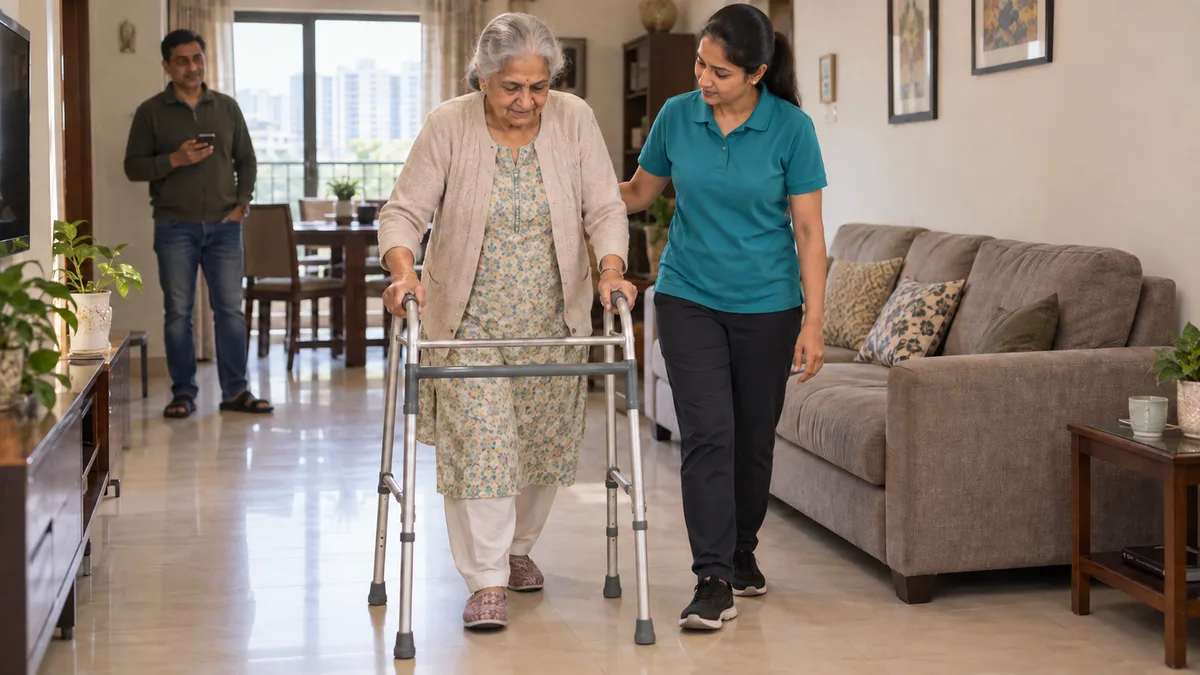
Most of the recovery after a hip fracture happens at home, short guided walks, many times a day, with the walker
After a fall: first check if anything is broken
Not every fall ends in a fracture, and not every fracture is obvious. Before thinking about rehab, make sure the right checks are done.
Go to the doctor or hospital the same day if your parent: cannot stand or put weight on one leg, has hip or groin pain that is worse on moving, has one leg that looks shorter or turned outwards, hit their head, especially if they take blood thinners, or seems drowsy, vomits or is more confused than usual. Some hip fractures do not show clearly on the first X-ray, so if pain stays severe and walking stays impossible, ask the doctor about further imaging.
If the X-ray is clear and they can walk, it is still worth asking why the fall happened. Common reasons we find in Noida homes: weak thigh and hip muscles, poor balance, a new blood pressure or sleeping tablet, getting up quickly at night, low light on the way to the bathroom, a wet bathroom floor, loose slippers. A fall is often the first warning. The second fall is the one that breaks the hip.
Because of that, even a fall without a fracture deserves a proper strength and balance check. A large Cochrane review of 108 trials found that exercise programmes targeting balance and strength reduce the rate of falls in older people living at home by about 23 percent. That is one of the strongest findings in all of elderly care.
Week-by-week: what recovery at home actually looks like
Every case is different. The type of surgery, your parent's age, their walking before the fall, and conditions like diabetes, heart disease or memory problems all change the pace. The surgeon's instructions always come first. But after many elderly recoveries across Noida, this is the honest shape of a typical journey after hip fracture surgery.
In hospital, days 1 to 5: out of bed early
Most hip fractures are operated within a day or two. The NICE hip fracture guideline, which many hospitals follow, recommends a physiotherapy assessment and getting out of bed on the day after surgery, then moving at least once every day. It sounds too early to many families. It is not. Every extra day in bed costs an older person muscle, balance, lung function and confidence, and raises the risk of clots, chest infections and bed sores.
Before discharge, get these answers in writing: how much weight your parent can put on the leg, whether there are hip precautions (movements to avoid, like bending the hip too far or crossing the legs), stitch or staple removal date, blood thinner duration, and the follow-up date.
Week 1 to 2 at home: safe transfers and short walks
The first two weeks at home are about safety and routine. The goals are getting in and out of bed safely, reaching the toilet with the walker, sitting out of bed for meals, and walking short distances indoors several times a day. Exercises are simple: ankle pumps for circulation, tightening the thigh and buttock muscles, gentle knee and hip movements in bed, deep breathing.
The biggest mistake here is kindness. "Aap aaram karo, main le aati hoon." Every cup of water fetched for them is one less walk they took. Let them do what is safe, with someone close by.
Week 3 to 6: strength and confidence
Now the building starts. Walks get longer, from the bedroom to the balcony, then around the house. The key exercise is sit-to-stand from a chair, because standing up is where older legs fail first. Standing exercises with support are added, side steps, heel raises, marching in place holding the kitchen counter. If the home has stairs, stair practice starts with the physiotherapist.
This is also the phase where things quietly stall. The wound has healed, the pain is less, the attendant is doing everything, and progress flattens. A physiotherapist's job here is to keep pushing the level up, safely, week after week.
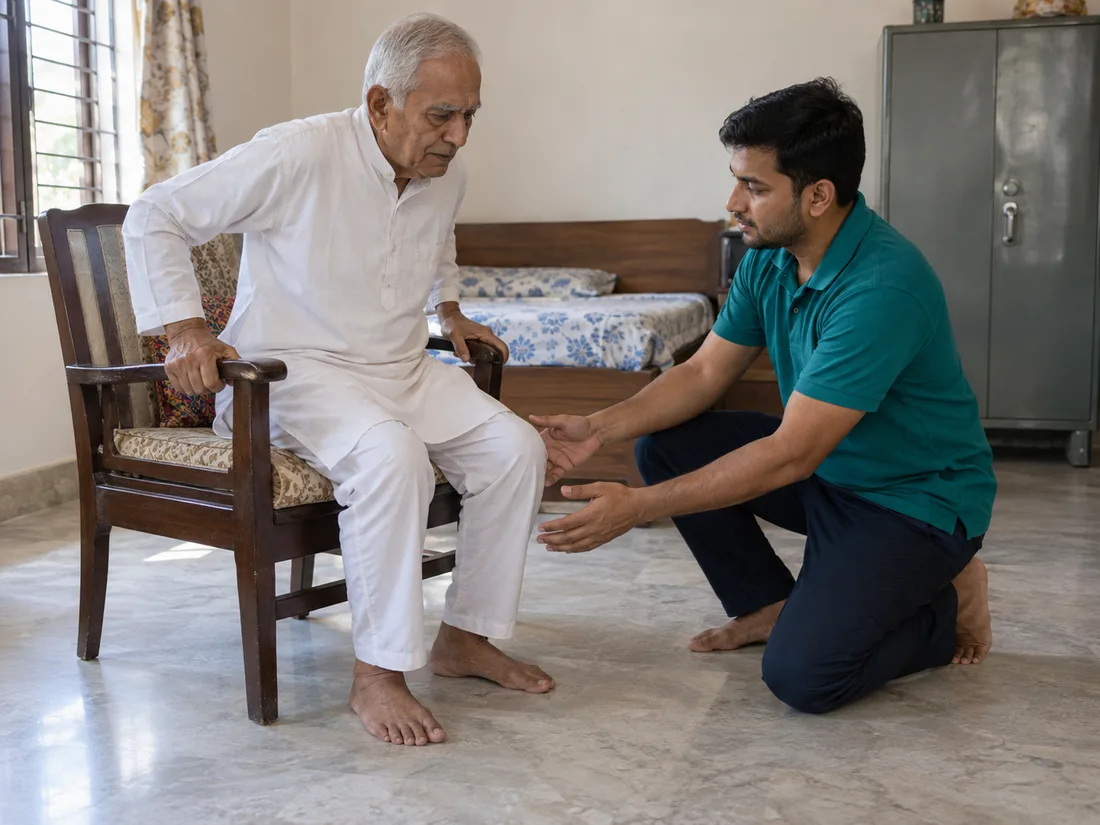
Sit-to-stand from a firm chair is the single most useful exercise after a hip fracture, it is how independence is measured at home
Week 7 to 12: from walker to stick, and balance work
Many patients move from the walker to a stick somewhere in this phase, only when their balance is ready for it, not on a fixed date. Balance training becomes the main focus: standing with feet closer together, turning safely, stepping over small obstacles, walking on different floors. Short walks outside the house begin, with company. Getting up from a fall is practised too, so your parent knows what to do if it ever happens again.
By week 12, a realistic goal for many of our patients is walking indoors independently with a stick, managing the toilet and bathing with minimal help, and short outdoor walks with someone beside them.
Month 3 to 6: getting life back
Research shows that most recovery of walking and daily activities after a hip fracture happens within the first 6 months. This phase is about the things that make life feel normal again: the morning walk, visiting the temple or the neighbours, sitting in the park, attending a family function. Sessions usually become less frequent, and a daily home routine carries the work. Strength and balance work should continue long-term, because the goal now is making sure there is no second fracture.
Get the home ready before discharge
If you do only one thing from this article before your parent comes home, do this. A few changes make the difference between a safe first week and a second fall.
The bed: firm mattress, bed height roughly at knee level so the feet touch the floor when sitting. Very low beds and soft, sinking mattresses make getting up very hard. Keep the bed near the bathroom if possible.
The path: clear the route from bed to bathroom. Remove loose rugs, floor wires and small stools. Put a night light or a motion-sensor light on the way, because most falls at home happen on the way to the toilet at night.
The bathroom: anti-slip mat, grab bars near the toilet and in the bathing area, a raised toilet seat or commode chair if the toilet is low, and a stable bathing chair. Indian-style toilets are not safe in the early weeks.
The chair: a firm chair with armrests, not a low sofa. Armrests give something to push from while standing up.
Footwear and clothing: closed-back slippers with grip, not loose chappals. Loose, easy clothes, and nothing long enough to trip over.
Equipment: a walker adjusted to the right height (the handles at wrist level when arms hang down), and a commode chair for nights if needed. Your physiotherapist can check the height and setup on the first visit.
What is normal, and what needs a doctor today
Recovery after a hip fracture brings a lot of new symptoms, and families often cannot tell which ones matter. Plainly:
Usually normal in the first weeks: pain on moving that is getting a little better each week, swelling and bruising around the hip and thigh (the bruise can travel down towards the knee), tiredness after walking, poor sleep, low appetite for a few days, and mild low mood. Keep the physiotherapist and doctor informed, but these usually settle.
Call the doctor the same day: sudden confusion or unusual drowsiness, pain, swelling or redness in the calf, breathlessness or chest pain, fever, a wound that is red, hot or leaking, a new sharp pain in the hip or a leg that suddenly looks shorter or turned, not passing urine, or no bowel movement for several days. Sudden confusion after surgery is called delirium, it is common in older people and very treatable, but it always needs a doctor to find the cause.
Slow warning signs to watch: red or dark patches on the heels, back or buttocks (early bed sores), eating and drinking very little, refusing to get out of bed for several days, or walking that is getting worse instead of better. These need action this week, not next month.
Fear of falling is the hidden second injury
This one is rarely written on a discharge summary, and it stops more recoveries than pain does.
After a fall, many older people become quietly afraid. They say the leg is fine but they do not want to walk today. They stay in bed or on the sofa. They hold on to every wall. They stop going to the bathroom alone and start drinking less water so they do not have to. The family thinks it is laziness or stubbornness. It is fear.
And fear feeds itself. Less walking means weaker legs and worse balance, which makes the next fall more likely, which makes the fear worse. We see it constantly, a hip that has healed well, and a person who has not.
What helps: small, successful steps practised often, with someone they trust close by. Practising the exact thing they are afraid of, getting up from the bed at night, walking to the bathroom, turning around in a small space, until it feels ordinary again. Learning how to get up from the floor, so a fall stops feeling like a catastrophe. And a lot of honest encouragement, not pressure. This is where a regular physiotherapist who your parent gets to know makes a real difference.
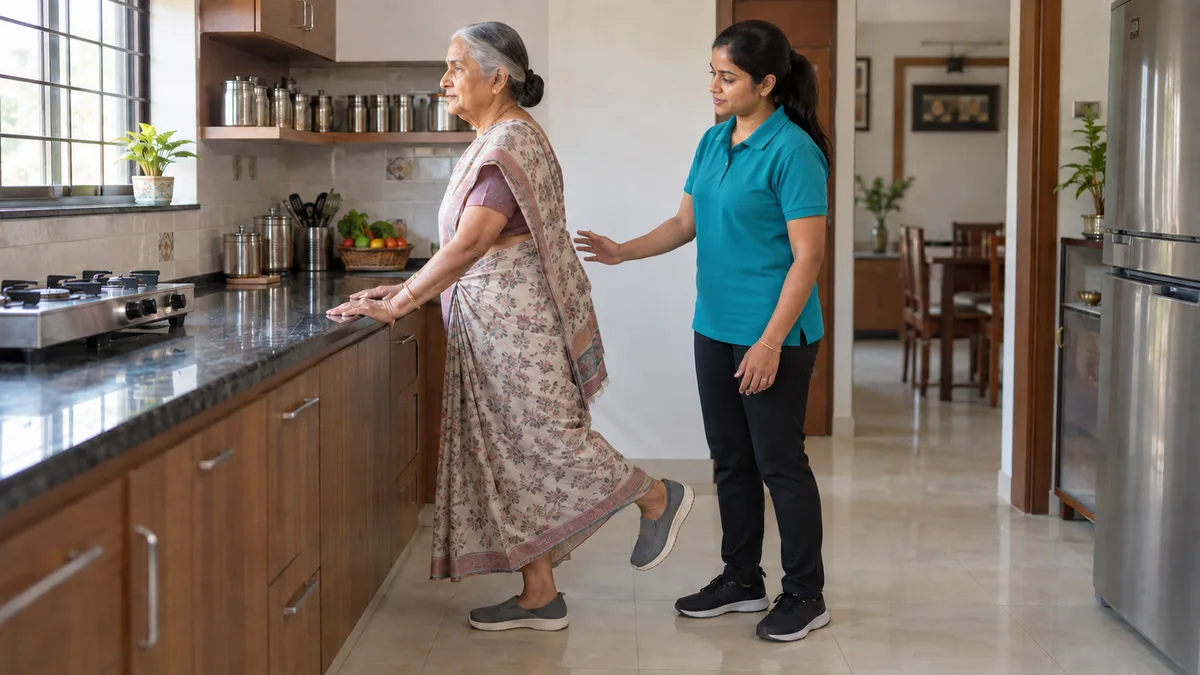
Balance training at a steady kitchen counter, the same work that lowers the risk of the next fall
If you are managing this from another city
Many of the families who call us have a parent in Noida and a son or daughter in Bengaluru, Pune, Dubai or London. You cannot be there for every session, so you need a way to know the recovery is actually moving. Here is what we suggest.
Ask for measurable goals, not "improving". For example: walking from the bedroom to the living room without stopping, standing up from a chair without pushing on the armrests, number of sit-to-stands in 30 seconds, walking with a stick instead of a walker. These numbers tell you more than any general update.
Ask these questions after the first assessment: What is the realistic goal in 4 weeks and in 12 weeks? How many sessions per week, and for how long? What should my parent practise between sessions, and who at home should help? What would make you worried?
Keep the same physiotherapist. Older people trust faces, not agencies. A different therapist every few days means repeating the same basic exercises forever. At Dynamics Mend the same physiotherapist follows your parent through the course.
Use the attendant well. If there is a caregiver or attendant at home, ask the physiotherapist to teach them the daily routine and the safe way to help with transfers. The attendant is with your parent for hours, the physiotherapist for one. That hour works best when the other hours support it.
Our free 30-minute teleconsultation is a good starting point if you are far away. You can explain the situation, share the discharge papers, and get an honest read on what the recovery should look like before the first visit.
Home physiotherapy for the elderly in Noida
For most elderly patients after a hip fracture, home physiotherapy is the sensible choice for the first weeks, and sometimes for the whole recovery. A car ride and a clinic staircase are hard work with a healing hip, and the real goals, the bed, the toilet, the bathroom, the stairs at home, are best trained where they actually happen.
Our physiotherapists visit homes across Noida, with the fastest response in the sectors near our Sector 52 clinic, including Sectors 50, 51, 53, 55, 56, 58, 59, 60, 61, 62, 71 and 72. A home session runs about 60 minutes and costs ₹800 to ₹1,200, with no separate travel charge. The physiotherapist brings the portable equipment needed, checks the home setup on the first visit, and gives a written plan. The complete details, conditions covered and sector-wise information are on our physiotherapy at home in Noida page.
If your parent had a hip replacement rather than a fracture fixation, the recovery is similar in many ways, and our post-surgical rehabilitation page explains how we plan it. For stroke or other neurological problems causing falls, see stroke and paralysis physiotherapy at home.
A recovery from Noida
Take Kamla ji. She is 78, lives in Sector 51 with a full-time attendant, and her son works in Bengaluru. In June she slipped in the bathroom at night and broke her left hip. The surgery at a Noida hospital went well, and she was discharged on day five with a walker and a sheet of exercises.
Ten days later her son called us. His mother was barely leaving the bed, had stopped eating properly, and told him on every call that she would never walk again. The attendant was helping with everything, including the few steps she could have taken herself.
At the first home visit our physiotherapist found a well-healed wound, a weak but workable leg, and a very frightened woman. We started with what mattered to her: walking to the bathroom by herself. Short walks with the walker, many times a day. Sit-to-stands from a proper chair instead of the low sofa. We rearranged the bedroom, added a night light and grab bar, and taught the attendant when to help and when to simply stand close.
By week 4 she was walking to the bathroom alone with the walker, and sleeping through the night. By week 10 she was walking inside the house with a stick and sitting on the balcony every evening. At around four months she walked down to the society garden with her attendant beside her, and her son, visiting that weekend, filmed it for the family group. She still does her balance routine every morning, because the plan now is making sure there is never a second fall.
Dr. Purti Shukla, who plans and reviews every elderly rehab case at Dynamics Mend, holds a BPT and an MPT in Sports Physiotherapy, and has guided many older patients in Noida through recovery after fractures, joint replacements and falls, at the clinic and at home.

Dr. Purti Shukla, BPT, MPT (Sports), plans and reviews elderly rehab cases at Dynamics Mend, Sector 52 Noida
Home visit charges, in writing
Families deserve clear numbers when they are already dealing with hospital bills. Here is what home physiotherapy costs with us.
| Service | Fee |
|---|---|
| First teleconsultation (30 min) good starting point if you are in another city | Free |
| Home physiotherapy session in Noida about 60 minutes, portable equipment, no travel charge | ₹800 to ₹1,200 |
| Home safety check done during the first home visit | Included |
| Full recovery programme frequent early sessions, tapering as walking improves | Quoted after first assessment |
We do not sell a fixed package before seeing your parent. After the first assessment you get a realistic session plan and a written estimate. See our home physiotherapy page for sector-wise details and the pricing page for clinic fees.
Parent had a fall or hip fracture? Get a free callback.
Tell us your parent's age, the surgery date if any, and how they are moving now. We will call back and tell you honestly what the recovery should look like.
Frequently asked questions about hip fracture recovery at home
How long does it take an elderly person to recover from a hip fracture?+
Most of the recovery in walking and daily activities happens in the first 6 months, with the biggest gains in the first 12 weeks. Many older people walk short distances indoors with a walker within the first week or two after surgery, move to a stick somewhere between week 6 and 12, and keep improving slowly for up to a year. Research shows only about 40 to 60 percent get back to their pre-fracture walking level, and structured rehab in those early months is the biggest factor you can influence.
When should physiotherapy start after hip fracture surgery?+
In hospital, the day after surgery if the doctors allow it. The NICE hip fracture guideline recommends a physiotherapy assessment and getting out of bed on the day after surgery, then mobilising at least once a day. The risky gap is after discharge, when families wait for stitches or a follow-up visit before starting. Home physiotherapy should ideally begin within a few days of reaching home.
Can my parent put weight on the leg after hip fracture surgery?+
Most modern hip fracture operations, like a hemiarthroplasty or a nail, are designed so the person can put full weight on the leg straight away, as much as pain allows. But some fixations need partial weight for a few weeks. Always follow the weight-bearing instruction written on the discharge summary. If it is unclear, ask the surgeon before the first home session, and show it to the physiotherapist.
My parent fell but nothing seems broken. Do they still need physiotherapy?+
Often, yes. A fall is usually a sign of weak legs, poor balance, a medicine side effect or a hazard at home, and that cause is still there after the bruises heal. Many older people also become afraid of falling and start moving less, which makes the next fall more likely. A Cochrane review found that exercise targeting balance and strength reduces the rate of falls in older people by about 23 percent. If they cannot put weight on the leg, see a doctor for an X-ray first, because some hip fractures are missed.
Why is my parent confused after hip surgery?+
Sudden confusion after surgery is called delirium and is common in older people after a hip fracture. It can be triggered by pain, infection, dehydration, constipation, new medicines or poor sleep. It usually settles as the cause is treated, but it always needs to be reported to the doctor, the same day if it starts suddenly. Physiotherapy continues gently during this time, because lying in bed tends to make delirium worse.
How much does home physiotherapy for the elderly cost in Noida?+
At Dynamics Mend, home physiotherapy costs ₹800 to ₹1,200 per session, depending on the case and the sector. There is no separate travel or visit charge, and a session runs about 60 minutes. The exact fee and a realistic session plan are shared after the first assessment. Full details are on our home physiotherapy page.
How many physiotherapy sessions are needed after a hip fracture?+
It depends on how mobile your parent was before the fall, the type of surgery, and other health conditions like diabetes or memory problems. A common pattern is frequent home sessions in the first weeks, then fewer sessions with a daily home routine as walking improves. We give a written plan with an honest session estimate after the first assessment, not a fixed package before we have seen your parent.
Can my parent use the stairs after a hip fracture?+
Yes, stairs are trained step by step. Early on, the rule is up with the good leg first and down with the operated leg first, holding a railing, one step at a time. Most families should not try stairs alone in the first weeks. Your physiotherapist will practise it with your parent and tell you when it is safe to do without supervision.
Sources
- NICE. Hip fracture: management (CG124), recommendations 1.7.1 and 1.7.2.
- Dyer SM et al. A critical review of the long-term disability outcomes following hip fracture. BMC Geriatrics, 2016.
- Sherrington C et al. Exercise for preventing falls in older people living in the community. Cochrane Database of Systematic Reviews, 2019.
This article is general information and does not replace advice from your parent's surgeon or doctor.
Help your parent walk again, at home
Whether the fall was yesterday or the surgery was two months ago, one honest assessment tells you where the recovery stands and what is still possible. Home visits across Noida, a written plan, and the same physiotherapist through the course.
Open: 10 AM to 9:30 PM, Friday closed · E-132, E-Block, Sector 52, Noida 201301