

The parchi says TENS and IFT. Now what?
Here is the short, honest answer. TENS and IFT are pain-relief machines, and they do give real relief while they are running. But research is equally clear that the machine alone does not fix the reason your back, neck or knee hurts. That job belongs to assessment and exercise-based physiotherapy. Your doctor was not wrong to prescribe it, and your physiotherapist is not wrong to add more to it. The machine starts the treatment. It was never meant to be the whole treatment.
Now the longer version, because you deserve to actually understand what is happening to your own body.
The scene is always the same. Ortho visit, X-ray, medicines, and a line at the bottom of the prescription: physiotherapy, TENS, IFT, 10 days. The patient reaches a physio centre, lies down, pads go on, current tingles for 15 minutes, and the pain genuinely feels lighter. So the brain draws the obvious conclusion: this machine is my cure, ten days of this and done.
Three weeks later the course is over, the machine is off, and the pain is back to its old routine. And the patient concludes physiotherapy does not work. That conclusion is wrong, but it is not the patient's fault. Nobody explained what the machine actually is.
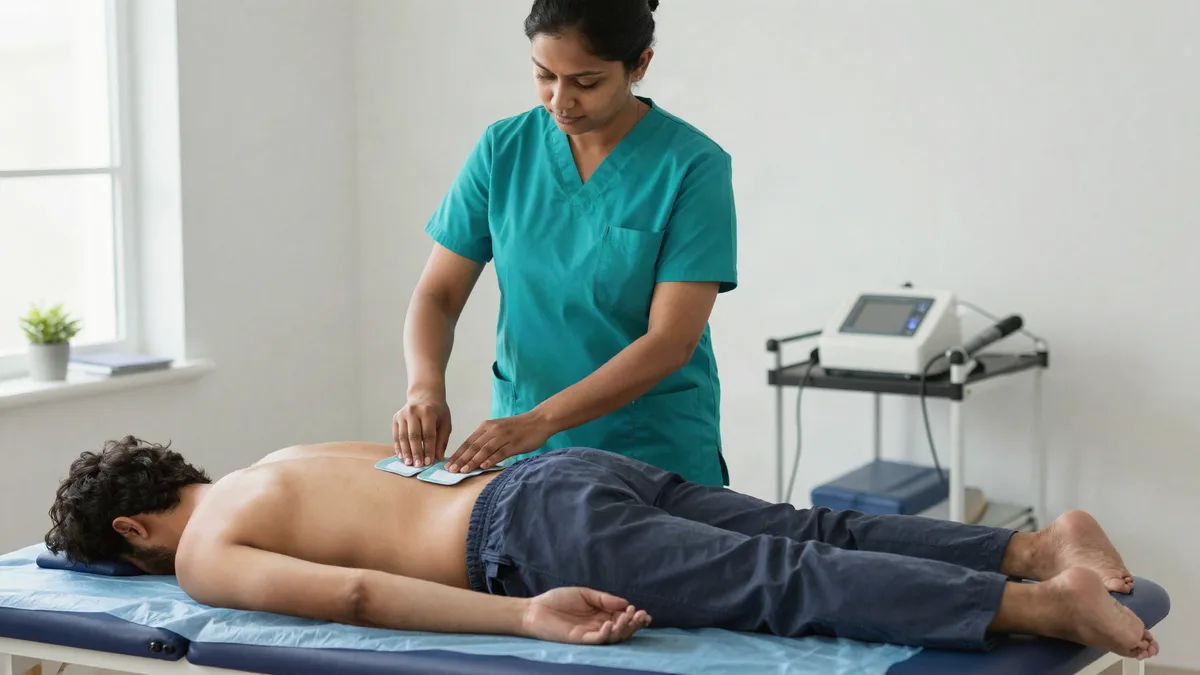
TENS pads on the lower back. The current calms pain signals while it runs, which is exactly what it is designed to do, no more, no less
What TENS and IFT actually do
Both machines send a mild electrical current through pads stuck on your skin. TENS (transcutaneous electrical nerve stimulation) uses one low-frequency current that works close to the surface. IFT (interferential therapy) crosses two medium-frequency currents inside the tissue, so the effect reaches a little deeper with less tingling on the skin. Different wiring, same basic purpose.
That purpose is simple: distract your nervous system. Your spinal cord has something like a gate for pain signals. Flood that gate with a safe, tingling sensation and fewer pain signals get through to the brain. The machines also nudge the body to release its own natural painkillers. This is why the relief is real and starts within minutes.
Notice what is missing from that description. Nothing about strengthening a weak muscle. Nothing about loosening a stiff joint. Nothing about fixing the sitting posture that loads your disc for nine hours a day. The machine does not know why you hurt. It only turns the volume of the pain down for a while.
A fair comparison: TENS and IFT are like a painkiller tablet, delivered through the skin instead of the stomach. Useful, genuinely. But nobody believes a painkiller strip cures a slipped disc.
Why the relief fades by evening
This is not our opinion, it is what the best available research shows, and we would rather show it to you than talk around it.
The largest analysis of TENS ever done, the meta-TENS study in BMJ Open (2022), pooled 381 trials with over 24,000 people. Its finding: TENS reliably reduces pain during and immediately after stimulation, with hardly any side effects. So the relief you feel on the table is real, measured, and worth having on a bad-pain day.
But a Cochrane overview (2019), the most careful review system in medicine, looked for proof that TENS helps chronic pain in the long run and could not find reliable evidence either way. And for IFT, a systematic review of interferential therapy found something very telling: IFT alone was no better than placebo, but IFT combined with another active treatment did beat control. The machine works when it works alongside something.
Read those three findings together and the picture is clear. Relief during the session: proven. Lasting recovery from the machine alone: not proven. Machine plus active treatment: that is where the results live.
What the research honestly says about recovery
If machines are the supporting actor, who is the hero? Every major guideline in the world gives the same answer, and it is not a secret ingredient. It is exercise, prescribed and progressed properly.
The UK's national guideline body NICE (guideline NG59) tells clinicians not to rely on machines for low back pain and to use exercise programmes instead. Its osteoarthritis guideline (NG226) goes further, its first treatment instruction is to offer therapeutic exercise to every osteoarthritis patient. The American College of Physicians says the same for back pain: non-drug, movement-based care first.
The evidence behind that is heavy. A Cochrane review of 249 trials (2021) found exercise clearly beats no treatment and usual care for chronic low back pain. For knee arthritis, a Cochrane review of 54 trials found high-quality evidence that exercise reduces pain, and here is the part machines cannot match, the benefit was still there 2 to 6 months after the sessions ended.
That last line is the whole difference. Machine relief switches off with the machine. Exercise gains stay, because you built something, stronger muscle, freer joints, a better movement habit. One is rent, the other is ownership.
Ortho ka kaam, physio ka kaam
So was your orthopaedic doctor wrong to write TENS and IFT? No. And this is the part most patients have never had explained.
An orthopaedic doctor's job is to answer the dangerous questions first. Is this a fracture? A tumour? An infection? Nerve compression that needs urgent surgery? They rule out the things that can seriously harm you, manage the medical side, and operate when operating is the answer. When your ortho hands you a physiotherapy line on the prescription, the real message is: this problem needs rehab now, go start it. The machine names on the parchi are shorthand, the way a doctor writes a medicine brand while the pharmacist manages the details.
A physiotherapist's job starts exactly there. Physiotherapy is its own clinical profession, a 4.5 year degree before any masters, built around one question the X-ray cannot answer: why does this body hurt when it moves? Which muscle stopped doing its share, which joint got stiff, which daily habit keeps reloading the problem. The physio assesses that, then chooses the tools, machine, hands-on treatment, and above all a graded exercise plan.
And physios have earned that role with data, not just degrees. A study at a US Army hospital compared diagnoses against MRI results and found physiotherapists matched orthopaedic surgeons in accuracy, and both were far ahead of non-specialist doctors. A systematic review of advanced practice physiotherapy reached the same conclusion: experienced physios diagnose and triage muscle and joint problems safely and well.
So no, koi bada ya chota nahi hai. The surgeon cannot be replaced in the operation theatre. The physiotherapist cannot be replaced in the rehab room. The patient gets their best result when each expert does their own job fully, and passes the ball to the other at the right time. That is exactly how we work with referring doctors across Noida.

Two experts, one patient. The ortho rules out the dangerous causes, the physio rebuilds the movement. Neither replaces the other
What a good physio actually does with that parchi
When you bring a TENS/IFT prescription to Dynamics Mend, here is what happens, and what should happen anywhere you go.
First, a real assessment. Twenty to thirty minutes. Movement tests, strength tests, your work setup, your history. Not because the doctor's diagnosis is doubted, but because rehab needs a different map than surgery does. Two people with the same X-ray can need opposite exercise plans.
Second, honest use of the machine. If your pain is high, we absolutely use TENS or IFT in the first sessions. That is what it is for, and refusing it out of principle would just make your week harder. The machine calms the pain gate enough for you to move.
Third, the actual treatment begins inside the same session. While the pain is dialled down, we start the work that lasts: hands-on release for stiff tissue, then targeted exercise, the right muscle, the right dose, progressed week by week. This is the part the evidence keeps pointing at, and it is the part that is still working for you months after the machine is forgotten.
Fourth, the machine retires. Somewhere between session 3 and 6, the electrotherapy time shrinks and the exercise time grows. By the end of a proper plan, you own a 15 minute routine and you know exactly why each exercise is in it. If a plan never reaches this stage, it was never a plan.
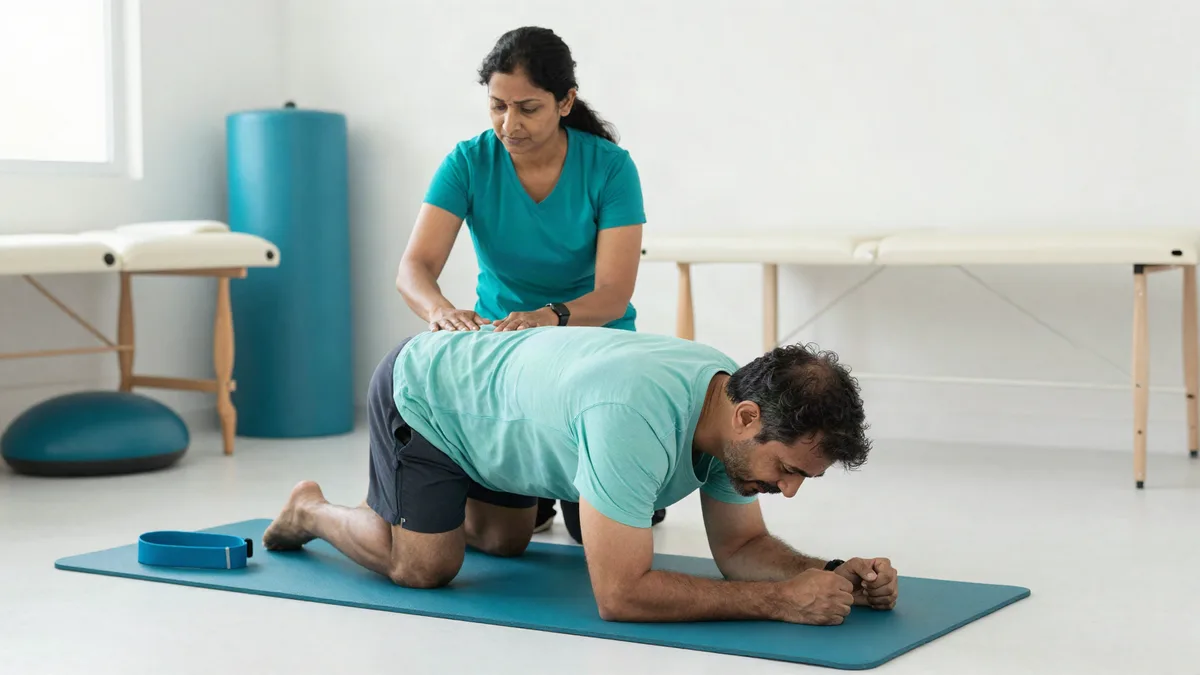
The part that lasts. Supervised, progressed exercise is what turns short-term relief into long-term recovery
This is also why we tell patients to judge any physiotherapy centre, including ours, by one simple question: by the third session, has someone taught you an exercise and corrected how you do it? If the answer is no, and you have only seen pads and hot packs, the treatment has not started yet. More on how we structure this is on our pain management and back pain treatment pages.
A real case from Noida
Rakesh, 41, IT professional from Sector 62, came to us in June with a four-month-old back pain and a folder. Inside the folder: an X-ray, two medicine courses, and two finished physiotherapy prescriptions from two different centres. Both said TENS, IFT, hot pack, 10 days. Both had given him relief for exactly as long as the course ran. He sat down and said, physiotherapy se mujhe thoda hi aaram milta hai, phir wapas.
His assessment took 25 minutes. The finding was almost boring: deep core muscles that had gone quiet, hips stiff from ten-hour sitting, and a back that was doing everyone else's job. Twenty days of machine time had never touched any of that, because it cannot.
We used IFT in his first three sessions, his pain was genuinely bad, and started core activation the same week. By week three the machine was retired. By week six he was deadlifting a light kettlebell under supervision, slightly offended that this was allowed. He finished at week eight with a 15 minute routine, and in his October review the pain had not returned. Nothing dramatic happened. The right expert just did the right job in the right order.
Dr. Purti Shukla, who designed his plan, holds a BPT and MPT in Sports Physiotherapy, is certified in dry needling and cupping therapy, and leads every treatment plan at Dynamics Mend, Sector 52, working alongside the referring doctors our patients come from.
What sessions cost at Dynamics Mend
One number worth noticing: a full physiotherapy session here, assessment-led, machine when needed, hands-on work and supervised exercise, costs about the same as the machine-only sessions many centres run. Same money, whole treatment.
| Service | Fee |
|---|---|
| First teleconsultation (30 min) | Free |
| In-clinic session assessment-led, includes electrotherapy when needed + exercise therapy | ₹500 to ₹800 |
| Home visit session in Noida sectors 50 to 72, portable kit, no travel charge | ₹800 to ₹1,200 |
| Full recovery plan session count and written estimate after first assessment | Quoted honestly |
No machine-only packages, because we do not believe in selling you rent when you can own the result. Full rate card on the pricing page.
Holding a TENS/IFT prescription right now?
Send your name and number. Dr. Purti will call back, look at what the doctor has written, and tell you honestly what your full plan should look like.
Frequently asked questions about TENS and IFT
Will TENS or IFT alone cure my back pain?+
Honestly, no. TENS and IFT are very good at reducing pain while the machine is on, and research confirms that relief is real. But they do not fix the reason the pain keeps coming back, which is usually a weak muscle, a stiff joint, or a movement habit. That part needs exercise-based physiotherapy. Machine for relief, exercise for recovery. Both together work, machine alone usually disappoints after a few weeks.
My doctor wrote TENS and IFT on the prescription. Is that wrong?+
Not at all. When an orthopaedic doctor writes TENS or IFT, they are really writing "start physiotherapy". The machine names are shorthand. Your doctor has done their job, ruling out fracture, serious disease and surgery. The physiotherapist then does their job, assessing your movement and building the full plan, in which the machine is usually the first step, not the whole treatment.
What is the difference between TENS and IFT?+
Both send a mild electrical current through pads on your skin to calm pain signals. TENS uses a single low-frequency current near the surface. IFT (interferential therapy) crosses two medium-frequency currents so the effect reaches slightly deeper tissue with less tingling on the skin. In practice they do a similar job, short-term pain relief, and a physiotherapist picks based on the area, depth and your comfort.
Is a physiotherapist a doctor?+
A physiotherapist holds a 4.5 year clinical degree (BPT), often followed by a masters (MPT), and is trained to assess and treat movement problems. They are not the same as an orthopaedic surgeon and do not operate or prescribe medicines. But research shows experienced physiotherapists diagnose muscle and joint problems with accuracy comparable to orthopaedic doctors. Two different experts, two different jobs, one patient.
How many days of TENS or IFT will I need?+
At our clinic, the machine part usually runs the first 3 to 6 sessions, when pain is at its worst, and then reduces as exercise takes over. If a clinic has you on a machine-only routine for weeks with no exercises added and no re-assessment, that is a sign the plan has stopped, not that you need more machine. Ask what the next phase is.
Can I buy a TENS machine and use it at home?+
Home TENS units are cheap and generally safe for most people, and for some long-term conditions they are a sensible comfort tool. But do not use one to replace an assessment. If you do not know why your back or knee hurts, the machine can quietly mask a problem that needed different treatment. Get assessed once, then ask us honestly whether a home unit makes sense for your case. Avoid it over the chest if you have a pacemaker, over open skin, or in pregnancy without advice.
Ortho doctor or physiotherapist, whom should I see first?+
If there is an injury with a possible fracture, numbness in the legs, fever with pain, night pain that does not settle, or bladder or bowel changes, see a doctor first, always. For everyday back, neck, knee and shoulder pain without those signs, either door works, and the two often refer to each other. What matters is that the plan you end up on includes assessment and active rehab, not just ten days of a machine.
Sources
Meta-TENS study, BMJ Open 2022 · Cochrane overview: TENS for chronic pain, 2019 · IFT systematic review and meta-analysis · Cochrane: exercise for chronic low back pain, 2021 · Cochrane: exercise for knee osteoarthritis, 2015 · NICE NG59, low back pain · NICE NG226, osteoarthritis · American College of Physicians guideline, 2017 · The Lancet low back pain series, 2018 · Physiotherapist diagnostic accuracy study, JOSPT 2005 · Advanced practice physiotherapy review, BMC 2012
Bring us the parchi. We will build the plan.
Machine when you need it, exercise that lasts, and a physiotherapist who works with your doctor, not against them. Clinic sessions at Sector 52 and home visits across Noida.
Open: 10 AM to 9:30 PM, Friday closed · E-132, E-Block, Sector 52, Noida 201301