
Hijama vs dry cupping: the short answer
Dry cupping uses suction only. A cup is placed on the skin, air is drawn out, the tissue lifts, and nothing breaks the surface. Hijama, also called wet cupping, adds a second step: after the first round of suction the practitioner makes tiny shallow scratches on the skin and reapplies the cup, so a small amount of blood is drawn out. That single difference changes everything, the training required, the infection risk, the aftercare, and which professional should be doing it.
Dry cupping is a soft-tissue technique that belongs inside a physiotherapy session. Hijama is a minor invasive procedure that belongs with a properly certified hijama practitioner using sealed, single-use equipment. At Dynamics Mend in Sector 52 Noida we offer dry cupping only, and this article explains that decision honestly rather than quietly.
Now the full version, because most people searching for cupping therapy near me have never had either one properly explained to them.
Same cups, two different procedures
Walk into three different places in Noida asking for cupping therapy and you can get three different things. A physiotherapy clinic will give you dry cupping as part of a treatment plan. A hijama centre will give you wet cupping. A spa might give you a light suction massage and call it cupping. All three leave round marks on the skin, and that visual similarity is exactly why the confusion survives.
The cups themselves are almost irrelevant. Glass cups, silicone cups, plastic cups with a hand pump, they are just the delivery device. What defines the treatment is what happens under the cup. If the skin stays whole, you had dry cupping. If the skin was scratched and blood came out, you had hijama. There is no in-between version, and any place that is vague about which one they are doing is a place to walk out of.
It is also worth saying plainly: hijama is an ancient therapy with deep traditional and religious significance for a lot of families, and it is practised sincerely by a lot of people. Nothing in this article is a dismissal of that. What follows is a clinical comparison, nothing more, written so you can make an informed choice instead of a confused one.
What dry cupping therapy actually does
Dry cupping creates negative pressure over a muscle. Instead of pressing tissue down the way a thumb or a massage gun does, it lifts tissue up. That decompression is the whole point, and it is why physiotherapists find it useful for problems that pressing simply does not solve.
Three things happen when the cup lifts the tissue. Blood flow to the area increases, which is visible immediately in the colour change. The layers of fascia, the thin connective sheets that wrap and separate your muscles, get gently separated where they have become stuck to each other. And the nervous system gets a strong new sensory input in an area that has been sending pain signals, which tends to quieten the guarding and let the muscle finally let go.
That is why dry cupping works so well on exactly the problems desk workers and gym goers in Noida come in with. Upper trapezius that has been braced for nine hours a day. Lower back muscles doing the work of a weak core. Calves and quads that are still stiff two days after leg day. In our clinic we most often use dry cupping on the upper back, lower back, glutes, calves and the outside of the thigh, and usually as an opener, softening the tissue so the hands-on work and the exercise that follow actually land.
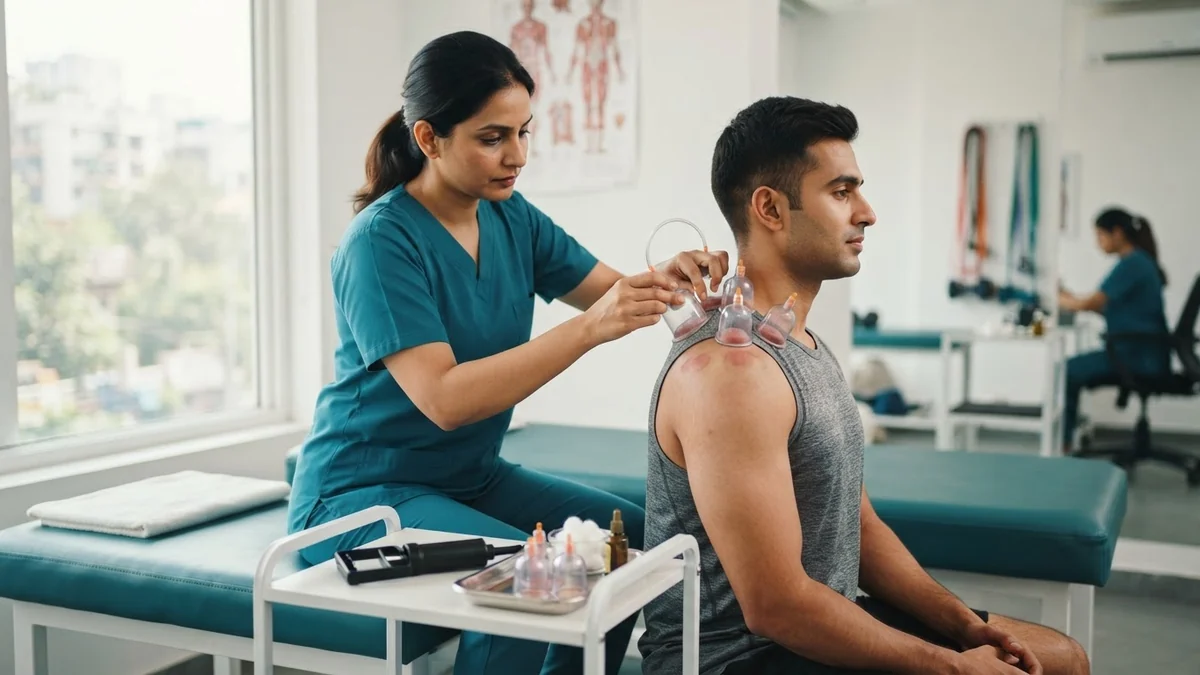
Dry cupping in a physiotherapy session. Suction only, the skin is never broken, and the cups usually stay on for five to fifteen minutes
One thing dry cupping is not: a treatment on its own. It reduces tightness and pain for a while. It does not strengthen the weak muscle that let the tightness build, and it does not change the sitting posture that reloads it every morning. Used as an opener inside a plan, it is genuinely valuable. Sold as a standalone weekly service forever, it is just a comfortable habit.
What hijama (wet cupping) actually is
Hijama runs in stages. First a cup is applied with suction for a few minutes to draw blood towards the surface. The cup comes off and the practitioner makes a series of very shallow scratches or pricks on that patch of skin using a sterile blade or lancet. The cup then goes back on, and the renewed suction draws out a small quantity of blood into the cup. The site is cleaned and dressed afterwards.
The traditional reasoning behind it is that stagnant or impure blood is being removed, and that the body benefits systemically from that removal. Sessions typically run longer than dry cupping, often forty five minutes to an hour against fifteen to thirty, and hijama is often used for a much wider range of complaints than musculoskeletal pain, including migraines, general wellbeing and detoxification.
Two things follow from the technique itself, and neither is controversial. First, hijama requires a completely different level of infection control, because you are creating open skin. Second, it belongs to a different professional scope. Physiotherapy in India is a non-invasive profession. A physiotherapist is trained to assess and treat movement, not to perform procedures that break skin and handle blood. Wanting to be good at your own job means knowing where it ends.
Dry cupping vs hijama, side by side
| What matters | Dry cupping | Hijama (wet cupping) |
|---|---|---|
| Skin broken? | No, suction only | Yes, shallow scratches |
| Blood drawn? | None | Small quantity, into the cup |
| Category | Non-invasive soft-tissue technique | Minor invasive procedure |
| Typical session | 10 to 30 minutes | 45 to 60 minutes |
| Main use | Muscle tightness, myofascial pain, recovery | Traditional systemic use, wide range of complaints |
| Infection risk | Very low, skin intact | Real, depends entirely on sterile single-use technique |
| Aftercare | None beyond warmth and water | Wound care, keep site clean and dry |
| Who performs it | Trained physiotherapist or certified therapist | Certified hijama practitioner |
| Offered at Dynamics Mend | Yes | No, referred out |
Both leave round marks. Only one of them involves a wound. If someone cannot tell you clearly which of these two they are about to do to you, that is your answer about whether to stay.
What the research honestly says
This is the part most cupping pages skip, so we will be direct even where it is inconvenient for us.
On dry cupping. A systematic review and meta-analysis of dry cupping for musculoskeletal pain found it effective for reducing pain in chronic neck pain and non-specific low back pain, but the authors were clear that the overall quality of evidence was low to moderate, so firm conclusions are not yet possible. A separate review of manual therapy, dry cupping and dry needling for myofascial trigger points was blunter still: manual therapy had moderate evidence behind it, while cupping and needling did not clearly beat placebo. On the other side, a controlled PLOS ONE study in athletes with myofascial pain measured an actual physical change in soft-tissue compliance after quantified dry cupping, which is a real mechanism, not just a feeling.
On hijama. The evidence is thinner and messier. A widely cited review of the evidence for hijama found some favourable results, particularly when wet cupping was used alongside conventional treatment rather than instead of it, but repeatedly flagged small studies, weak methods and a lack of standardised technique. The NCBI cupping therapy review reaches a similar place: plausible mechanisms, encouraging individual trials, insufficient high-quality evidence to make strong claims, and a clear call for standardised training and procedure.
Put honestly, neither technique has the kind of evidence base that lets anyone promise you a cure. Dry cupping has moderate support for short-term pain relief in the neck and lower back. Hijama has weaker and less consistent support across a much wider set of claims. Anyone quoting either one as proven medicine is going beyond what the papers say.
The safety difference nobody explains
Here is where the two therapies genuinely separate, and it has nothing to do with tradition or belief. It is simple biology: intact skin is a barrier, and broken skin is a doorway.
Dry cupping leaves the barrier intact. Its side effects are cosmetic and mild, round marks that fade in a few days, occasional skin irritation, sometimes a small blister if suction was too strong or held too long. There is no wound to infect.
Hijama deliberately opens that barrier, which introduces two real risks. The first is local infection at the cut sites, and published case reports document serious disseminated infection following wet cupping. The second is more serious at a population level: if cups or blades are reused between people, bloodborne viruses including hepatitis B and hepatitis C can transmit. Infection-control researchers writing in the American Journal of Infection Control have specifically called for regulation and public awareness on exactly this point, because the practice is widespread and often unregulated.
None of this makes hijama automatically unsafe. Done with sealed single-use blades and cups, proper skin preparation, gloves, and a practitioner trained to manage blood and wounds, the risk drops sharply. The problem is that in an unregulated market, you the patient have no easy way to verify any of that, and the marketing rarely mentions it.
So if you do choose hijama, here is the practical checklist we give patients who ask: watch the packaging being opened in front of you, confirm blades and cups are single-use and disposed of in front of you, check the practitioner wears gloves and changes them, ask what their training was and where, and tell them your full medical history. And skip it entirely if you are on blood thinners, have a bleeding disorder, are significantly anaemic, have uncontrolled diabetes, or are pregnant.
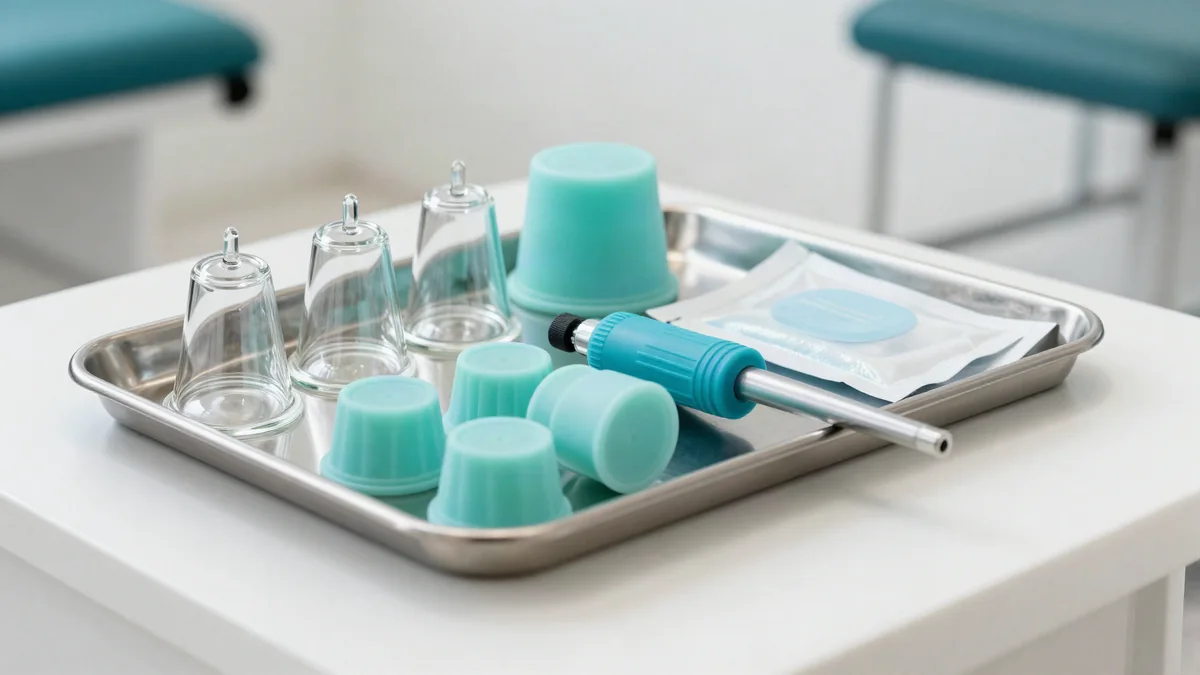
Dry cupping equipment at our Sector 52 clinic. Glass and silicone cups, hand pump, sealed wipes, and no blades anywhere in the tray
Where we stand: dry cupping only
Dynamics Mend offers dry cupping. We do not offer hijama, and we do not plan to. We would rather write that clearly on our own website than have you find out after booking.
The reason is scope, not superiority. Physiotherapy is a non-invasive clinical profession. Our training is in assessing movement, diagnosing why a body hurts when it moves, and treating that with hands-on work, graded exercise and adjunct tools like dry cupping and dry needling. A procedure that cuts skin and draws blood sits outside that scope. A clinic that quietly adds services outside its training is exactly the kind of clinic we tell patients to avoid, so we are not going to become one.
What that means for you in practice is simple. If you come to us with muscular back pain, a stiff neck, tight calves or a stubborn trigger point, dry cupping may well be part of your session, alongside the assessment and the exercise plan that make it hold. If you specifically want hijama, we will say so honestly and point you towards finding a certified practitioner, and we will still be happy to handle the physiotherapy side of your problem.
Our cupping sessions are run by Dr. Sidharth Narayan, the clinic's cupping therapy specialist, under the supervision of founder Dr. Purti Shukla, MPT (Sports) and BPT, who is certified in dry needling and cupping therapy. Every session uses cleaned or single-use cups and starts with an assessment, never with the cups.
Which one for which problem?
Here is the practical sorting, based on what actually walks into a physiotherapy clinic in Noida.
Dry cupping makes sense for muscular back pain and stiffness, desk-job neck and shoulder tightness, myofascial trigger points, delayed onset muscle soreness after training, tight calves and hamstrings in runners, and IT band and glute tightness. In short, anything where a muscle or its fascia has become tight, stuck or overworked.
Cupping of any kind will not fix a slip disc or true sciatica with nerve symptoms, a torn ligament or meniscus, a frozen shoulder that needs graded mobilisation, arthritis pain that needs strengthening, or a fracture. These need a proper diagnosis and a structured plan, and if a place offers you cupping as the answer to any of them without an assessment, that is a marketing decision, not a clinical one.
Red flags that mean see a doctor first, not a cupping room: numbness or weakness in an arm or leg, pain with fever, night pain that will not settle, unexplained weight loss, or any change in bladder or bowel control. None of those are cupping problems.
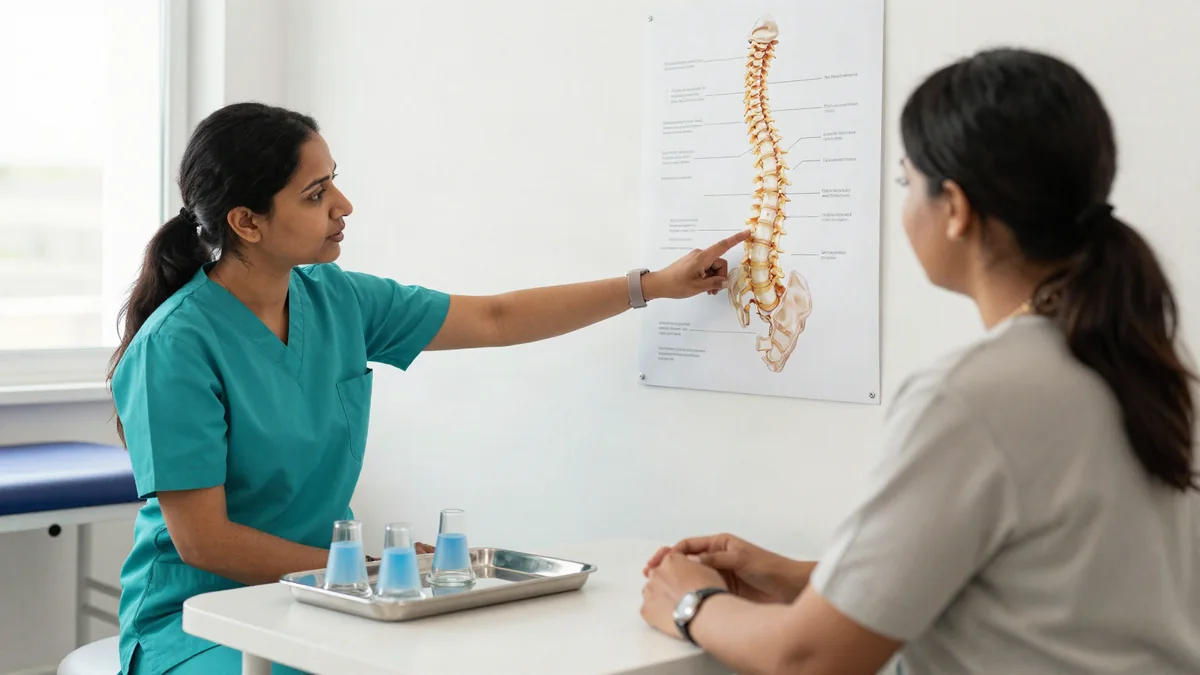
Assessment first, cups second. Which technique you need depends on what the assessment finds, not on what you booked
Those round cupping marks, explained
The marks are the most misunderstood part of cupping therapy, and there is a persistent myth worth killing: darker marks do not mean a better session.
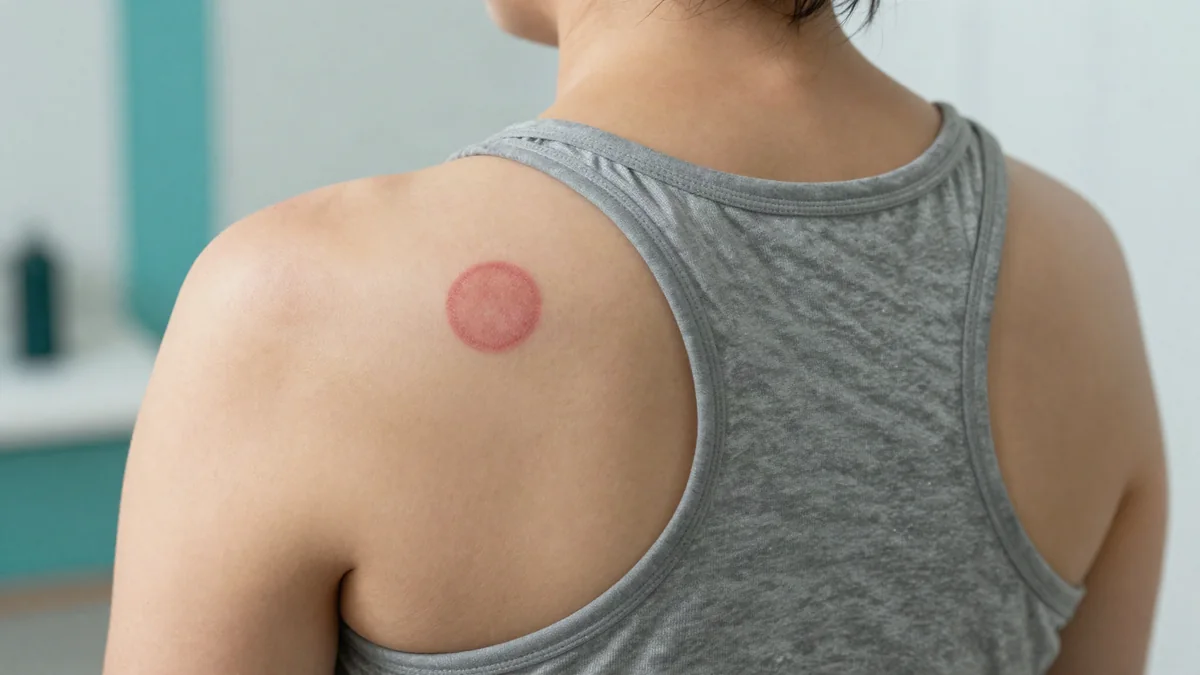
A typical dry cupping mark. Skin is intact, there is no wound, and the colour fades over three to seven days
After dry cupping, the round marks are pooled blood sitting under skin that is completely intact. They are not bruises in the impact sense, they are usually painless to touch, and they fade over roughly three to seven days. Colour tends to track how tight or how poorly circulated that patch of tissue was, so the same person can mark dark on one shoulder and barely mark on the other in the same session. As the tissue improves over a course of treatment, most people find they mark less.
After hijama the picture is different, because there are actual small wounds under those marks that need to stay clean and dry while they heal. That is a genuine aftercare difference, not a detail.
Practical notes for dry cupping: keep the area warm, drink water, skip a hot sauna or a heavy massage on the same patch that day, and do not book cupping the day before a wedding or a beach holiday unless you are relaxed about the photographs.
A case from our Noida clinic
Faizan, 34, works in sales and drives across Delhi NCR most days. He came to us in May with upper back and neck pain that had been building for about eight months. He had been getting hijama every few weeks from a centre near his home and told us honestly that it helped for four or five days and then faded, and he wanted to know whether he should be doing it more often.
We did not tell him to stop anything. We assessed him, which nobody had done in eight months. The findings were unremarkable and completely typical: a mid back that had lost rotation from years of driving, deep neck flexors that had gone quiet, and an upper trapezius that was doing the work of three muscles and had every right to be angry.
His plan used dry cupping and hands-on release on the upper back for the first four sessions, because the tissue genuinely needed opening before anything else was possible. From week two we added mid back mobility and deep neck strengthening, and rebuilt his car seat and phone setup, which was quietly causing half the problem. By week five the cupping came out of the plan entirely. He finished at week seven with a nine minute daily routine.
The point is not that dry cupping beat hijama. The point is that no cup of any kind was ever going to fix a stiff mid back and a weak neck, and eight months of any passive treatment was always going to loop. He got relief for four or five days at a time because that is what passive treatment gives you. The exercise is what ended the loop.
Cupping therapy cost in Noida
Straightforward pricing, no packages sold before an assessment.
| Service | Fee |
|---|---|
| First teleconsultation (30 min) | Free |
| Standalone dry cupping session includes assessment | ₹800 to ₹1,000 |
| Dry cupping + manual therapy or dry needling | ₹1,200 |
| 3 session dry cupping pack saves up to ₹300 | ₹2,700 |
| Home visit cupping in Noida therapist travels to you with the full kit | ₹2,000 |
| Cupping inside an ongoing physiotherapy plan included in the standard session fee | ₹500 to ₹800 |
| Add-ons if the assessment calls for it dry needling, manual therapy, taping and similar | Quoted upfront |
| Hijama / wet cupping | Not offered |
Full rate card on the pricing page. More on how cupping fits into a treatment plan on our cupping therapy in Noida page, and a longer walkthrough of what a first session looks like in our guide to finding cupping therapy near you.
Not sure which one you actually need?
Send your name and number. We will call back, ask what is hurting and for how long, and tell you honestly whether cupping is even the right tool for your problem.
Frequently asked questions about hijama and dry cupping
What is the difference between hijama and dry cupping?+
Dry cupping is pure suction. A cup is placed on the skin, air is pulled out, the skin lifts, and nothing breaks the surface. Hijama, also called wet cupping, adds a step: after the first suction the practitioner makes tiny shallow scratches on the skin and reapplies the cup so a small amount of blood is drawn out. So dry cupping is a non-invasive soft-tissue technique, while hijama is a minor invasive procedure involving blood. Same-looking cups, completely different category of treatment, different training, and a very different safety checklist.
Which is better for back pain, hijama or dry cupping?+
For everyday muscular back pain, neck stiffness and desk-job tightness, dry cupping is the sensible first choice. It is non-invasive, it can be repeated easily, and it fits directly into a physiotherapy session alongside hands-on work and exercise. Research on dry cupping for chronic neck pain and non-specific low back pain shows real short-term pain reduction, though the overall quality of evidence is still low to moderate. Some reviews suggest wet cupping may do slightly better for certain inflammatory pain conditions, but that evidence is weaker still and comes with an infection risk dry cupping simply does not carry. Neither one is a cure on its own. Whatever cup you choose, the lasting result comes from the exercise plan that follows it.
Is hijama safe?+
Hijama is safe only when it is done with strict sterile technique, single-use blades and cups, proper skin preparation, and a practitioner trained to handle blood. Because the skin is deliberately broken, the real risks are infection at the site and, if equipment is reused between people, transmission of bloodborne infections such as hepatitis B and C. Published case reports document serious infections after wet cupping, and infection-control researchers have flagged reuse of equipment as a genuine public health concern. Hijama is also not appropriate for people on blood thinners, people with bleeding disorders, uncontrolled diabetes, anaemia, or during pregnancy. If you choose hijama, choose the practitioner very carefully and watch them open sealed, single-use equipment in front of you.
Do you offer hijama therapy at Dynamics Mend in Noida?+
No. We offer dry cupping only, as part of a physiotherapy treatment plan. That is a scope decision, not a judgement. Physiotherapy in India is a non-invasive profession, and any procedure that deliberately breaks the skin and draws blood sits outside what a physiotherapy clinic should be doing. Hijama has deep traditional and cultural roots and many people value it, and we respect that completely. If you specifically want hijama, we will tell you honestly that it is not our department and suggest you find a properly certified hijama practitioner who uses sealed single-use equipment.
Does dry cupping hurt, and how long do the marks last?+
Dry cupping is not painful. You feel a firm pulling sensation for the first few seconds, then the area usually starts to soften and relax. The round marks are pooled blood under intact skin, not bruises from impact, and they fade in roughly three to seven days. Darker marks usually mean that area was tighter or had poorer circulation, not that the session was more effective. There is no wound, no bleeding, no dressing and no aftercare beyond keeping the area warm and drinking water.
How many dry cupping sessions will I need?+
Most patients feel a clear change in the very first session. For long-standing tightness the usual plan is three to five sessions across two to three weeks, paired with a short home exercise routine. Once the underlying cause is corrected, most people do not need ongoing cupping. At Dynamics Mend we give you a realistic session count after the first assessment, not before. If any clinic promises you a fixed long package before assessing you, be sceptical.
Can I get cupping therapy if I am diabetic or on blood thinners?+
This is exactly where the difference between the two matters. Dry cupping can often still be done for well-controlled diabetics and for people on blood thinners, using lighter suction, shorter hold times and careful skin checks, because the skin is never broken. Hijama in those same patients is a different story, since deliberate skin cuts in someone on anticoagulants or with poor healing carries real risk. We take a full medical history at the first visit, and if cupping in any form is not right for you we will use other physiotherapy tools that are.
How much does cupping therapy cost in Noida?+
At Dynamics Mend, a standalone dry cupping session at the clinic is Rs 800 to Rs 1,000 and includes the assessment. Dry cupping combined with manual therapy or dry needling is Rs 1,200. A three session pack is Rs 2,700. A home visit cupping session in Noida is Rs 2,000, since the therapist travels to you with the full kit. If cupping is part of a physiotherapy plan we are already treating you for, it is included in the normal Rs 500 to Rs 800 session fee. Add-ons like dry needling or taping are only used if the assessment calls for them, and we quote them before we start. The first 30 minute teleconsultation is free, and the price never changes after you walk in.
Is dry cupping the same thing as physiotherapy?+
No, and this matters. Dry cupping is one tool inside physiotherapy, the same way a spanner is one tool inside a mechanic’s box. On its own it gives good short-term relief of muscle tightness. What makes that relief hold is the assessment that tells you why the muscle was tight, the hands-on work that follows, and the exercise plan that fixes the weakness or stiffness underneath. A clinic that offers cupping as a standalone service with no assessment is selling you the relief, not the recovery.
Sources
Cupping Therapy, StatPearls / NCBI Bookshelf · Hijama (cupping): a review of the evidence, 2011 · Practice of cupping (Hijama) and the risk of bloodborne infections, American Journal of Infection Control · Disseminated infection after scarification wet cupping, case report 2023 · Dry cupping for musculoskeletal pain and range of motion, systematic review and meta-analysis 2020 · Manual therapy, dry cupping and dry needling for myofascial pain, systematic review 2019 · Quantified dry cupping and soft tissue compliance in athletes, PLOS ONE 2020 · NICE NG59, low back pain and sciatica · Cochrane: exercise for chronic low back pain, 2021
This article is general information, not a diagnosis or a treatment recommendation for your specific case. Cupping therapy of any kind is not suitable for everyone. Please get assessed before starting any treatment, and speak to a doctor first if you have any of the red flag symptoms listed above.
Dry cupping, inside a plan that actually holds.
Assessment first, cups when they help, and an exercise plan so the relief does not fade by the weekend. Clinic sessions in Sector 52 and home visits across Noida.
Open: 10 AM to 9:30 PM, Friday closed · E-132, E-Block, Sector 52, Noida 201301